SEOUL —
The United States experienced surging labour strikes in 2024, with workers
across various sectors staging protests over issues ranging from wages to
working conditions.
The nation witnessed 334 labour actions across 515 locations
as of Friday, continuing an upward trend in strike activity in recent years,
according to the Cornell University School of Industrial and Labor Relations's
Labor Action Tracker, a database of strike and labour protest activity.
One of the year's most notable strikes occurred at
Starbucks, where at least 5,000 workers from over 300 stores across 45 states
walked off their jobs on Christmas Eve, according to their union, Starbucks
Workers United, reports Xinhua news agency.
The strike, the largest ever at the coffee chain, involved
workers from 12 major cities, including New York, Los Angeles, Boston, and
Seattle. Workers demanded higher wages and fair scheduling while criticising
the company's executive compensation practices, particularly CEO Brian Niccol's
$113 million compensation package.
Just days before the Starbucks walkout, Amazon faced what
the striking workers called the largest-ever strike during the peak Christmas
shopping season.
While the labour union reported nearly 10,000 workers
joining the movement for higher wages and improved workplace safety, Amazon
disputed these figures, claiming that the striking workers aren't even Amazon
employees.
The manufacturing sector was also affected when
approximately 33,000 Boeing machinists launched a seven-week strike in
September.
Their union accepted a contract offer in November, and the
striking workers returned to work. The strike, involving workers who assemble
the bestselling 737 Max airliner in Washington, added to Boeing's challenges in
a turbulent year.
Maritime commerce faced major disruption in October when
nearly 50,000 members of the International Longshoremen's Association (ILA)
struck against East and Gulf Coast ports, affecting the flow of imports and
exports from Maine to Texas.
The hospitality industry wasn't spared from labour actions,
as about 10,000 hotel workers struck across several major tourist destinations
in September. The walkout impacted 24 hotels operated by Marriott, Hilton, and
Hyatt in cities including San Francisco, San Diego, Honolulu, Boston, and
Seattle.
The hotel workers' union, Unite Here, highlighted
understaffing issues, with three staff members often doing the work meant for
four.
Several factors contributed to the surge in labour activism.
The US Department of Labor reported a doubling of union representation
petitions from 1,638 in fiscal 2021 to 3,286 in fiscal 2024.
"Unions continue to be more popular than at any time
since the 1960s, with 70 per cent public approval," said the Labor Notes,
an organisation and network for rank-and-file union members and grassroots
activists.
In addition, economic conditions played a crucial role in
driving labour actions. The unemployment rate remained low, giving workers more
leverage in negotiations.
The rise of remote work and concerns about technological
displacement have added new dimensions to labour negotiations as workers seek
protection against job losses due to automation and artificial intelligence
advancement. These issues have become particularly pressing in industries
undergoing rapid technological transformation.
This was especially evident in the recent port workers'
dispute, where automation became a central issue. The ILA said automation at
ports would cost some members their jobs.
Besides, reform movements in labour unions have also led to
effective strike threats.
With a January 15 deadline looming to resolve the automation
dispute at East and Gulf Coast ports, tensions remain high, raising the
possibility of another significant port disruption in the new year.



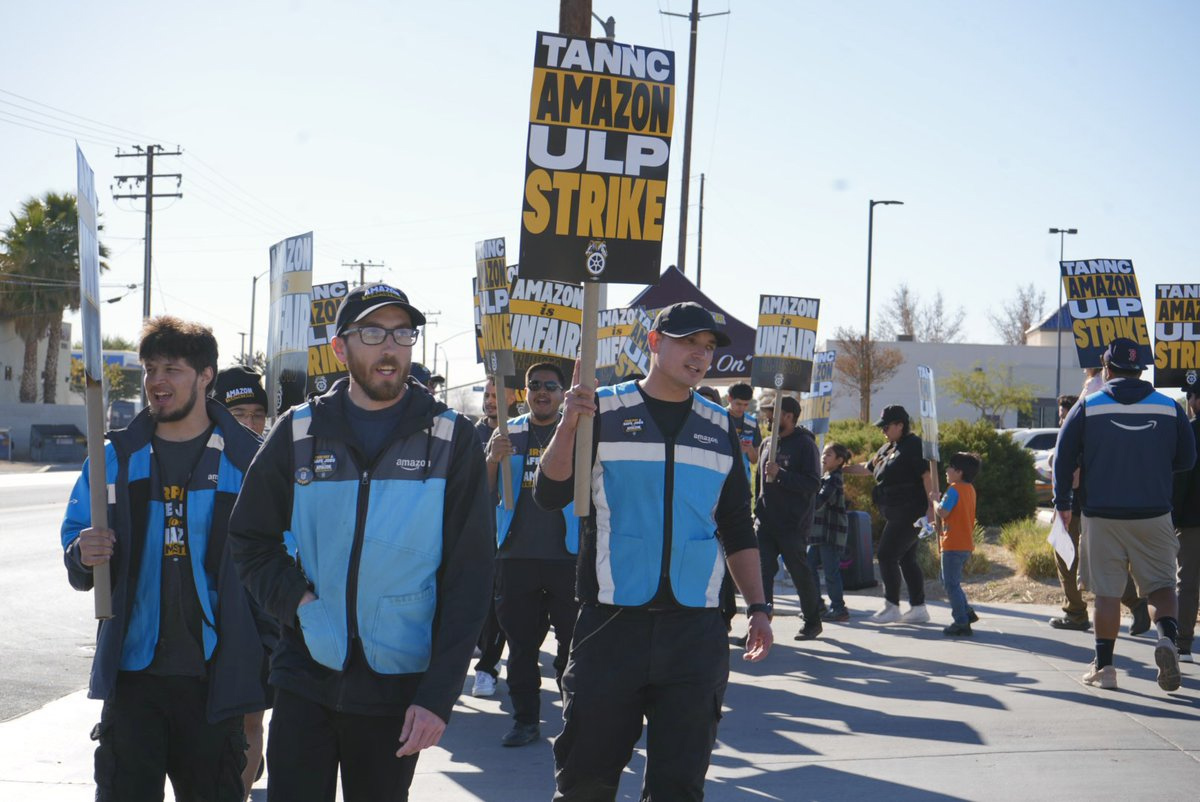 (Amazon Teamsters on X)