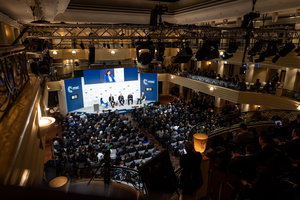
MUNICH — As the
situation in Ukraine continues to evolve, the United States and its European
allies have demonstrated increasing divisions regarding resolving the Ukraine
crisis, a rift that became particularly pronounced at the just-concluded 61st
Munich Security Conference (MSC).
Keith Kellogg, Ukraine envoy of US President Donald Trump,
told a conference event in Munich on Saturday that Europe would not have a seat
at the negotiation table. "I think this is not going to happen," he
said, although he confirmed that Ukraine would be involved.
Trump held a phone call with Russian President Vladimir
Putin on Wednesday, during which they discussed immediately engaging in direct
negotiations aimed at ending the three-year-long conflict between Russia and
Ukraine.
Speaking to reporters afterward, Trump suggested he might
meet Putin in Saudi Arabia.
The unexpected call caught European leaders off guard,
sparking concerns that the United States could reach a deal with Russia that
would compromise European security without their involvement.
In response, top foreign affairs officials from major
European countries, including Germany, France and Poland, issued a joint
statement, stressing that both Ukraine and Europe must be part of "any
negotiation" regarding the Ukraine issue.
Also attending the MSC, Ukrainian President Volodymyr
Zelensky cautioned on Saturday that the era of guaranteed American support for
Europe is over, indicating that remarks made by US Vice President J.D. Vance a
day before signaled a shift in US-Europe relations.
Vance had criticised Europe's approach to democracy and
immigration in Munich, stating that the greatest threat to the continent came
from within.
Zelensky also urged Europe to unite to create a joint
military force and a coordinated foreign policy strategy.
Fearing being sidelined on the Ukraine issue, EU leaders
have urged unity and action across the continent. "This is an existential
moment, and it's a moment where Europe has to stand up," said German
Foreign Minister Annalena Baerbock during a panel discussion.
French President Emmanuel Macron scheduled an emergency
meeting in Paris on Monday to discuss Ukraine and security in Europe. The
meeting is expected to include leaders from Germany, Britain, Italy, Poland,
Spain, the Netherlands and Denmark, as well as the NATO Secretary-General and
the Presidents of the European Council and the European Commission, Xinhua news
agency reported.
Polish Foreign Minister Radoslaw Sikorski said Saturday at
the conference that he expects the meeting to address the challenges posed by
Trump.
On Sunday, British Prime Minister Keir Starmer said he is
"ready and willing" to deploy British troops to Ukraine to help
guarantee its security.
Writing in the Daily Telegraph, Starmer said Britain was
"ready to play a leading role" in Ukraine's defence and security,
including the commitment of three billion pounds (about 3.8 billion US dollars)
a year until 2030.