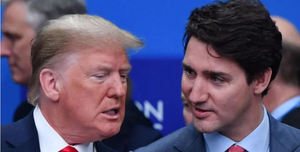
OTTAWA — A senior
official in the government of Ontario, Canada, recently warned that the
province might ban US-made alcohol and restrict electricity exports to several
American states if President-elect Donald Trump imposes tariffs on all Canadian
products, according to media reports.
This warning, along with others issued by Canadian
officials, has heightened concerns about a potential trade war between the
United States and one of its most important trading partners.
Additionally, according to a senior official, Canada's most
populous province is considering imposing export bans on critical minerals
essential for electric vehicle batteries and barring US-based companies from
participating in Ontario's government procurement processes, reports Xinhua
news agency, citing the Associated Press.
Ontario Premier Doug Ford confirmed on Thursday that the
province is considering cutting energy supplies to the US states of Michigan,
New York, and Wisconsin. "We power 1.5 million (US) homes, and if they
impose tariffs, it will become unaffordable for Americans to buy electricity,"
Ford told reporters.
"If you come and attack Ontario, you attack the
livelihoods of people in Ontario and Canadians; we are going to use every tool
in our toolbox to defend Ontarians and Canadians," said Ford.
Commenting on Ford's warnings, Trump said on the same day,
"That's OK if he does that. That's fine."
"I have so many friends in Canada, but we shouldn't
have to subsidise a country," said the US President-elect, who announced
in late November his intention to impose a sweeping 25 per cent tariffs on all imports
from Canada and Mexico.
Earlier this week, Canadian Prime Minister Justin Trudeau
met with provincial premiers to coordinate a response to the potential tariffs.
Finance Minister Chrystia Freeland revealed that several premiers supported
"a robust Canadian response," including restricting exports of
critical minerals and metals to the United States.
Freeland also noted that Canadian business and labour leaders
are engaging with their US counterparts to address the issue.
The proposed tariffs on Canada and Mexico would
significantly impact US consumers, driving up prices for automobiles,
vegetables, fuel, prepared foods, and animal products, according to a Peterson
Institute report cited by CNN on Thursday.
"American consumers and firms will bear the effect of
higher tariffs, with the substantial cost for the average American household,
and a burden that falls more heavily on lower-income households," said Peterson
Institute researchers.
Meanwhile, a Nanos Research survey commissioned by CTV News
earlier this month revealed that approximately 65 per cent of Canadians would
be "less likely" or "somewhat less likely" to purchase US
products if the proposed tariffs were implemented.
A model by the Canadian Chamber of Commerce estimates that a
10 per cent tariff alone would shrink Canada's GDP by 0.9 to 1 per cent,
costing approximately 30 billion Canadian dollars ($21.3 billion) annually,
while the United States could lose 125 billion ($88.8 billion) a year. A 25 per
cent tariff would likely amplify these losses, according to a Canadian Press
report in November.