


Ura Academy calls for united efforts to secure Eighth Schedule status for Tenyidie at Kohima seminar.
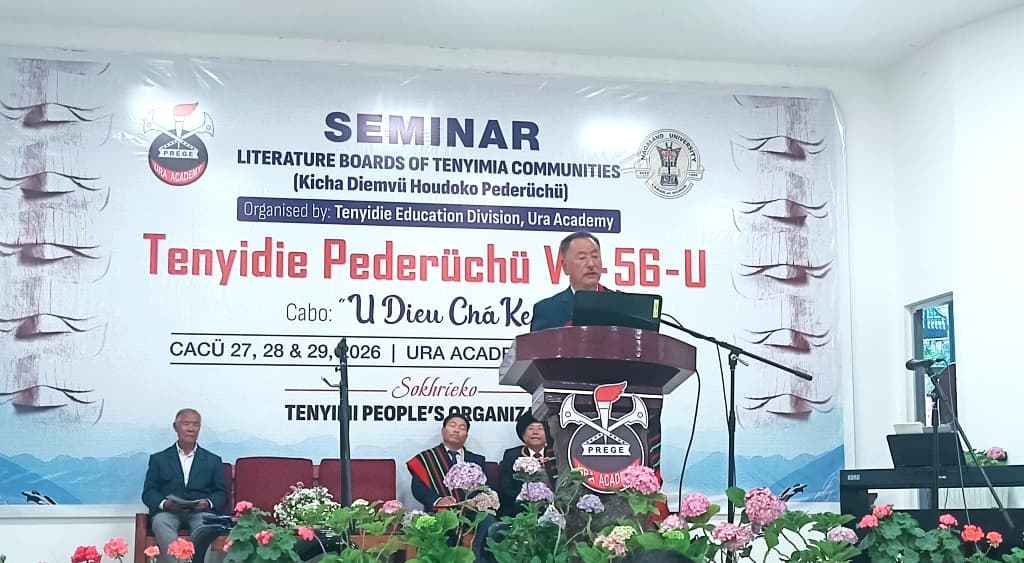
KOHIMA — The three-day 56th annual seminar of Ura Academy culminated on Friday at Ura Academy Hall, Mission Compound, Kohima, with a call for a collective push to promote Tenyidie and secure constitutional recognition as an Eighth Schedule language.
Addressing the valedictory function, Daso Paphino, vice president of Ura Academy, spoke about the uniqueness of Naga history, culture and traditions, which were recognised by the colonial administrators, leading to the passage of a separate law for the protection of the Naga Hills through the Bengal Eastern Frontier Regulation Act of 1873, which continues to exist post India's Independence as the Inner Line Permit (ILP).
Crediting the pioneers of the Angami Literature Committee (Diemvü Houdo), formed in 1939, which translated the Bible and hymnals that existed for a long period until 1970, when the committee was rechristened as Ura Academy, he said that from this milestone, Dr. Shürhozelie Liezietsu took over the responsibility as president and continues to hold the position till date.
Paphino informed that the Tenyidie language was introduced at Nagaland University (Central University) in 1997 as a department and has completed 29 years.
Also read: Erosion of native languages highlighted at Ura Academy seminar
Nine scholars have completed their PhD, while 16 more are pursuing their research. About 350 scholars have completed their Master of Arts (MA) in Tenyidie, and those who have completed their BA in Tenyidie are called Ura Academy Rüpfhünuo.
He informed that efforts are being made for the inclusion of Tenyidie in the Eighth Schedule of the Indian Constitution and stated that the proposal for inclusion is now before a Parliamentary Committee for consideration.
Meanwhile, the vice president stated that with the introduction of a third language in the education system of Jawaharlal Navodaya Vidyalaya (JNV) schools in Nagaland, Assamese is being used as the third language. He said Ura Academy has taken up the matter with the authorities and that the matter is under process.
To strengthen the efforts of Ura Academy for inclusion in official government use, Paphino highlighted the importance of recording Tenyidie along with the sub-dialect (mother tongue) in the forthcoming General Census of India in formats such as Tenyidie (Angami), Tenyidie (Chokri), Tenyidie (Khezha), Tenyidie (Rengma), and Tenyidie (Zemi), while stressing the need for concerted efforts by all Tenyimi communities in this endeavour.
Furthermore, Paphino called for collective efforts to preserve and promote the Tenyidie language, which has been spoken by the people since before the arrival of colonialism.
Kekhwengulo Lea, president of Tenyimi Union Nagaland (TUN), in his speech asserted the importance of forming TUN even though the Tenyimi People's Organisation (TPO) exists, so as to look into the affairs of the Tenyimi communities within the state of Nagaland, while TPO serves as a body for Tenyimi communities living across state borders.
He highlighted that the call for oneness among the Nagas is gradually breaking down and expressed concern that unity and peace should begin within each community and extend to society at large.
In this regard, he highlighted the need for the Tenyimi community to take the lead in unifying the Nagas, adding that the Tenyimis were pioneers in trailblazing and stressing the need for the present leadership and people to carry forward that legacy.
Lea highlighted that TUN is making efforts to promote the Tenyidie language in collaboration with Ura Academy and appealed through the tribal bodies to include the mother tongue (sub-dialect) along with Tenyidie in the forthcoming nationwide census.
He also implored the need for establishing more Tenyidie Learning Centres in various areas to revive Tenyidie learning, which was once a common medium of communication in earlier times.
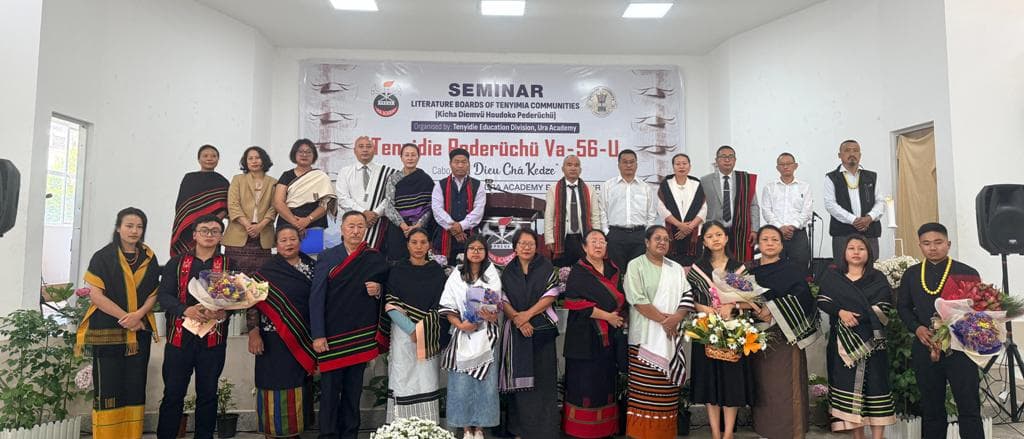
A new team of Ura Academy Rüpfhünuo for the tenure 2026–29 was also installed, led by Nuveta Khusoh as president, Dzuvisato Savino as vice president, and Khriephrenuo Kuotsu Solo, along with others.
The programme also featured a folk song by Southern Angami Cultural Society, Pfhesi Kro-u, and a choral presentation by Pochury Baptist Church, Kohima.
Earlier during the day, the Tenyidie Kephrunuoko Krotho (TKK) conclave was held with Dr. Keduolhoulie Belho, Associate Professor, Department of Tenyidie, Kohima College, Kohima, as the speaker. The programme was led by Dzuzienuo Yhome, President of TKK, followed by literary competitions.
On the occasion, various awards were conferred. The Dr. Neilhouzhu Kire Angami Award (highest mark in Tenyidie, HSLC) was conferred on Rokotsino Senotsu of Baptist Mission School, Jotsoma; the Rȕzhȕkhrie Sekhose Award (highest mark in Tenyidie, HSSLC) was awarded to Keduoneinuo Evelyn of Don Bosco Higher Secondary School, Kohima; the A. Kevichusa Award (BA Tenyidie Honours topper) was awarded to Dziesekhrietuo Khezhie of Oriental College; and the Nini Vinguriau Lungalung Award (HSSLC highest mark in Music) was awarded to Aleno Bio of Patkai Higher Secondary School, Chumoukedima. Kekhrielhoutuoȕ Kire, who completed the Certificate Course in Tenyidie in the first division, was also presented with a certificate.