[caption id="attachment_114298" align="alignnone" width="561"]
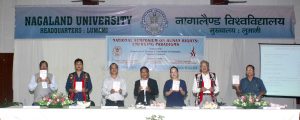 NS Jamir, Vice Chancellor of Nagaland University (centre) and others seen here after the release of a book ‘Human rights in Nagaland: Emerging Paradigms’ at Nagaland University, Lumami campus on Tuesday, May 9
.[/caption]
Lumami, May 9 (EMN): Professor A Lanu Ao, former Pro-Vice Chancellor of Nagaland University, on Tuesday asserted that the people from the northeast region are considered the ‘most suffering people subjected to Human Rights violations.’ He called upon students at a symposium he was addressing, to be ‘fully aware of the value system of Human Rights’ and to be activists of the Human Rights movement.
The former pro-Vice Chancellor was addressing the National Symposium on Human Rights jointly organized by the department of Sociology and the department of Geography, of Nagaland University, at the Lumami campus.
The professor felt that ‘if we have to talk about a paradigm shift on Human Rights lest we forget all the past stories.’ He has urged them to prepare themselves to ‘protect and to promote the Human Rights values. Important features of Human Rights include rights to be free from ‘governmental violation, rights to enjoy all basic needs of life and to enjoy all aspects of civil, economic and political rights.’
Even in democratic institutions, governments and their agents also violate rights, it was implied. He reasoned that “in the name of law and constitution people are arrested and tortured.” He expressed apprehension that the northeast region might again be turned into a military zone. The Naga people are not aware about how things are going to change in the area of Human Rights, or peace. He predicted that the Nagas will be experiencing ‘a new paradigm shift in the context of politicalizing and government mobilization.’
“If the Nagas are not aware how things are going to take place in the aftermath of Framework Agreement. I wish that there should be no more bloodshed,” Prof. Lanu Ao said.
In this connection, he called upon Naga academicians and students to deliberate on the issue of Human Rights to protect and promote the scope of their identity and to get involved in ushering in peace.
Saying that Human Rights should be ‘in our hand,’ Prof. Lanu said that every individual ‘irrespective of sex or religion’ should claim their rights–rights to enjoy all those basic needs of life and rights to enjoy all aspects of civil, economic and political rights.
‘If we shy away to exercise those rights, then we will be exploited and overshadowed by other dominant cultures,’ he said. He implied that ‘other cultures’ are becoming dominant in the region.
Another matter that he talked about was the Supreme Court and UGC (University Grants Commission) giving directives to introduce Human Rights as subjects. He urged that the university, theological institutions and schools introduce a separate course on Human Right Education to make aware the values of Human rights to scholars and students.
Meanwhile, during the technical session, resource persons Niketu Iralu, a noted social activist spoke on the theme ‘people’s movement and Human Rights.’ Dr Akum Longchari, managing director of The Morung Express spoke on the theme ‘The Naga Caravan: The Struggle between Memory and Forgetting.’
Students and faculties from colleges and theological institutions attended the programme.
During the symposium a book, ‘Human Rights in Nagaland: Emerging Paradigms,’ edited by Dr Lanusashi Longkumer and Dr Toshimenla Jamir was released by NS Jamir, Vice Chancellor of Nagaland University.
Each discussion in the books has its relevant and revealing the situation that Nagas has gone through in the past many decades. This volume is an attempt to tell the world how Nagas see themselves in a situation wherein they as people have never experienced through democracy as rightly should be. It an exercise not necessarily to tell stories and experiences but rather a quest that can help broken the basic human rights and dignity as enshrined in the universal declaration of Human Rights said Dr Lanusashi about the book.


