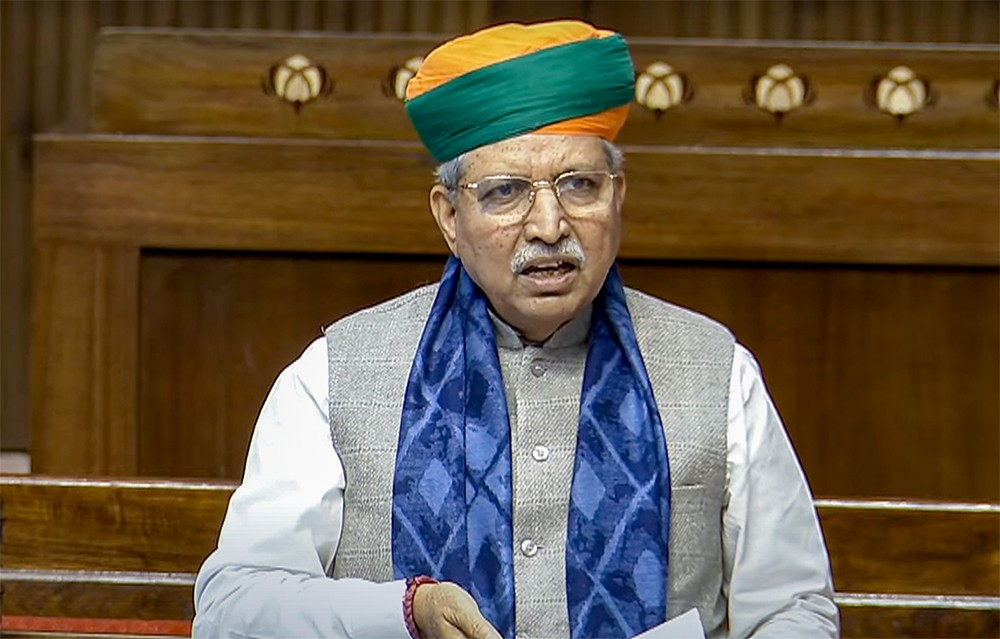
JAIPUR — Union Minister of State (Independent Charge) for Law and Justice,
Arjun Ram Meghwal, on Saturday, defended the concept of "One Nation, One
Election", addressing concerns raised by some political parties that it
threatens federalism.
Speaking on the issue, Union Minister Meghwal questioned
the Opposition's stance, stating, "When Lok Sabha and Assembly elections
were held simultaneously in 1952, 1957, 1962, and 1967, was that not an attack
on the federal structure? Elections were conducted smoothly back then without
any issues. Now, with PM Modi bringing improvements, why should it not be
considered an election reform?"
His remarks come amid an ongoing debate over the
feasibility and impact of synchronising elections across the country, a
proposal that has been actively discussed by the Central government.
"Elections were held at that time, there was no
problem. Now PM Modi is improving it, why should it not be considered an
election reform," the Union Minister asked.
Minister Meghwal, who came to attend the inauguration of
the new Law Building (Academic Block-3) at the Manipal University in Jaipur,
said: "The new criminal justice system implemented on July 1, 2024,
includes many important aspects related to spiritual and moral values. Keeping
this in mind, value-based education should also be an important part of the
educational institutions. Manipal University has taken a step in this
direction, I have come to Jaipur to attend this session."
India’s democratic framework thrives on the vibrancy of
its electoral process, enabling citizens to actively shape governance at every
level.
Since independence, more than 400 elections to the Lok
Sabha and State Legislative Assemblies have showcased the Election Commission
of India’s commitment to fairness and transparency.
However, the fragmented and frequent nature of elections
has sparked discussions on the need for a more efficient system. This has led
to the resurgence of interest in the concept of "One Nation, One
Election."
Union Minister Arjun Ram Meghwal defends 'One Nation, One El
The idea, also known as simultaneous elections, proposes
aligning the election cycles of the Lok Sabha and State Assemblies. This would
allow voters to cast their ballots for both tiers of government on the same day
in their constituencies, though voting could still occur in phases across the
country.
By synchronising these electoral timelines, the approach
aims to address logistical challenges, reduce costs, and minimise disruptions
caused by frequent elections.