[caption id="attachment_194768" align="aligncenter" width="565"]
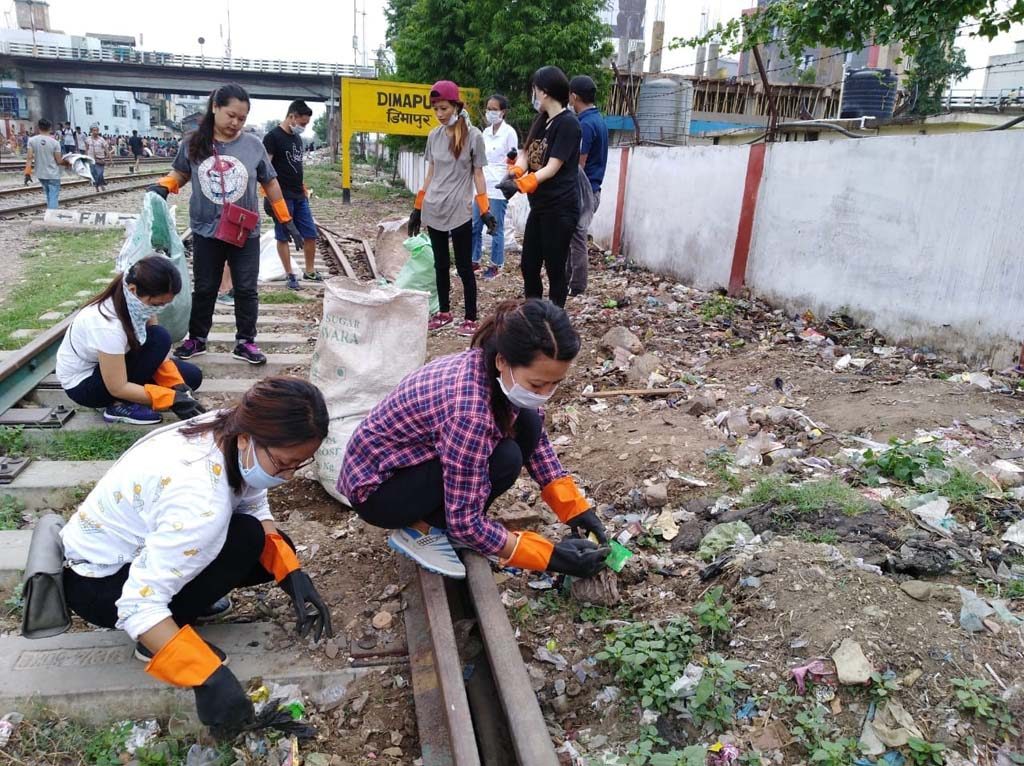 Volunteers collecting plastic wrappers along the Dimapur railway tracks. The activity was part of a cleanliness programme. (EM Images)
[/caption]
Dimapur, July 12 (EMN): Although intensive activities have been undertaken in Nagaland forming the central government’s flagship sanitation programme, the Swachh Bharat Mission (SBM), results remain sketchy. The reason why the state was declared the third dirtiest in the country might have something to do with the absence of a proper report. In fact, the assessment to the initiations by the people might never have been carried out in the first place.
The additional director of Municipal Affairs Tiamanen Ozukum informed Eastern Mirror in an email that the department did not undertake a separate survey because the census department had done so in 2011. The figures and information from it are already available with the census department, he said.
The officer affirmed that the centre had allocated financial assistance for SBM. However, he asserted that the department did not receive financial assistance to conduct a survey.
Ozukum assured that he was aware of the parameters that were taken by the Swachh Survekshan 2018 report. However, he was unsure of how the survey was conducted. Further, he added, basing on the report the government of Nagaland should submit a proposal to clean the choked drainage etc.’
What SBM ambassadors say
Well-known local musician Alobo Naga, an ambassador of the SBM for Kiphire highlighted the roles they play as mission representatives. He said, “Everywhere I go, I try to talk about the importance of cleanliness to my audience and followers on social media and through every platform.”
Talking about the activities being undertaken in the district, he asserted, ‘I have been there and did cleanliness drive for a couple of times, conducted school competitions and awareness campaigns, formed Swachh Bharat team who does the cleanliness drives every month, distributed dumper trucks to various wards, car dustbins to vehicle owners, build bamboo community toilets etc.’ He maintains many more plans in the pipeline.
When asked about the criteria that were followed for the Swachh Survekshan 2018 report ranking Nagaland as third dirtiest state in the country, he stated, ‘I don’t know on what basis they did the ranking.’ Further, he added, ‘I did see some states like West Bengal complaining about this ranking.’
However, the singer nodded to the fact that the state still lacks in many ways, owing to which is the issue of ineffective town planning, and questions of sanitation, and waste management. The singer said that such ranking can be an eye-opener for public as well as stakeholders. “We need to work towards cleaner Nagaland literally in the true sense,” Naga hoped.
Former legislator Supongmeren Jamir who is also an ambassador of the state’s SBM Mokokchung said that the ministry sends representatives and officials to inspect SBM works in the state. In fact people are not informed about inspections by the ministry as the representatives tend to ‘disguise themselves as tourists’ rather than inspection teams, he said.
Jamir pointed out that the officials usually take photographs of the dirty spots and corners of the area for assessment.
In most cases ministry officials will not inform the department in concern about their inspection but take it as a surprise check. This is to check the sincerity of the department as to whether works are being undertaken properly with the allotted fund sanctions from the centre, Jamir disclosed.
Talking about financial assistance from the department toward undertaking cleanliness initiatives in the district, he maintained that “We did not receive any funds from the department.” Instead, as ambassadors, one has to mobilise funds and get donors for the activities. ‘It is purely voluntary,’ he added.
With April 2015 nomination of nine SBM ambassadors by the Nagaland governor for the then 11 districts of Nagaland, the mission had covered almost all the targeted villages, Jamir said. ‘We have planned to conduct mass social every three month until Oct 2 2019,’ which is the mission’s end-term coinciding with Mahatma Gandhi’s 150th birth anniversary, he said.
The Swachh Survekshan survey targeted mainly the urban areas, the ambassador said. Unfortunately, urban denizens are slow in catching up with the cleanliness work when comparing to rural residents. ‘We are depending on each other instead of doing the work. Thus, it ultimately leads to a dirty urban,’ he added.
The ambassador for Phek’s SBM Vizapol Chaya said during a telephonic interview that he does not recall a survey being conducted in the district. Further, he added, in any case ‘only the department would be aware about such a survey and not us.’ Chaya added that it did not receive any financial assistance from the department.
‘A lot of positive changes have been happening since 2015 until now, including Phek district which, was declared ‘Open Defecation Free,’ Chaya asserted. Although visiting each village in the district is non-viable, the areas that have been visited are ‘progressing,’ he added.
On June 9 2017, the NPF-led government had declared five districts in Nagaland as Open Defecation Free. These districts were Dimapur, Mokokchung, Longleng, Phek, Kiphire, and Zunheboto. In continuation, the chief minister of Nagaland, Neiphiu Rio, on May 10 2018 had tweeted: “We are hopeful of making our state ODF with support of people and community.”


