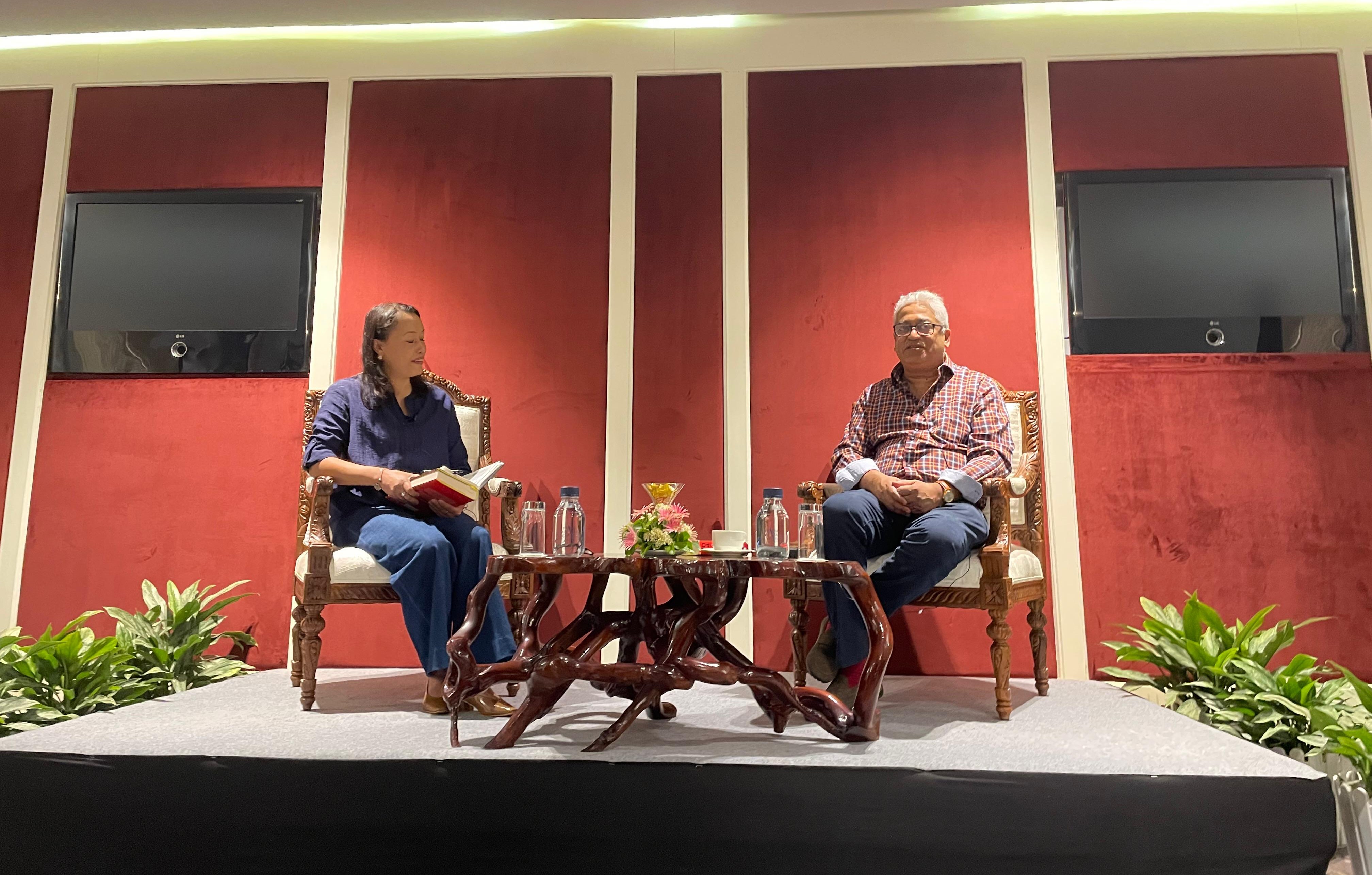
Addressing ‘The White Circle’ session at Zone Niathu by The Park, Chümoukedima, on Sunday, Sardesai expanded on his critique of the media today and how it is disconnected from grassroots realities.
Award-winning journalist Rajdeep Sardesai (right) during an
event at Chümoukedima, on Sunday.
Rajdeep Sardesai discusses disconnect between mainstream
media and grassroots realities
DIMAPUR — The
dominance of a limited set of voices in ‘mainstream’ media today has led to a
lack of diversity in opinions and perspectives, according to Rajdeep Sardesai,
an award-winning journalist and author.
Addressing ‘The White Circle’ session at Zone Niathu by The
Park, Chümoukedima, on Sunday, Sardesai expanded on his critique of the media
today and how it is disconnected from grassroots realities.
In a conversation with Ayieno Kechü, media secretary to the
chief minister of Nagaland, Sardesai admitted that the Northeast region
receives minimal coverage in mainstream media; a drainpipe leak in Noida
becomes breaking news, but floods in Assam or Mizoram don’t, unless hundreds of
people have died.
He attributed this lack of coverage to the ‘tyranny of
distance’, a concept espoused by Australian writer Geoffrey Blainey to explain
how Australia’s geographical remoteness, particularly from Great Britain, has
shaped the country's history and identity.
“It’s an explanation that the further you are from Delhi,
the less relevant you seem to be to the mainstream,” he said, adding that this
disconnect extends even to South India and states like Jharkhand and
Chhattisgarh. “So it's not just a Northeast problem. It’s an India problem, and
it’s a media problem,” he said.
Similarly, he observed that elections in the country are
covered “from a Delhi point of view” and not grassroots realities. “When most
journalists go to cover elections, they follow a politician and don’t go to the
people, the real voters,” he said.
He also noted how platforms like WhatsApp and Instagram
enable real-time information dissemination but also amplify misinformation.
Referring to videos that were purported to be from the Manipur violence that
erupted in 2023 but were later found to be old and unrelated, the senior
journalist noted that the speed of digital news cycles not only undermines
journalists’ ability to verify facts but also risks public manipulation.
Grounding his responses in over three decades of political
reporting, Sardesai also highlighted systemic challenges facing the ‘world’s
largest democracy’.
He viewed that India is the “most crazy diverse country in
the world”, and thus, the concept of “one nation with one leader, one party,
and one religion will always battle against the diversity dividend.”
Sardesai, who has written three books about elections in
India starting from 2014, observed that the Indian electoral democracy has
always lacked a level playing field. However, this inequality has only grown
over the past decades.
While there are several factors at play, the misuse of money
power and misuse of state and media power mean that “our electoral democracy is
reduced to come vote, give your vote once every five years, go back, and then
you have no power.” This, he asserted, is not true democracy, where one should
be able to hold their leaders accountable for what they promise and what they
say, not just once in five years.
Further stating that this “cash-and-carry democrazy” is
prevalent everywhere in the country, he quipped that “if the great Mahatma
Gandhi contested today, he might lose his deposit.”
Responding to a query on whether the politics of Hindutva
has normalised under the “Narendra Modi raj,” Sardesai argued that under Modi’s
leadership, Hindutva politics has mainstreamed a majoritarian ideology that
contradicts the Indian ethos of “Jiyo aur Jeene Do” (Live and Let Live).
“And to me, a secular constitutionalist, this is troubling,”
he said, highlighting how in many places, people are being told what they can
eat, what they can wear, who they can marry, and where they have to pray.
He also referenced a quote attributed to Lok Sabha MP
Asaduddin Owaisi, stating how “for the BJP today, beef is yummy in the
Northeast but mummy in Uttar Pradesh” for political expediency.
Sardesai also elaborated on his latest book, ‘2024: The
Election That Surprised India’, and how it probes into these themes and how
majoritarianism has gained ground.
However, there has been pushback in the form of protests
across the country. “The protests show that democracy is still vibrant.
Protesting is part of being Indian. You cannot criminalise dissent,” he said,
adding that the Indian state has to accommodate these forces.
“As long as there is no violence, there is space for
protest, and we must allow more space for it,” he said.
On the matter of what may happen in 2029 and how the
electorate may ‘surprise’ the nation once again, he quipped that the only
concern is that India does not go the Nagaland way and be ruled by an
opposition-less government.
The Write Circle, a vertical and an initiative of Prabha Kaitan Foundation and organised by Ehsaas Women of Dimapur -- Viketuno Rio and Abokali Jimomi-- is supported by Shree Cement limited as their CSR initiative.