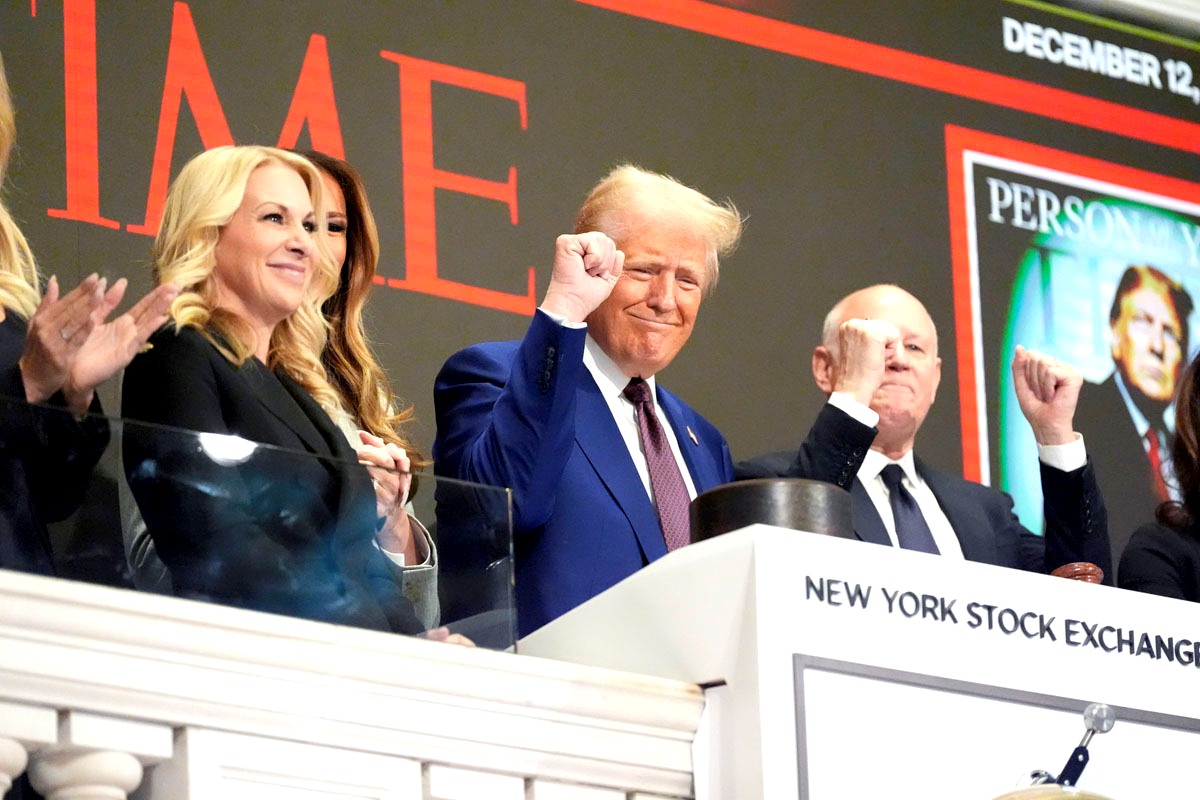
NEW YORK — President-elect Donald Trump rang the opening bell Thursday at the
New York Stock Exchange after being recognised for the second time by Time
magazine as its person of the year.
The honours for the businessman-turned-politician are a
measure of Trump's remarkable comeback from an ostracised former president who
refused to accept his election loss four years ago to a president-elect who won
the White House decisively in November.
Before he rang the opening bell at 9.30 am, a first for
him, Trump spoke at the exchange and called it “a tremendous honour.”
“Time Magazine, getting this honour for the second time,
I think I like it better this time actually,” he said.
Trump, accompanied by his wife, Melania Trump, daughters
Ivanka and Tiffany and Vice President-elect JD Vance, grinned as people chanted
“USA” before he rang the bell. He then raised his fist.
In his remarks, he talked up some of the people he has
named to his incoming administration, including Treasury pick Scott Bessent,
and some of his announced policies, including a promise this week that the
federal government will issue expedited permits, including environmental
approvals, for projects and construction worth more than USD 1 billion.
“I think we're going to have a tremendous run. We have to
straighten out some problems, some big problems in the world,” he said.
Sam Jacobs, Time's editor in chief, announced on NBC's
“Today” show that Trump was Time's 2024 Person of the Year. Jacobs said Trump
was someone who “for better or for worse, had the most influence on the news in
2024.”
“This is someone who made an historic comeback, who
reshaped the American presidency and who's reordering American politics,"
Jacobs said. "It's hard to argue with the fact that the person who's
moving into the Oval Office is the most influential person in news."
He added that “there's always a hot debate” at the
magazine over the honour, "although I have to admit that this year was an
easier decision than years past.”
In an interview with the magazine published Thursday,
Trump spoke about his final campaign blitz and election win.
“I called it '72 Days of Fury,'” Trump said. “We hit the
nerve of the country. The country was angry.”
Trump was on Wall Street to mark the ceremonial start of
the day's trading. The Time magazine cover featuring him was projected onto a
wall at the stock exchange, flanked by American flags.
Trump took the stage at the exchange flanked by family
members and members of his incoming administration while his favoured walk-on
song, “God Bless the USA,” played.
Trump was also Time's Person of the Year in 2016, when he
was first elected to the White House. He was listed as a finalist for this
year's award alongside notables including Vice President Kamala Harris, X owner
Elon Musk, Israeli Prime Minister Benjamin Netanyahu and Kate, the Princess of
Wales.
The NYSE regularly invites celebrities and business
leaders to participate in the 9.30 am ceremonial opening trading. Thursday was
Trump's first time doing the honours, which have become a marker of culture and
politics.
Last year, Time CEO Jessica Sibley rang the NYSE opening
bell to unveil the magazine's 2023 Person of the Year: Taylor Swift.
Trump has long had a fascination with being on the cover
of Time, where he first made an appearance in 1989. He has falsely claimed to
hold the record for cover appearances, and The Washington Post reported in 2017
that Trump had a fake picture of himself on the cover of the magazine hanging
in several of his golf country clubs.
Earlier this year, Trump sat for interviews with the
magazine for a story that ran in April. Time's billionaire owner, Salesforce CEO
Marc Benioff, criticised Trump's Democratic rival, Vice President Kamala
Harris, for not granting the magazine an interview.
"Despite multiple requests, Time has not been
granted an interview with Kamala Harris—unlike every other Presidential
candidate,” Benioff said in a post on X. “We believe in transparency and
publish each interview in full. Why isn't the Vice President engaging with the
public on the same level?”
In his latest interview published Thursday, Trump
reiterated that he's going to pardon most of those convicted in riot at the US
Capitol on January 6, 2021. “It's going to start in the first hour,” he said of
the pardons. “Maybe the first nine minutes.”
Trump said he would not ask members of his administration
to sign a loyalty pledge. “I think I will be able to, for the most part,
determine who's loyal,” he said. But he said he will fire anyone who doesn't
follow his policies.
On the war in Gaza, Trump said he wants to end the
conflict and that Israeli Prime Minister Benjamin Netanyahu knows it. When
Trump was asked whether he trusted Netanyahu, he told Time: “I don't trust
anybody.”
The incoming president also discussed his plans for mass
deportations and argued he will have the authority to use the military to
assist with the effort, even though, as the magazine notes, the Posse Comitatus
Act forbids the deployment of the military against civilians.
“It doesn't stop the military if it's an invasion of our
country,” he said. “I'll only do what the law allows, but I will go up to the
maximum level of what the law allows.”
Trump crafted his image as a wealthy real estate
developer, which he played up as the star of the TV reality show “The
Apprentice” and during his presidential campaign. He won the election in part
by channelling Americans' anxieties about the economy's ability to provide for
the middle class.
The larger business community has applauded his promises
to reduce corporate taxes and cut regulations. But there are also concerns
about his stated plans to impose broad tariffs and possibly target companies
that he sees as not aligning with his own political interests.
The US stock market has historically tended to rise
regardless of which party wins the White House, with Democrats scoring bigger
average gains since 1945. But Republican control could mean big shifts in the
winning and losing industries underneath the surface, and investors are adding
to bets built earlier on what the higher tariffs, lower tax rates and lighter
regulation that Trump favours will mean.