[caption id="attachment_186505" align="alignnone" width="550"]
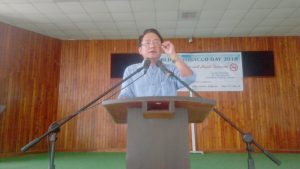 Dr. K Vikato Kinimi speaking during the World No Tobacco Day programme at Greenwood Higher Secondary School in Dimapur on Thursday.
[/caption]
Eastern Mirror Desk
Dimapur, May 31 : Certain sections of the medical administration in Dimapur district are of the opinion that the scourge of tobacco in all its health risks ought to be banned totally at least in Nagaland. The principle argument about taking the route of “prohibition” is understood to be centred on the presumption that the ‘economy’ would not be affected.
Every year on May 31, the World Health Organisation (WHO) and its partners mark World No Tobacco Day (WNTD) to highlight health risks associated with the use of tobacco. The movement advocates effective policies to reduce tobacco consumption.
The focus of the WNTD for this year is “tobacco and heart diseases.” The campaign aims to increases awareness about the link between tobacco use and the heart besides other cardiovascular diseases including stroke. It aims to increase feasible action and measure that key audiences including governments and the public can take to reduce the risks to heart health posed by tobacco.
Dimapur too observed the WNTD on May 31 Thursday at Greenwood Higher Secondary School in Dimapur. The programme was organised by the District Tobacco Control Cell and the Dimapur District Legal Services Authority (DDLSA).
During the event, the state’s nodal officer for National Tobacco Control Programme (NTPC) Dr. Hotokhu Chishi said in his keynote address that tobacco use was a risk factor and the sixth of the eight leading causes of death worldwide. The others include HIV and AIDS and diarrhoea.
According to Dr. Chishi Nagaland has shown significant reduction of tobacco consumption, according to a 2018 survey and has moved from second place to the eighth. This can be attributed to anti-tobacco campaigns that are being conducted in the state. However, he lamented that Nagaland has the highest number of nasopharyngeal cancer (head and neck cancer) in the country with about 15.3% among male and 10.8% among female.
The state also has 454 new cases of cancers every year, according to a population-based cancer survey by the Indian Council of Medical Research during 2012–2014. Another survey that was carried out by the department of Health and Family Welfare during 2013–2014 showed Nagaland as a state with high tobacco-abuse prevalence (29.3%) among children under 15 years of age and 41.2% for children buying tobacco products for parents.
Dr. Chishi advocated total prohibition of tobacco in Nagaland. He said that prohibition in the state will lead neither to ‘burden of shifting for alternate livelihood’ nor would it have any negative impact on the domestic economy. The reason he gave was that there is no cultivation or production of tobacco in the state.
The medical officer hoped that Nagaland would be a ‘tobacco-free state’ in future, with the active participation of NGOs, pressure groups, and such, to support the anti-tobacco campaign.
The chief medical officer of Dimapur Dr. K Vikato Kinimi was the guest of honour for the function. He informed that 107 schools in the district have been declared tobacco-free. He encouraged the students to continue keeping their surroundings tobacco-free.
Two resource persons Zuchumpeni Ezung and Sentimenla Tzudir, panel lawyers of the DDLSA, gave discourse to the audience. Ezung spoke about the Cigarette and Other Tobacco Products Act (Cotpa). She elaborated its salient features, legal implications, prohibitions, and penalty.
Likewise, Tzudir explained the characteristics of the Protection of Children from Sexual Offences (Pocso) Act, and child abuse. She gave the students tips about the ways there are to protect themselves.
The secretary of the DDLSA Ajongba Imchen was the chief guest for the event. During his speech, he said that it was his constitutional duty to make the participants aware of their rights and it was the constitutional rights of the participants to know about relevant statutes such as the Cotpa and the Posco.
Imchen was disappointed that citizens generally are not aware of their rights. He reckoned that, “Until the people know what their rights are, this state will be in pathetic condition for another 20–30 years.” With his statement, he urged the participants to be aware of their rights and said that without knowing rights, they will not progress.
Imchen added that the DDLSA provides free legal consultations to the poor. Speaking to Eastern Mirror Imchen said that statutory regulations in the state need to be engaged. “I don’t want the nodal agencies to keep the Copta Act 2003 as dead letter. We have to make them alive,” he said.
‘We have so many act in India. With all the required Acts in India, the problem is that the concerned department is not using them. We are not making it alive, but making it a dead letter.’


