


Shehnab Sahin discusses “Colour My Grave Purple” at The Write Circle hosted by Prabha Khaitan Foundation.
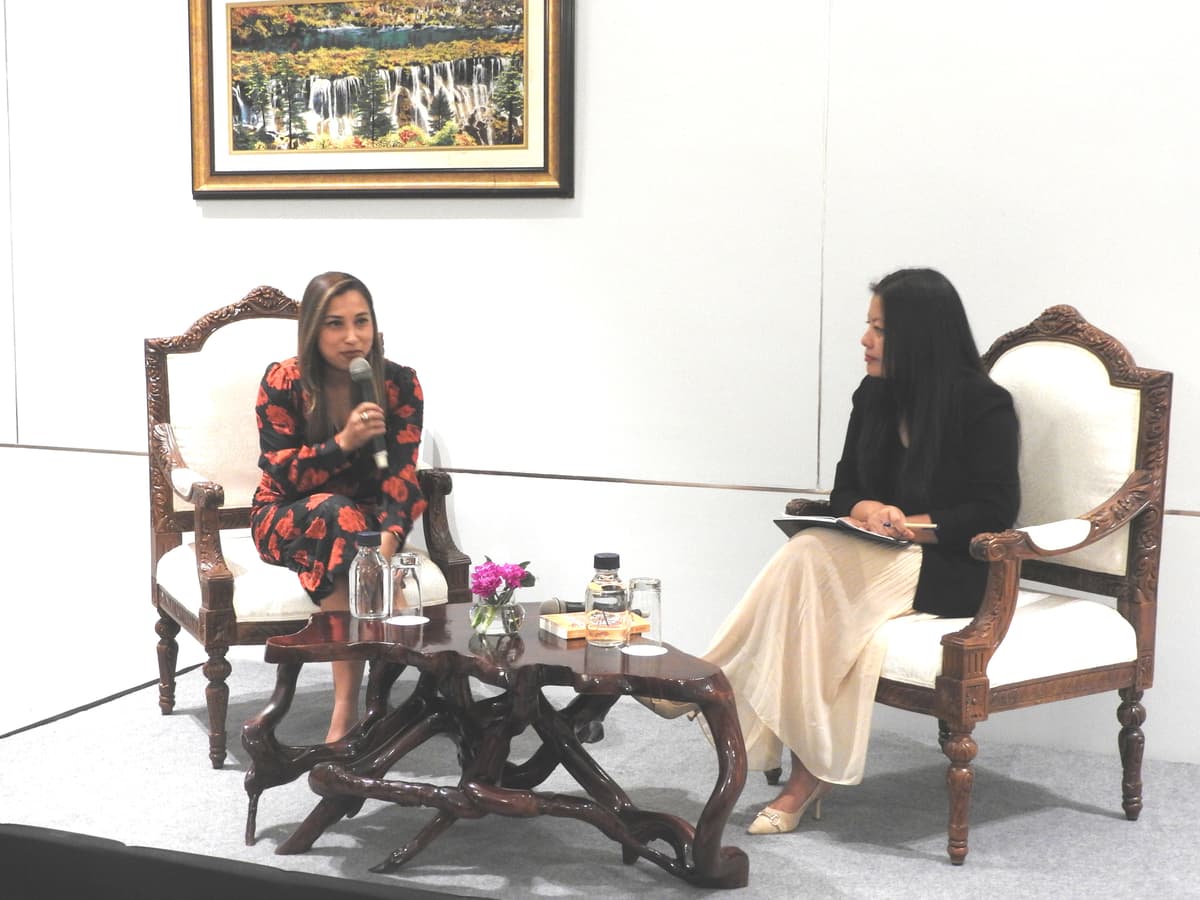
DIMAPUR — The Prabha Khaitan Foundation organised The Write Circle featuring humanitarian leader and author Shehnab Sahin in conversation with Akangjungla, Editor of The Morung Express, at Zone Niathu by The Park on Tuesday.
Speaking about her book “Colour My Grave Purple”, Sahin said that a book “does not happen overnight,” but is shaped by loss, longing, identity and the instinct to survive.
She described the work as emerging from her own journey of grief, displacement and self-discovery.
Sharing her personal background, Sahin said she grew up quickly following her father’s death, taking on responsibilities within her family before eventually working internationally in humanitarian roles.
Although working in conflict zones felt aligned with her calling to serve, her return to Assam in 2019 after clearing APSC proved emotionally complex.
Also read: Farmers in eastern Nagaland report climate change impacts
The home she longed for felt altered, and she found herself professionally constrained and increasingly conscious of her religious identity in ways that unsettled her.
During the pandemic, while handling demanding frontline duties, she began writing as a way to rediscover what “home” meant to her. The stories, she said, emerged instinctively, drawing from Assam’s layered cultural and political history. Writing became both a grounding exercise and a process of healing.
The book comprises ten historically rooted stories spanning 1855 to 2019. Sahin said she deliberately avoided centring insurgency as the defining lens of Assamese history.
While acknowledging that political unrest is part of the region’s past, she stressed that “it is not the only story we have.”
She cited the opening story, inspired by the smell of tea and set against the backdrop of the 19th-century tea plantations and figures such as Maniram Dewan.
Another story, set in 1921 during the Non-Cooperation Movement and Mahatma Gandhi’s visit to Assam, juxtaposes a major political moment with the intimate struggles of a young girl confronting menstrual taboos.
“This is the power of historical fiction,” she noted, adding that while she can create fictional spaces, she cannot distort historical facts.
On language, Sahin said she intentionally retained several Assamese words without translation. There was never an intention to erase the “Assameseness” of tone, she said, even as she hoped the book would travel beyond the region.
Every story eventually finds its reader,” she remarked, describing the Northeast as the “wild wild East” and expressing pride in its ecological and cultural richness.
Explaining the significance on the usage of colour purple, Sahin shared that the colour purple is linked to her personal grief. After her father’s death, she was discouraged from visiting his grave due to certain interpretations of Sharia. Years later, she was allegedly stopped at the cemetery gate when she attempted to visit again. In fiction, she chose to give her father what she could not in reality, a resting place shaded by his favourite purple ezhar blossoms.
“If I cannot visit my father’s grave, then perhaps the world can visit it with me through my stories,” she said.
On her future plans, Sahin stated that writing was always part of her environment, influenced by her father, who was also a writer. Though not a planned ambition, writing emerged as an act of survival. She intends to continue balancing her humanitarian work—particularly in conflict-affected regions such as Syria—with her literary pursuits, encouraged by the strong reception of her debut.