


A brief opinion on Naga rights, Article 371A, and the importance of protecting customary laws, land ownership, and village self-governance in the wake of the Porba case.
A Bird, a Young Man, and the Future of Naga Rights: The incident that took place in Porba village appears like a small case, but it has very large consequences for every Naga person. This is a case that can happen to you and me and to our future generations tomorrow, restricting our rights to food and living. Vezhoto Hesuh, a Chakhesang youth from Porba village in Phek District, was summoned by the Wildlife Crime Control Unit in Dimapur on 11 September 2026, over photos and videos on his Facebook page. He respected the law and appeared before the authority but was detained. Not only that, forest officials entered Porba on 14 September and took away a Great Barbet (Ehwu) which a family in the village had cared for over six to seven years. Community organisations also alleged that a sum of one lakh rupees was demanded for the release of Vezhoto Hesuh; that allegation is now before a CID inquiry.
The seized bird - Great Barbet (Ehwu) was handed back only after the Centre Chakhesang Youth Organisation and other bodies protested and it was later set free in the Porbami forest by the community itself. The case against Hesuh is still pending.
The Naga society appears to see this as a quarrel over one bird. However, looking deeper into the issue it is not. The main thing is about who governs the land, forests and animals of all the Naga people in our land: Is it the village councils or the Legislative Assembly, or the government officials?
Article 371A: Our Constitutional Shield
Article 371A of the Constitution of India states that no law made by the Indian Parliament on the following matters shall apply in Nagaland unless the Nagaland Legislative Assembly decides so by a resolution:
1. The religious or social practices of the Nagas;
2. Naga customary law and procedure;
3. The administration of justice according to Naga customary law;
4. The ownership and transfer of land and its resources.
These provisions mean that the land and what lives on it belong to the people. Over 88% of Nagaland's forest is owned by communities and individuals, an ownership that every official must respect as guaranteed by Article 371A in the Constitution.
Article 371A, not the 1981 resolution, is the ruling law. Officials say the Wild Life (Protection) Act binds Nagaland because the Nagaland Assembly adopted it on 18 December 1981. That is putting the cart before the horse. Article 371A is part of the Constitution; the 1981 resolution is an ordinary decision of the Assembly taken under it. A resolution cannot rise above the provision that gives it life. The 1981 adoption does not override what Article 371A guarantees: Naga customary law, and Naga ownership of land and its resources.
The Naga position is therefore clear:
• The 1981 resolution adopted a law to protect wildlife. It did not, and could not, hand over Naga ownership of land and its resources, or set aside the customary law under which Naga villages hunt, gather and care for animals. Those remain protected by Article 371A.
• The Naga people were never asked. No village council, Hoho or tribal body gave its Free, Prior and Informed Consent. A decision that restricts how a people feed themselves, taken without their consent, cannot be turned against them.
• Parliament has changed the Act many times since 1981, most recently in 2022. Under Article 371A, no Act of Parliament touching Naga land, resources or custom can apply without the Assembly's own decision. No Assembly decision adopting these later changes is publicly known, and the Assembly must answer this question openly.
• Even the Act itself does not make all wildlife "government property". It says so only in specific cases, such as animals unlawfully taken. The claim that every animal on Naga land belongs to the government has no basis in law.
What India Has Promised the World
India has signed international agreements that protect peoples like the Nagas. These are promises the Government of India has made, and the Nagas have every right to hold India accountable to them.
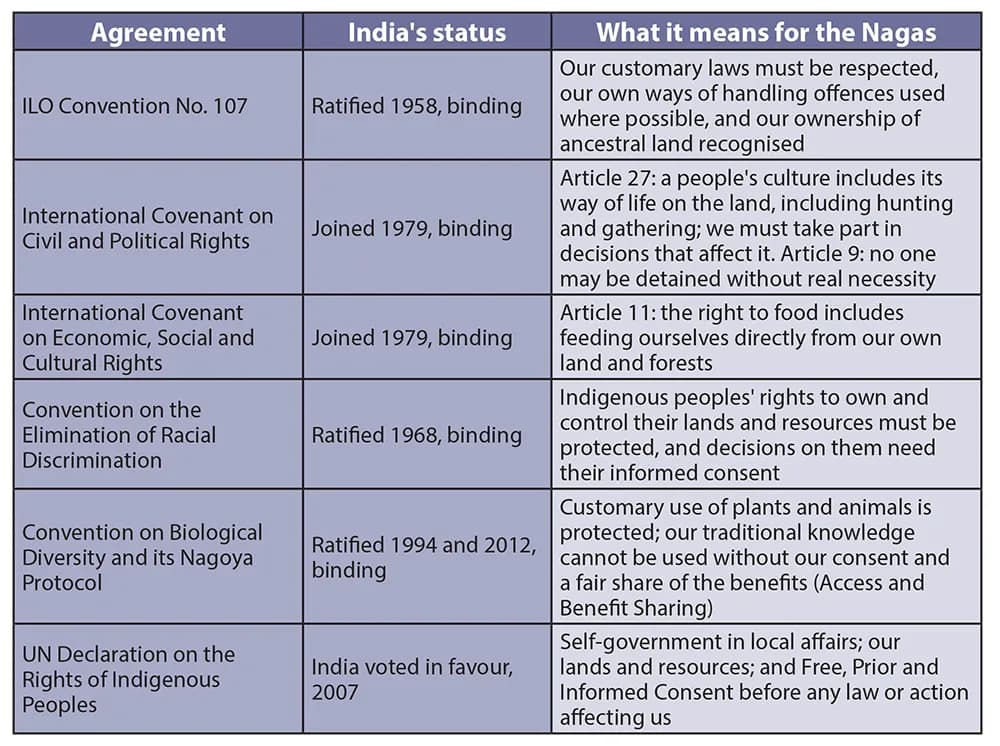
Free, Prior and Informed Consent (FPIC) simply means that the people must be informed in advance and they must give their willingness freely before anything is done to their land or way of life. However, according to the community, the government officials who entered Porba did not seek the consent of the village or its council.
The world has noticed. In August 2026, the UN Committee on the Elimination of Racial Discrimination reviewed India. It named the Naga people among those whose lands are being affected without their consent, and asked India to obtain Free, Prior and Informed Consent before any conservation decision on Indigenous lands.
Hunting, Food and the Naga Way of Life: From time immemorial, hunting, gathering and keeping animals have been part of how Nagas feed their families, mark the seasons and pass on knowledge. The barbet's call told Porba farmers when to start and stop work in the fields. This is culture and food security, and both are protected rights.
Restricting our resources is restricting our food. The term "Land and its resources" means more than just the soil. It includes wild vegetables, mushrooms, honey, edible insects, river fish and bush meat that fill Naga kitchens and feed the people. If access to these plants, animals and insects is restricted without our consent, our right to food is obstructed. That right is protected by Article 11 of the International Covenant on Economic, Social and Cultural Rights, to which India is a party, and by the right to life under Article 21 of the Constitution, which India's courts have read to include the right to food.
Other nations already recognise these rights. In the United States, courts upheld the treaty fishing rights of Native American tribes in 1974, and the tribes now manage the fisheries together with the state. Canada's Supreme Court ruled in 1990 that Indigenous food fishing comes first once conservation needs are met. New Zealand settled Māori fishing rights by law in 1992, and Māori communities now authorize customary fishing in their own reserves. Australia's High Court upheld an Aboriginal man's right to hunt crocodiles by traditional means in 1999. If the fishing and hunting rights of Indigenous peoples are recognized in these countries, the hunting rights of the Naga people deserve the same recognition.
Recognition does not mean unlimited hunting. Our village councils and tribal bodies have shown that Nagas can protect wildlife better than any outsider. Naga villages have declared over 400 community conserved forests on their own land, and Chakhesang bodies already ban hunting and air guns. The right we defend is the right to decide, through our own institutions, when and how hunting is allowed.
Why a small case matters
If the Nagas remain silent and no one questions what happened at Porba, thinking that it does not matter to me, then a pattern is set: Government officials can enter Naga villages, seize what a family keeps, and detain anyone, without the village council and without our Assembly's say.
Tomorrow, the same reasoning can be used to restrict our forests, our jhum lands, our medicinal plants and our traditional knowledge. Rights that are not used and defended slowly disappear. Our silence today, thinking that it does not matter to me, can become our loss tomorrow and a curse to our future generations.
A Call to the Naga People
The Chakhesang public organisations have raised their voices on this case, and that matters. But what about our politicians? Or other civil organisations including the NPMHR? Why are our politicians not voicing their concerns? Protest alone is not enough. We must speak the language of our own rights: Article 371A, India's binding international promises, and the UN's own findings on India. Knowing these rights is the first step to using them.
We therefore appeal:
1. To the Nagaland Legislative Assembly: pass a resolution under Article 371A declaring that the Wildlife Act does not override Naga customary law or the people's ownership of land and its resources, that customary hunting, gathering and care of animals on community land are governed by village councils, and that no law touching these matters will apply without the people's Free, Prior and Informed Consent.
2. To the State Government: complete the CID inquiry openly, review the case against Vezhoto Hesuh, and make a clear rule that no village is entered for wildlife matters without involving its council.
3. To village councils, hohos, churches and civil society: record your community conservation rules in writing, so the world can see that Nagas govern their land responsibly. Seek legal advice and stand together. The Naga Peoples Movement for Human Rights (NPMHR) has long championed the rights of the Naga people; the right to food and to our customary way of life must stand at the centre of that work.
4. To every Naga, especially our youth: learn these rights, share this message, and ask your representatives where they stand.
Porba has given us a warning. If we understand it and act together now, a small case can become a turning point for Naga self-governance instead of the start of its loss.
Zhoponeyi Zuo,
President,
Unified Covenant Party, Nagaland.