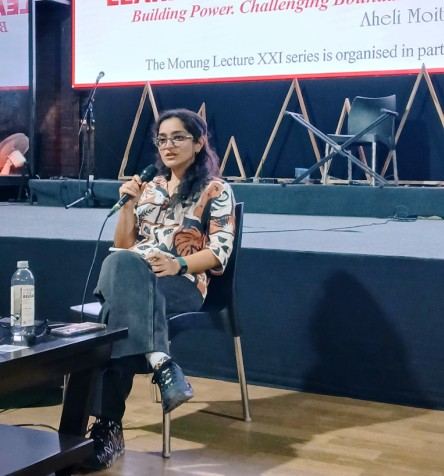
Aheli
Moitra during The Morung Lecture XXI in Dimapur on Saturday. (EM Images)
DIMAPUR — The Morung Lecture XXI on “Learning from the terrain of
struggle-building power, challenging boundaries, activism, journalism and
scholarship” with Aheli Moitra was held on Saturday at The Lighthouse Church in
Dimapur.
The 21st series of the Morung Lecture initiated by The
Morung Express was organised in partnership with the Sinai Ministry.
Moitra, former journalist with the Morung Express and
currently a researcher of Archaeology, History, Religious Studies and Theology
at UiT, The Artic University of Norway, shared reflections on how her
engagement with and the study of a specific institution helped her traverse the
terrain on which knowledge is built in our times.
In her words “I will address some ways in which knowledge is
produced and how being a partial insider to a newsroom and later a partial
outsider to academia, working between boundaries challenged my understanding of
journalism and pushed my work as a research scholar”.
In the discipline of indigenous religions that her Ph.D work
was located in, Moitra stated Naganess was often related to only a few and
fixed ways in which people claim themselves or their related environment to be
Naga.
“The essentialising notion of Naganess seemed to me the
connecting and grounding point of further investigation. Not because Naganess
is effervescent, but just the opposite. It is something specific, relational
and historical. Norms related to Naganess are often challenged and shift over
time. What kind of shifts are these? Who brings them up? For what purposes? What
are the myriad structures that operate in Nagaland today that may be studied
through the public arena of the newspaper? These questions propelled the
research on” she said.
The scholar added that “it is important to mention here that
academic objectivity also entailed thinking about the power I held working as
an Indian journalist and now academic, in Nagaland and on Naga issues.”
According to her, the history of political relations between
the Naga and Indian polities has been marked by the unjust and unacknowledged
use of brute force.
She said that Indian armed forces as representatives of the
Government of India in Nagaland for many decades have militarised and torn up
Naga lives and society with complete impunity. She added that the power
imbalance built by those actions has crept into almost every institutional,
social and sometimes individual relation between the Nagas and Indians.
“This power imbalance came up often as I reported the news
in Nagaland but also enabled me to be as critical as I wanted to be. This,
while Naga journalists often face backlash from the state, the non-state, but
also their own communities as insiders to various other categories like the
tribe alongside being journalists”, she observed.
Safety for journalists in Nagaland, she pointed out, is
unheard of and the profession has never become financially stable for those who
want to participate in this democratic endeavour.
‘In this sea of uncertainty, my secure caste and class
Indianness gave me many degrees of certainty, as also a few gender based
challenges. How these power imbalances have implicitly informed my research is
something that my former journalist colleagues and others can point out best,’
she shared.



 Aheli
Moitra during The Morung Lecture XXI in Dimapur on Saturday. (EM Images)
Aheli
Moitra during The Morung Lecture XXI in Dimapur on Saturday. (EM Images)