


Minister Temjen Imna Along addressed the ANCSU Degree Toppers' Felicitation Programme in Kohima and called for collective vision.
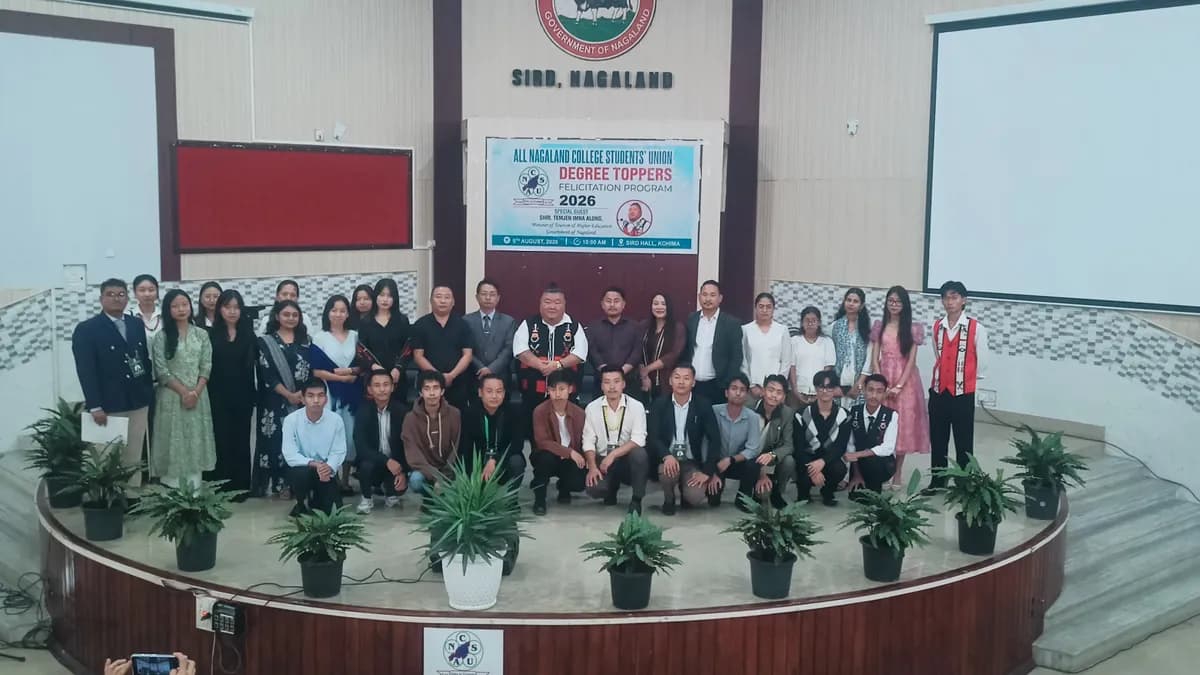
KOHIMA— Minister for Tourism and Higher Education Temjen Imna Along on Wednesday urged the people of Nagaland to build an "enterprise of progress and prosperity" through collective responsibility, inclusiveness, and a long-term vision, while cautioning against divisive agendas and overdependence on government jobs.
Along was speaking at the All Nagaland College Students' Union (ANCSU) Degree Toppers' Felicitation Programme held at the SIRD Hall in Kohima.
During the event, he congratulated university, autonomous college, technical institution, and other degree toppers and commended the ANCSU for recognising meritorious students from across the state, including non-Naga students studying in Nagaland.
He stated that the felicitation programme should serve not only as recognition of academic excellence but also as a statement on the resilience needed to build a progressive, inclusive, and prosperous Nagaland. Stressing that no single tribe or community could progress in isolation, Along said Nagaland's future depended on unity and collective achievements rather than individual or sectional interests.
He observed that in an increasingly globalised world, knowledge and opportunities were no longer confined to classrooms but were readily accessible through technology and digital platforms.
Highlighting the growing influence of artificial intelligence and digitalisation, the minister encouraged students to become seekers of knowledge and verify information before drawing conclusions. He urged them to continuously upgrade their skills and prepare themselves for the rapidly changing educational and employment landscape.
Referring to the implementation of the National Education Policy (NEP), Along said the policy was transforming India's education sector and challenged Nagaland to assess its preparedness for the changes ahead. He said parents, teachers, students, and student organisations all had a role to play in equipping the younger generation with the skills required for the future.
While acknowledging reforms aimed at ensuring transparency in government recruitment, he said government employment alone could no longer absorb the growing number of educated youth. Instead, he called for greater focus on skill development, entrepreneurship, agriculture, hospitality, healthcare, and other emerging sectors.
Achievement, he said, should never be viewed as a matter of chance but as the result of vision, perseverance, and action. He encouraged parents, teachers, and educational institutions to work together in nurturing the state's human resources.
The minister also called on society to move away from unnecessary divisions, saying Nagaland needed responsible civil society organisations that contributed positively to the state's development rather than creating avoidable conflicts. He urged citizens to adopt a common agenda centred on equality, prosperity, and inclusive growth, stating that no community should seek advancement at the expense of another.
Addressing the toppers, Along said academic excellence should be matched by a commitment to becoming agents of positive change for the state. He encouraged them to think beyond short-term gains and contribute towards long-term development that would benefit future generations.
On student scholarships, the minister assured that there should be no discrepancies in the release of scholarship funds and said both the ministry and the state government were committed to ensuring timely disbursement. He advised students to submit scholarship applications through their respective institutions instead of relying on private agents or internet cafés, cautioning that many students were unnecessarily paying money to third parties for services available within their colleges.
Along also informed that the government was working towards enhancing scholarship support through discussions on fee fixation and broader reforms in higher education.
Observing that the state's challenge today was not a lack of education but unemployability, he said graduates and postgraduates must complement their academic qualifications with practical skills and technological competence. He said Nagaland's youth had the potential to excel not only within the state but also across the country and internationally if they embraced continuous learning, research, and innovation.
Calling for broader recognition of student achievements, Along suggested that future editions of the ANCSU felicitation programme should also honour excellence in sports, innovation, entrepreneurship, community service, and other fields alongside academic performance.