


Teachers, school leaders, and administrators join the NagaEd team during the final phase of the LEAP in Kiphire.
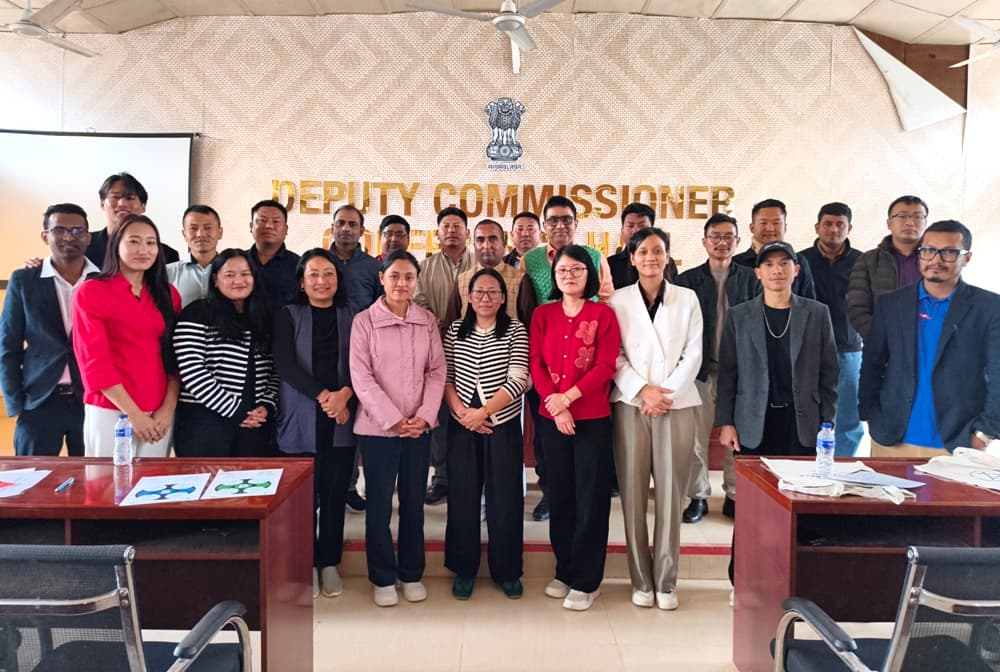
DIMAPUR — NagaEd and the Office of the Deputy Commissioner, Kiphire, convened the annual orientation training and certification ceremony on Thursday 9, marking one of the final milestones of the Learning Enhancement and Accessibility Project (LEAP) before it concludes in June 2026.
In a press release, NagaEd stated that three years earlier, LEAP had set out to bring quality digital education to one of India’s most remote districts.
“What it leaves behind is something harder to measure than minutes on a platform or certificates on a wall. In a school on the eastern edge of Nagaland, a teacher has begun using an AI assistant on WhatsApp to help her students revise Science concepts after school hours. Nobody asked her to. She chose to.
“That is what genuine change looks like in Kiphire,” it stated.
Kevisato Sanyu, founder of NagaEd, said that LEAP had never been about merely placing technology in a school and calling it transformation.
He explained that it had been about engaging with the teachers and students of Kiphire, understanding their aspirations, and building something that genuinely served them.
Sanyu said that when a teacher in a remote village became a champion of digital learning—not because she was told to, but because she chose to—that was the kind of transformation they had set out to achieve.
Also read: Nagaland pushes child-centric adoption under 2022 Regulations
“As the LEAP Project enters its third year, it is encouraging to witness the steady progress being made in improving learning outcomes and classroom practices in Kiphire. The continued collaboration between implementing partners and the district administration has been key to sustaining this momentum,” Deputy Commissioner of Kiphire Temsuwati Longkumer said.
A district that needed a different approach
Kiphire, located in the eastern reaches of Nagaland bordering Myanmar, is part of NITI Aayog's Aspirational Districts, regions that have historically faced concentrated development challenges.
Its schools face difficulties including unreliable connectivity, limited teaching resources, terrain that isolates communities, and a persistent gap between what the curriculum sets out to teach and what classrooms are equipped to deliver.
In June 2023, LEAP launched to take these challenges. Backed by NITI Aayog's Aspirational Districts Programme and implemented in partnership with the Kiphire district administration and NagaEd, the project brought curriculum-aligned digital learning in Mathematics and Science to 15 schools — government and private — across Classes 9 and 10.
The goal was not to place technology in a classroom and call it transformation. It was to make that technology genuinely serve the teachers and students who needed it most.
What three years built?
LEAP deployed an interactive learning management system carrying Maths and Science content developed specifically for the NBSE syllabus and aligned with NEP 2020.
All 15 participating schools received 5G routers and internet access.
The infrastructure was in service of strengthening teacher confidence and capacity.
More than 35 educators across Kiphire received structured training and sustained support, including refresher sessions, blended learning demonstrations, one-on-one troubleshooting, and direct access to subject matter experts through a dedicated WhatsApp channel.
When connectivity disrupted learning, offline graded-test booklets kept students on track. When engagement needed encouragement, a gamified leaderboard gave students a reason to participate.
LEAP also introduced a "Prerequisites" approach, comprising short digital lessons designed to strengthen students' foundational knowledge before they encountered new syllabus topics, enabling teachers to focus on deeper instruction rather than returning to the basics.
“The LEAP Project has demonstrated how effective coordination between schools, administrators, and implementation teams can lead to meaningful improvements in the education ecosystem. Year three reflects a maturing of these systems on the ground,” said Takatemjen Pongen, EAC, Kiphire.
In their own words
The people closest to LEAP — the administrators, teachers, and school leaders who lived it — describe what the project meant in practice.
“The Learning Enhancement and Accessibility Project with NagaEd for my school for the past three years flew by so quickly. The learning pace of my students changed a lot with the help of the online content. Asela Rothrong, proprietor and ITeS teacher at Saramati View Modern School, Kiphire, said.
“Over the past three years, the consistency and dedication of team NagaEd is truly impressive. Their mentorship, engagement, and depth of knowledge regarding edtech is excellent. Their ability to manage a complex multi-year curriculum while keeping everyone engaged and motivated is a rare skill,” Gopal Koirala, Maths Teacher, GHS Salmomi, testified.