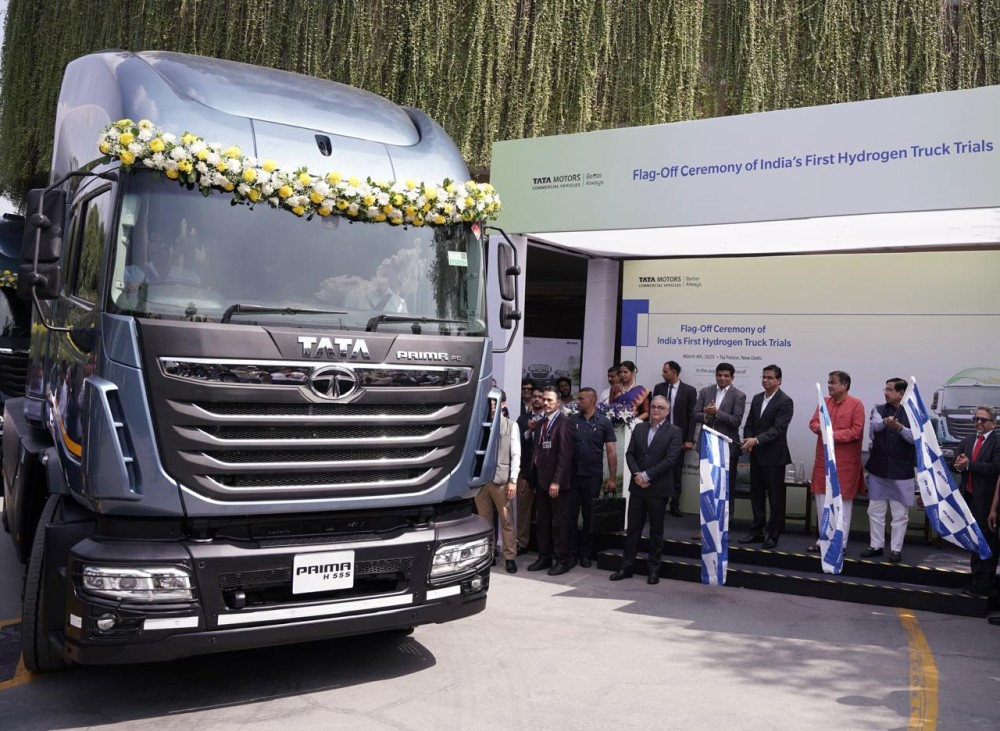
Tata Motors starts first hydrogen truck trials on Indian roa
Tata Motors starts first hydrogen truck trials on Indian roads
Tata Motors has launched the first-ever trials of hydrogen-powered heavy-duty trucks on Indian roads in line with the country’s green campaign to fight climate change
NEW DELHI — Tata Motors, the country’s
largest commercial vehicle manufacturer, has launched the first-ever trials of
hydrogen-powered heavy-duty trucks on Indian roads in line with the country’s
green campaign to fight climate change.
This historic trial, which marks a significant step
towards sustainable long-distance cargo transportation, was flagged off by
Minister of Road Transport & Highways Nitin Gadkari and Minister of New
and Renewable Energy Pralhad Joshi.
The trial phase will span up to 24 months and involves
the deployment of 16 advanced hydrogen-powered vehicles with varying
configurations and payload capacities. These trucks, equipped with new age
Hydrogen Internal Combustion Engines (H2-ICE) and Fuel Cell (H2-FCEV)
technologies, will be tested on India’s most prominent freight routes,
including those around Mumbai, Pune, Delhi-NCR, Surat, Vadodara, Jamshedpur,
and Kalinganagar.
Tata Motors was awarded the tender for this trial, which
is funded by the Ministry of New and Renewable Energy under the National Green
Hydrogen Mission. It marks a significant step forward in assessing the
real-world commercial viability of using hydrogen-powered vehicles for
long-distance haulage as well as setting up the requisite enabling
infrastructure for their seamless operation.
"Through this pioneering initiative, Tata Motors
underscores its commitment to leading the charge in sustainable mobility
solutions, aligning with India’s broader green energy goals," the auto
major said.
Flagging-off the trial, Gadkari said: "Hydrogen is
the fuel of the future with immense potential to transform India’s
transportation sector by reducing emissions and enhancing energy self-reliance.
Such Initiatives will accelerate the transition to sustainable mobility in
heavy-duty trucking, and move us closer to an efficient, low-carbon future.”
Joshi said: "Hydrogen is an important fuel for
India's transition to a sustainable and zero-carbon future. The beginning of
this trial is a significant step forward in showcasing the potential of green
hydrogen in decarbonising India’s transportation sector. This initiative, part
of the National Green Hydrogen Mission, reflects our commitment to driving
innovation and achieving India’s energy independence while contributing to
global climate goals."
According to the company’s statement, the flagged-off
vehicles exemplify Tata Motors’ comprehensive approach to hydrogen mobility, displaying
both Hydrogen Internal Combustion Engine (H2ICE) and Hydrogen Fuel Cell
Electric Vehicle (FCEV) technologies. This includes two Tata Prima H.55S prime
movers—one powered by H2ICE and the other by FCEV, alongside the Tata Prima
H.28, an advanced H2ICE truck.
With an operational range of 300-500 km, these vehicles
are engineered for sustainable, cost-efficient, and high-performance
transportation. Featuring the premium Prima cabin and advanced driver-assist
safety features, they enhance driver comfort, reduce fatigue, and improve
productivity while setting new benchmarks for safety in trucking, the statement
added.
Highlighting the company’s preparedness, Tata Motors
Executive Director Girish Wagh said: "Tata Motors is deeply honoured to be
at the forefront of driving India's transformation towards greener, smarter,
and sustainable mobility. With the commencement of these hydrogen truck trials…
we are proud to be pioneering the transition to clean, zero emission energy for
long haul transportation."