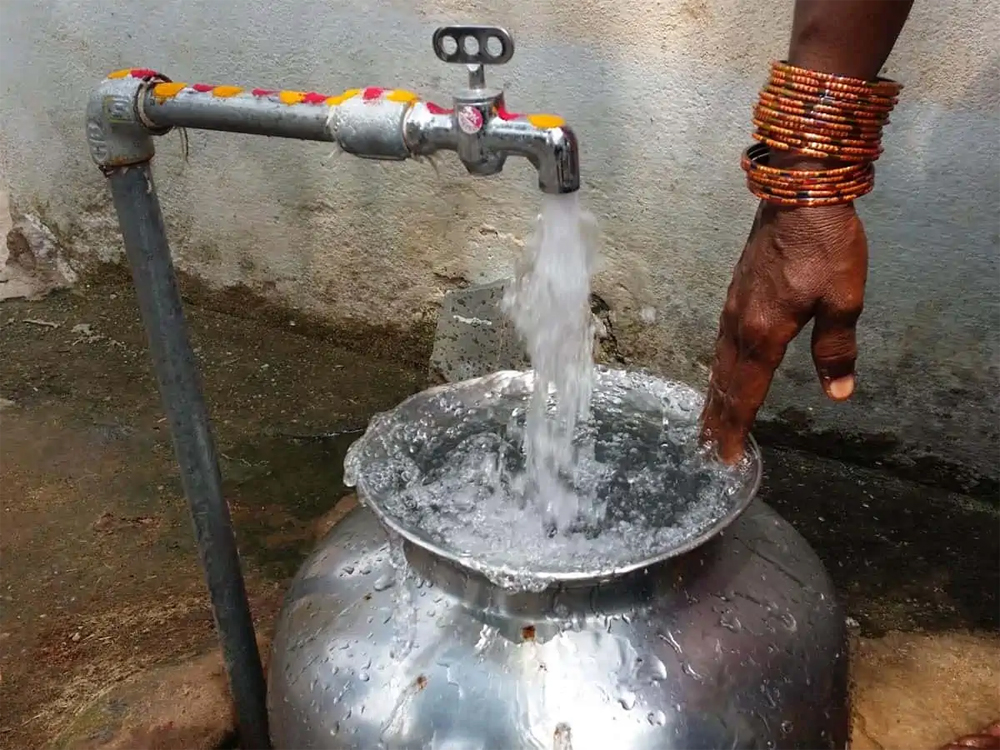
Tap water extended to 12.28 crore rural households in India
Tap water extended to 12.28 crore rural households in India in last 5 years
Around 12.28 crore rural households in India have been provided with tap water connections during the last five years under the Centre’s Jal Jeevan Mission
NEW DELHI — Around 12.28 crore rural households in India have been provided
with tap water connections during the last five years under the Centre’s Jal
Jeevan Mission taking the number of such homes to more than 15.51 crore which
constitutes 79.91 per cent of the total rural households in the country,
according to information tabled in Parliament.
This represents a huge jump as at the start of Jal Jeevan
Mission in August 2019, only 3.23 crore or 16.8 per cent of rural households
were reported to have tap water connections, Minister of State for Jal Shaktu
V. Somanna said in a written reply to a question in the Lok Sabha.
The Government of India in partnership with states and
UTs is implementing Jal Jeevan Mission (JJM) Har Ghar Jal to make provision of
potable water to every rural household of the country, through functional tap
water connection at a service level of 55 litre per capita per day (lpcd), of
prescribed quality on a regular and long-term basis, the Minister said.
He also highlighted that for developing in-village water
supply infrastructure, water resource management, source strengthening,
distribution network, treatment plant, unskilled, semi-skilled and skilled
human resource is required in rural areas. Moreover, there has been procurement
of material for the construction of water supply schemes therein generating
employment at different levels throughout the country, boosting the
manufacturing activities, thus, the economy and in the long run will enhance
‘ease of living’ in rural areas.
The Minister also highlighted the positive impacts of Jal
Jeevan Mission as assessed by reputed national and international institutions.
The World Health Organisation (WHO) estimated that achieving saturation under
JJM will result in savings of more than 5.5 crore hours of time every day,
which is otherwise spent in the collection of water for household needs,
primarily for women.
WHO has also estimated that ensuring safely managed
drinking water for all households in the country could prevent nearly 4,00,000
deaths caused by diarrheal diseases, leading to savings of approximately 14
million Disability Adjusted Life Years (DALYs) on account of the lives so
saved.
A report released by the Indian Institute of Management
Bangalore, in partnership with the International Labour Organisation (ILO),
estimates that implementation of the Jal Jeevan Mission will result in 59.9
lakh person-years of direct and 2.2 crore person-years of indirect employment
during the capex phase of JJM. Furthermore, the operation and maintenance of
the mission is likely to generate 13.3 lakh person-years of direct employment.
Similarly, Nobel laureate Prof. Michael Kremer has
published a research paper and has concluded that the coverage of all
households with safe water is likely to lead to an almost 30 per cent reduction
in mortality among children below the age of five years, amounting to 1,36,000
lives saved annually.
The Minister also said that to ensure the long-term
sustainability of infrastructure created, quality material and quality
construction are being ensured through third-party inspection before making
payment. Moreover, to instil a sense of ownership among the rural communities
and Panchayats, the aspects of village-level planning and community participation
in all decisions pertaining to water supply systems have been included in the
design of JJM.