


Seventh international Naga culture symposium highlights need to preserve traditional ecological knowledge.
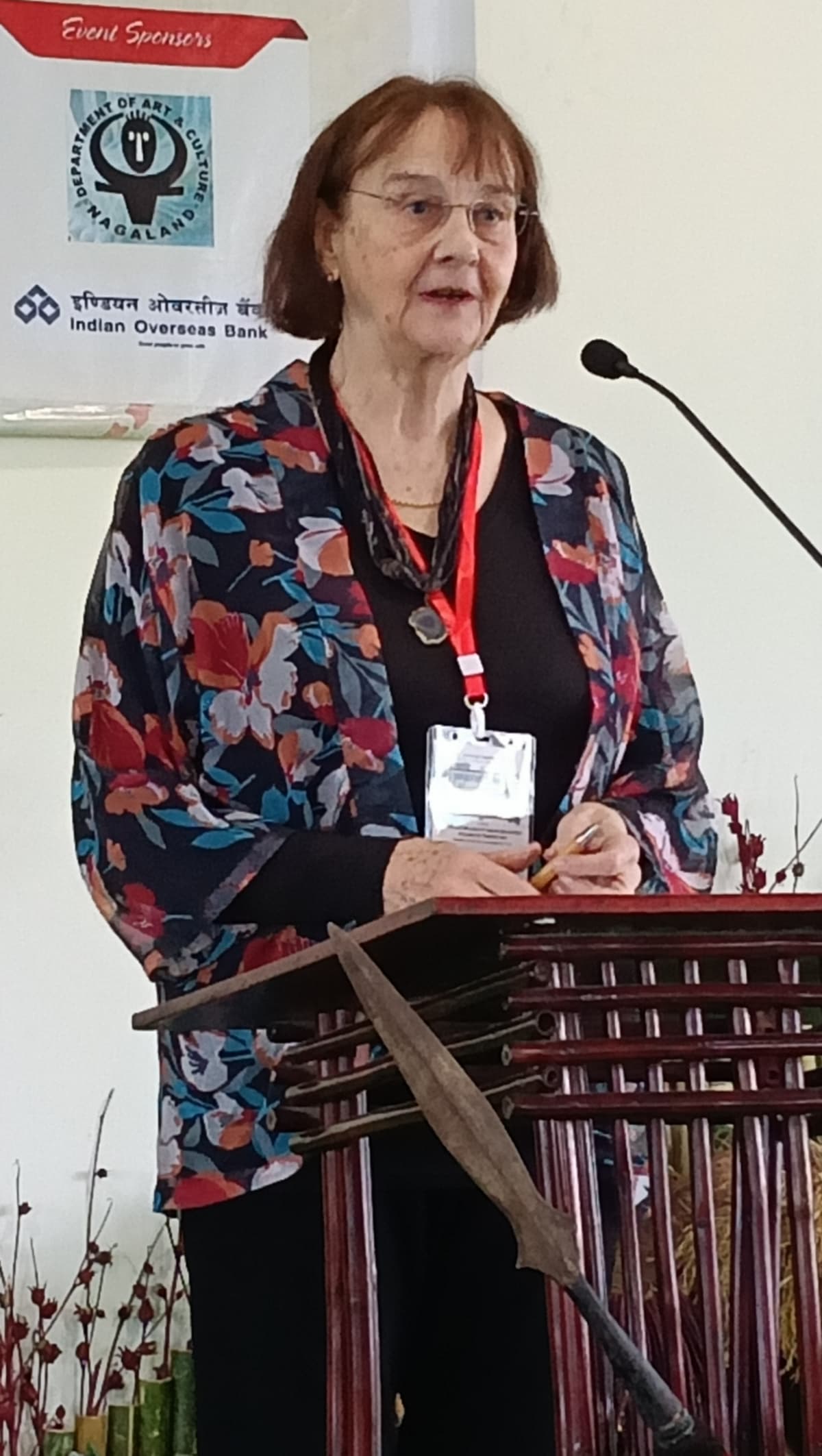
DIMAPUR — Noting that schooling, migration and westernised lifestyles disrupt inter-generational learning, the executive vice president and executive director of The Highland Institute, Kohima, Catriona Child, has underlined an urgent need to preserve traditional ecological knowledge (TEK) for cultural continuity, ecological resilience and climate adaptation in Nagaland.
She described TEK as a cumulative body of knowledge practice and belief about the relationships between living beings (including humans) and their environment, which is passed down through generations by cultural transmission.
She stated this while delivering the keynote address at the two-day 7th international Naga culture symposium, organised by the North East Christian University (NECU) on Friday on the theme “Naga culture, identity and globalisation: policies and perspective.”
Catriona made the presentation basing on the Earthkeepers Project (2023–2025), a case study led by early-career indigenous researchers based at The Highland Institute, which examined the methodological, ethical and practical challenges in traditional ecological knowledge research in Nagaland using a collaborative, non-extractive approach.
Also read: Need to build a skilled and future-ready Nagaland — Advisor Longkumer
She stated that TEK was formerly dismissed by mainstream scientific community describing it as anecdotal, old-fashioned or unscientific. She, however, stated that it has now come to be recognised as critically important by scholars especially in relation to sustainability, biodiversity protection and climate adaptation.
She explained that Nagaland — a global biodiversity hotspot — is home to 17 indigenous tribes whose centuries-old ecological knowledge sustains forests, farms and water through customary governance and community stewardship rooted in daily cultural practice.
She also said colonial portrayals of the Nagas as ‘primitive’ or ‘headhunters’ shaped global perceptions and influenced later academic work as well as impacting internal identity politics. According to her, research was often extractive, removing cultural knowledge for western use without accountability to communities.
She added that today, Naga scholars and indigenous researchers have challenged colonial narratives and demanded ethical, community-led research rooted in local agency, shared decision-making and responsibility to the people whose knowledge was studied. She, therefore, stated that research must be accountable to indigenous peoples and not external agendas.
Laying the principles for decolonial practice, she suggested effective collaboration with indigenous communities based on respect for cultural protocols and local knowledge, reciprocity that benefits communities, relational accountability built on trust and reflexivity about researcher's positionality.
Despite certain challenges faced during the project, she stated that it laid the foundation for stronger community leadership in future work.
This was followed by conversation with Dr. Easterine Kire, poet and writer on Naga literature.
Papers were also presented by Nutsolu Swuro, research scholar of Political Science; Dr. Shonreiphy Longvah, associate professor of Political Science at St. Joseph University, Chümoukedima; Khrutalu Dozo, research scholar of Political Science; Dr. Achanger Aier, professor of Political Science at St. Joseph University, Chümoukedima; Srijita Ghosh, research scholar at Assam University, Silchar; and Tialong Changkiri, research scholar at Nagaland University, Lumami.
The first day of the symposium concluded with a panel discussion on the theme “Act East Policy: Perspectives from northeast.”