 Our Correspondent
Kohima, Oct. 15 (EMN):
Our Correspondent
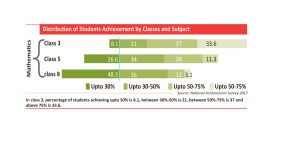
Kohima, Oct. 15 (EMN): In a worrying indication, the National Achievement Survey for 2017 jointly conducted by NCERT and Unicef in Nagaland has shown that on an average only 64% of students in class 3 responds to mathematics correctly; 46% in class 5; and 34% in class 8.
The findings were shared during a state-level workshop for mathematics teachers in Kohima on Monday. It also identified ‘the mismatch between teachers' teaching style and students’ learning style as one of the important factors of poor performance in maths.’
Unlike in government schools, math teachers in private schools use variety of teaching methods, conduct frequent tests and provide more attention where needed, it informed.
To address the issue of ‘math phobia’ and poor performance of students in mathematics in government schools, the department of School Education has organised a three-day state-level workshop for math teachers in government schools at Ura Academy Hall, Kohima.
The primary objective of the workshop is to highlight problems related to teaching and learning mathematics, to introduce constructivist approach of teaching-learning, explore how easily can teachers introduce different topics of mathematics in class etc., it was informed.
The department has also come up with a study material titled ‘Ready reckoner on basic secondary mathematics’ authored by Dr. Sandip Ratna, an assistant professor at SCTE, Kohima. It comes in the form of a guide for teachers “to impart learning of mathematics in a more systematic and simplified manner to boost effective learning outcome.”
According to Ratna, the reasons for poor performance in government schools include the students’ poor concept of basic math, mundane teachers’ teaching method, mismatch between students’ learning style and teachers’ teaching style, irregular students practice and class test.
Referring to the data showing students’ performance in math as better during the early stages, he asserted that it is necessary to find why students’ performance in math worsens as they grow.
Strongly emphasising on the need to tackle ‘math phobia’ among students, Ratna said it is important to address it early by ‘relating complex concepts to basic concept’ and using wide variety in solving problems.
“Not all students like math, but a good math teacher has the power to change that,” said Ratna and explained that a good math teacher can help students, who have traditionally struggled with arithmetic, build confidence in their skills.
According to him, the most important ingredients were ‘care and concern’ for the students while reminding that ‘teaching focuses less on the content being taught than the students being taught.’
With Dr. Ratna; Elizabeth, an assistant professor at SCTE in Kohima; and Sanjay Sinha, the vice principal of DIET, Mokokchung as the resource persons, the workshop will deal on various topics like discussion on problems of teaching mathematics, what math teachers should know, news trends in teaching-learning, planning lessons using constructive approach etc.


