


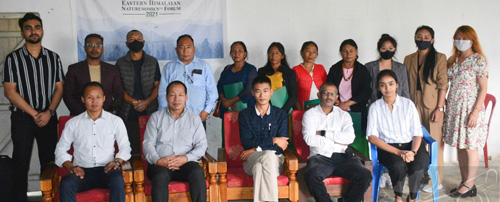
Dimapur, Aug. 2 (EMN): Nagaland Regional Eastern Himalayan Naturenomics™ Forum 2021, organised at Sukhai village of Zunheboto district on August 1, was aimed at bringing together community voices, government officers, SHG groups, farmers and indigenous organisations towards understanding community conservation model in Sukhai, and exploring opportunities for a sustainable future.
According to a DIPR update, the theme of the forum was “understanding the socio-economic conservation models for biodiversity preservation in Community Conserved Areas”.
It said that the Nagaland Regional Eastern Himalayan Naturenomics™ Forum was held in partnership with the Tizu Valley Biodiversity Conservation and Livelihood Network (TVBCLN) and The Energy and Resources Institute of India (TERI).
It said that Balipara Foundation conducted the regional colloquium, adhering to the SOPs and norms regulated by Nagaland state government. A total 35 participants- including resource persons, community representatives and volunteers registered for the programme.
“Sukhai has brought into light the rich biodiversity the village has, and how every effort has been taken towards mobilising the community members towards preserving the land,” it read.
Chairman of Sukhai CCA and leader to Tizu Valley Biodiversity and Community Livelihood Network (TVBCLN), Ivan Jimo highlighted the indigenous culture and tradition of Sumi Naga communities, which are interlinked to nature since time immemorial, it said.
“For a conservation model to be successful, as much the indigenous knowledge of the community is essential, the participation and engagement of indigenous women in the decision-making process is an important aspect for effective implementation”, Zhimo stated.
A presentation was made on “Biodiversity vis- a- vis Shifting Cultivation to Nagaland” by Pikato V Jimo, the POU of Nagaland Empowerment through People Economic Development (Neped) and general secretary to Sukhai CCA.
Speaking about the traditional farming practices once practiced in the community conserved areas (CCA) across Sukhai and nearby villages, Jimo stated that ‘conservation won’t be successful, until we provide livelihood options’.
He stated that ‘shifting cultivation does not always degrade the ecology, and it is a far more economically and biologically sustainable way of farming when compared to settled form of agriculture’.
Speaking on Article 371A, and land ownership in Nagaland, Chief Conservator of Forest (Environment, Biodiversity & Research), Nagaland, Supongnukshi, stated that forest and ecosystem management in the state involves many stakeholders like Forest department, Agricultural department and civil society, amongst others.
“As per Forest Survey of India report, 2019, over 75.31 % of the total geographical area of Nagaland is under forest cover. Open Forest category of forest lands largely fall under the jhum fallow lands”, he informed.
It said that the Nagaland regional EHNF witnessed insightful and informative deliberations from an eminent panel of speakers like Dr. Rakesh Kumar Chaursia- Head and Sr. Scientist to Krishi Vigyan Kendra (KVK) Nagaland, Heirang Lungalang- Chairman to the Nagaland Community Conservation Area's Forum (NCCAF) and Rokongulie Meyase - Professional bird guide and tour operator from Khonoma CCA.
“The grassroot colloquium was strategically designed and orchestrated to focus and explore indigenous perspectives on rural futures context such as biodiversity conservation, community led habitat restoration, harmonic coexistence with nature, grassroots climate action, resilient livelihood through sustainable agricultural practices, traditional handloom and handicrafts. It tried to delve into interesting case studies of the fringe communities in context to indigenous forest conservation, governance and management through Naga traditional customary laws and practices,” it read.
The forum was organised by Balipara Foundation, a non-profit organisation from. Established in 2007 Balipara Foundation focuses on community development and conservation of natural resources in the region through the concepts of Naturenomics™ and Rural Futures, it informed.