


Airstrikes battered Iran and Iranian missiles, and drones targeted Israel's Tel Aviv and sites across the Mideast on Tuesday, even as President Trump said the US was in talks end the war
Pakistan says it is ready to host talks
DUBAI (AP) — Airstrikes battered Iran and Iranian missiles, and drones targeted Israel's Tel Aviv and sites across the Mideast on Tuesday, even as President Donald Trump said the United States was in talks with the Islamic Republic to end the war.
With thousands more US Marines on their way to the Gulf, both sides firing barrages and Iran denying any negotiations are taking place, the war's tempo remained high a day after Trump delayed his self-imposed deadline for Iran to reopen the Strait of Hormuz. Tehran's chokehold on that crucial waterway has snarled international shipping, sent fuel prices skyrocketing, and threatened the world economy.
Pakistan offered to host diplomatic talks, but Iran remained defiant, vowing to fight “until complete victory.”
Any talks between the US and Iran would face monumental challenges. Many of Washington's shifting list of objectives — particularly over Iran's ballistic missile and nuclear programs — remain difficult to achieve. Meanwhile, it's not clear who in Iran's government would have the authority to negotiate — or be willing to, as Israel has vowed to continue taking out leaders after killing several.
Also read: PM Modi and US President Trump discuss West Asia situation, Strait of Hormuz
Iran remains highly suspicious of the United States, which twice, under the Trump administration, has attacked during high-level diplomatic talks, including with the Feb. 28 strikes that started the current war.
Pakistan says it is ready to host talks
Pakistan's Prime Minister Shehbaz Sharif wrote on X that his country is ready to “facilitate meaningful and conclusive talks” to end the Iran war.
The US had agreed “in principle” to join talks in Pakistan, according to three Pakistani officials, one Egyptian official and a Gulf diplomat, while mediators were still working to convince Iran. The Pakistani officials said the “quiet diplomacy” had grown more complicated since news of it leaked.
The officials spoke on condition of anonymity because they were not authorised to provide the details to the media.
Iranian Foreign Minister Abbas Araghchi's office said he has been talking about the war this week with his counterparts in several countries. But Iranian Parliament Speaker Mohammad Bagher Qalibaf called the idea of negotiations “fake news” — and the spokesman of Iran's top military command issued a newly defiant statement.
“Iran's powerful armed forces are proud, victorious and steadfast in defending Iran's integrity, and this path will continue until complete victory,” Iranian state television quoted Maj. Gen. Ali Abdollahi Aliabadi, as saying on Tuesday.
Aliabadi did not say what victory would look like, but Iran's military could be trying to warn against offering concessions in any possible negotiations.
The Egyptian official said efforts are centred on “trust-building” between the US and Iran, with the aim of bringing about a pause in fighting. Israel is not involved.
The official, who is involved in the efforts, said the priority is to prevent attacks on both Iran's and Gulf Arab countries' energy infrastructure and that they were working on a “mechanism” for Iran to reopen the Strait of Hormuz.
Talk of negotiations briefly drove down oil prices and boosted stocks. But that respite was short-lived, with the price of Brent crude, the international standard, nudging back over USD 100 a barrel Tuesday, up nearly 40 per cent since the war started.
Iran hits Israel and Gulf neighbours while Israel attacks Beirut
Israel said it carried out an extensive series of strikes on Iranian “production sites,” without providing more information. In Tehran, a massive blast was heard in northern neighbourhoods and another in the city centre.
Iran also fired multiple waves of missiles at Israel.
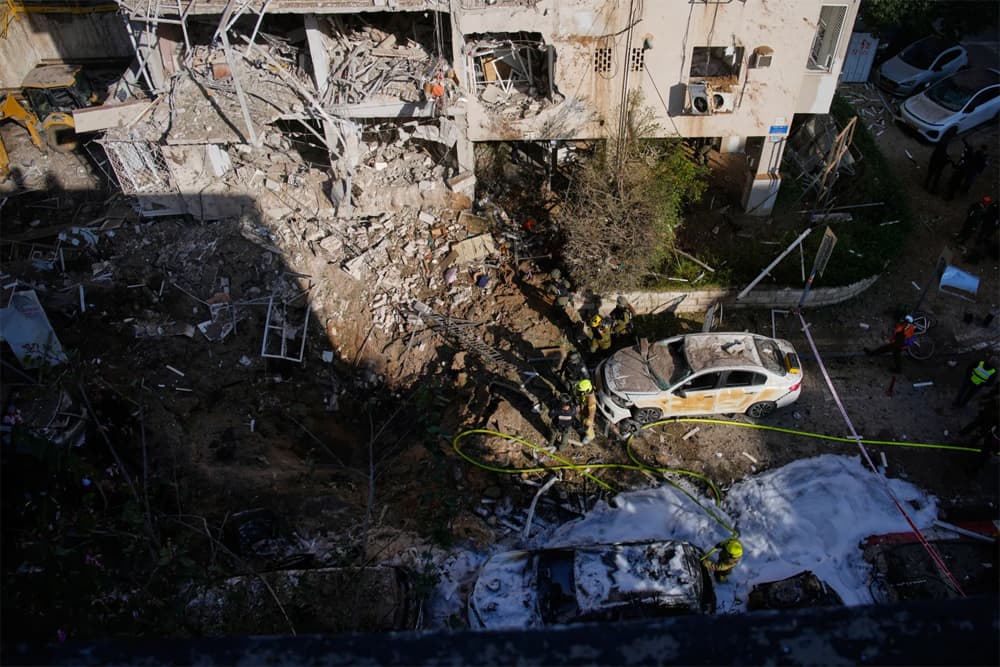
In Tel Aviv, a missile with a 100-kilogram (220-pound) warhead slammed into a street in the city centre, blowing out windows of an apartment building and sending smoke billowing. Four people suffered minor wounds, rescue service worker Yoel Moshe said.
“It feels like you're a (sitting) duck, waiting for the missiles to hit you, or someone next to you,” said Amir Hasid, emerging from a shelter.
In Kuwait, power lines were hit by air defence shrapnel, causing partial electricity outages for several hours. Bahrain said it was attacked with missiles and drones, the United Arab Emirates said air defence systems responded to similar attacks, and Saudi Arabia said it destroyed Iranian drones targeting its oil-rich Eastern Province.
Israel pounded Beirut's southern suburbs, saying that it was targeting infrastructure used by the Iran-linked Hezbollah militant group.
A strike on a residential apartment southeast of the Lebanese capital killed at least three people, including a 3-year-old girl, according to the Lebanese Health Ministry. Another five people were killed in the south.
Meanwhile, Lebanon declared Iran's ambassador persona non grata and ordered him to leave by Sunday.
The dramatic move offers the latest evidence of the deterioration in relations between Lebanon and Iran. Iranian flights have been banned from landing in Lebanon, out of fear that they would carry weapons or funding for Hezbollah, and some top Lebanese government officials have been critical of Tehran's role in the country, accusing it of dragging Lebanon into another war with Israel.
Authorities say Israeli strikes have killed more than 1,000 people in Lebanon and displaced more than 1 million.
Iran's death toll has surpassed 1,500, its Health Ministry has said. In Israel, 15 people have been killed. At least 13 US military members have been killed, along with more than a dozen civilians, in the occupied West Bank and Gulf Arab states.
Marines are on the way to the Persian Gulf
Trump's announcement came as thousands of Marines headed to the region, raising speculation that the US may try to seize Kharg Island, which is vital to Iran's oil network. The US bombed the Persian Gulf island more than a week ago, hitting its defences but saying it had left oil infrastructure intact.
Iran has threatened to mine the Gulf if the US appears to be on the verge of landing troops.
Trump said he would hold off on a threat to bomb Iran's power stations while talks unfold — a delay that could be aimed at buying time for the Marines to arrive, the New York-based think tank the Soufan Centre wrote in an analysis.
However, the centre also noted that “Trump could be actively seeking an offramp.”
Trump has said he has no plans to send ground forces into Iran but has not ruled it out. Israel has suggested its ground forces could participate in the war.