[caption id="attachment_282681" align="aligncenter" width="565"]
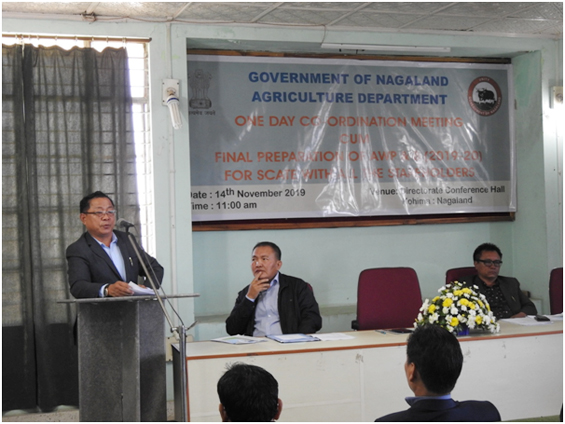 M Ben Yanthan addresses the meeting on Thursday, in Kohima.
[/caption]
Our Correspondent
Kohima, Nov.14 (EMN): The department of Agriculture met to prepare its annual working plan and budget for 2019-2020 for “scaling up of agricultural engineering technology for smallholder farmers,” or Scate, with stakeholders, on Thursday in the directorate of Agriculture in Kohima.
The director of Agriculture M Ben Yanthan said the Scate will be implemented in five states that have relatively higher levels of poverty, low farm power availability, and low appropriate technology development and diffusion. The official said Assam and Nagaland and three eastern states Chhattisgarh, Odisha and Jharkhand have been selected.
Nagaland is in the category-IV states ie., states with less than 1.00 KW/ha farm power. Nagaland, Jharkhand and Chhattisgarh states have a large area of hill agriculture but low appropriate technology diffusion and adoption. He said all the states have significant tribal population where exposure to and adoption of technology is even less than that of the national or state average.
The project will be implemented in 31 selected districts in the five states, he said. The selected districts are Mon, Longleng, Zunheboto, Wokha, Kiphire, Phek, Mokokchung and Kohima. The total project cost is USD 124.27 million for 31 districts of five states, which will be funded by the IFAD, through the government of India. The project period is from 2019-20 till 2025-26.
The government servant maintained that India, despite being the third largest economy in purchasing power, parity terms, still depends on agriculture. The current focus of the government is to double farmer’s income by 2022, and promoting agriculture mechanisation is one of the important interventions to achieve this goal.
Further, Yanthan said that the project will reach out to 400,000 households. The project will significantly reduce agricultural production costs by 31 percent, incremental production ranging between 11-15 percent, and improve access of small and marginal farmers to the farm mechanisation services and agriculture-based primary processing.
The official said it has dedicated activities for young women and men. The project will provide fellowships for youths to work on research and innovations in agriculture-engineering technologies which will prioritise youth in the selection for lead farmers and in training as mechanics to establish service centres.
The project will have two components: (i) Participatory technology development; arid (ii) Business models for scaling up appropriate AE technologies. Under the Participatory Technology Development component, the project will develop an inventory of location specific AE technologies, capacity building by ICAR to create AE research interest amongst among the youth through awards and fellowships; develop national technology forums, protocols and training manuals, and train Scientists, engineers, or economists to undertake techno-economic assessments of technologies and demonstrations.
The project will establish an innovation platform to promote new technology, development from concepts to prototypes; adaptation/customization of existing technologies; and existing prototypes to move into commercial production.
The official highlighted the components of business models for scaling up appropriate AE technologies. The project will support training lead farmers and organisations of lead farmers-led field days through the Krishi Vigyan Kendras. The project will also support individual ownership of AE machinery equipment, other than prime movers, by small holders.
Technological opportunity is to increase production in the state, he said. “Through this scheme gender friendly will reach to the farmers at their door steps and that the department will gradually able to acquainted the process of implementing the programme scheme which will also boost in the field of agriculture in our state.”


