[caption id="attachment_119895" align="alignleft" width="550"]
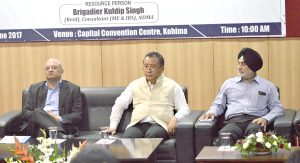 (L-R) Chief seretary Pankaj Kumar, Home commissioner Temjen Toy and NDMA consultant Brig. Kuldip Singh.
[/caption]
Our Correspondent
Kohima, June 7 (EMN): Chief Secretary Pankaj Kumar today said despite serious efforts being made to increase the state’s capacities to deal with natural and manmade disasters, Nagaland is still underprepared even today for an event like an earthquake of huge magnitude.
Speaking at the inaugural session of a two-day stakeholders workshop on Incident Response System (IRS) at the Capital Convention Centre Kohima, the chief secretary said overlaying all the different aspects of disasters, the Nagaland faces the big challenge of earthquakes, which can occur anytime, particularly as the state lies on a vulnerable zone. He expressed concern that when it comes to earthquake resistant structures, the state’s progress is still not enough and underscored that much more needs to be done. “It is only a matter of good fortune that at most places, the hill-type structures themselves are of such a nature that they are not so vulnerable but there is a fast conversion to ‘pucca’ structures, we have to do more to make them earthquake resistant,” he stated.
Sharing the challenges that the state faces, Kumar pointed out that Nagaland has a peculiar weather cycle, roughly categorised into two seasons- the ‘rainy season’ from April to September and the ‘dry season’ from October till March. Both these seasons, he said, are associated with different kinds of risks and disasters, such as landslides and floods during rainy season while the dry season sees the problem of drought in the agricultural areas and fire incidents in forests and inhabited areas.What the state has been experiencing during the recent years is that with the change in climate pattern, such events are becoming more frequent and their severity I also increasing, he stated while also expressing concern that the degradation of the forest cover is also contributing to the resistance of the terrain to deal with the shocks that come to the terra firma. Besides these, he remarked that there are freak incidents such as lightning which destroys property and sometimes are fatal to humans; the frozen lake incident at Dzukou valley wherein young lives were lost; and more recently the flooding in Meluri district where four lives perished.
He also highlighted the structure of the state disaster management agency, mentioning in particular the recently set up permanent organisation State Disaster Response Force (SDRF) which is primarily manned by the Home Guards personnel and the trainings for armed personnel, village guards and village youth on disaster response.
On IRS, he suggested that more line departments should be taken on board, taking into account the roles they could play, such as the Public Works Department (PWD), Irrigation & Flood Control and also some coordination with the security forces to aid the civil administration, first responders and the SDRF.
Also stressing on the importance of conducting mock drills, he said such demonstrations help in putting one in a simulated situation and test one’s responses. Kumar is of the view that learning how to respond to incidents theoretically is different from how one responds in an actual situation.
In his opening remarks, resource person of the programme, National Disaster Management Authority (NDMA) consultant for mock exercises & IRS, Brigadier Kuldip Singh said natural disasters impact more devastatingly on populous and developed places. He explained that the Indian sub-continent is one of the world’s most disaster prone areas, ranking fourth, after China, the United States and Philippines. The vulnerabilities of the country are being compounded by expanding demographic changes, socio-economic conditions, unplanned urbanisation, lack of stringent building norms and non-adherence to existing norms, environment degradation, climate change etc in addition to chemical biological radiological and nuclear and other manmade disasters. He said that any natural or manmade disaster has the potential to wreck immense damage- social and economic havoc which in turn impinges on the sustainable development of the place. This is why, he stated, disaster management is today accompanied by disaster risk reduction (DRR) which have become a political imperative, therefore all future infrastructures whether private or public should be disaster resilient.
The NDMA official also gave a brief background on the formation of the IRS, which he said, was an “Indianised version” of the United States’ Incident Command System. While stating that many states and UTs were yet to adopt IRS, he said it was heartening to see the IRS being ‘very capably’ co-opted by the state of Nagaland. He observed that the state has gone beyond just co-opting the IRS by covering 159 villages in community first responders’ programme and expecting to expand double that number by the end of 2017.
He also emphasized on the necessity of investing in DRR, for which, he said the benefits are seen only after disasters strike. He said the private sector and other stakeholders have a huge role to play including local governments from the standard disaster management to a more holistic risk resilient development practices.
The official also highlighted the vision and mandate of the National Disaster Management Authority on the occasion.
Earlier, Home Commissioner and additional chief secretary, Temjen Toy delivered the welcome address.
The workshop is being organized by the Nagaland State Disaster Management Authority (NSDMA) in collaboration with the National Disaster Management Authority (NDMA), Government of India.


