[caption id="attachment_111900" align="alignleft" width="550"]
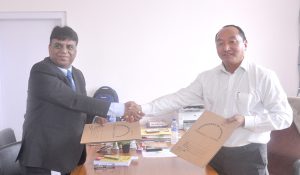 Ashish Kumar, Manager of Project (I&C) of International Centre for Automotive Technology (Left) and Transport Commissioner Elias T Lotha seen during the signing of the tripartite Memorandum of Understanding at the latter’s office in Kohima on April 28.
[/caption]
Our Correspondent
Kohima, April 28 (EMN): In an attempt to improve road safety and further check on emission standards, the Ministry of Road Transport and Highways (MoRTH), Government of India, and Department of Transport, Government of Nagaland in association with the International Centre for Automotive Technology (ICAT) signed a tripartite Memorandum of Understanding (MoU) today at Kohima.
With the signing of the agreement, concerned stakeholders (MoRTH, DoT and executing agency) have agreed in principle to push for a commensurate improvement in terms of emission and safety norms, which in turn will also be environmental friendly.The new project is an initiative of MoRTH and the same tripartite agreement will be signed with all the states of the country, it was informed.
The motor vehicle emission standards in India, ever since it was enforced by the central government in 1991, have been updating the emission and safety norms for new vehicles. However, in spite of the introduction of the Indian safety and emission standards for the new vehicles, there has been no commensurate improvement noted in ambient air quality levels and reduction of road related accidents, the MoU read.
As per the papers laid down in the MoU, the new project was necessitated as the existing vehicle inspection system in India has become inefficient with several weaknesses.
It has been found out that most of the vehicle inspection centres do not have any instrument or equipment to carry out proper inspection of the vehicles. To make it worse, there are no set of procedures for inspection and quite often, the decision whether a vehicle is fit or not is left to the discretion of the vehicle inspector, Ashish Kumar, an official representing ICAT pointed out. Kumar is the manager of Project Inspection & Certification (I&C).
“There is no mechanism at present for auditing, monitoring performance and capability of these centres. There are no organised industries for repair and maintenance of vehicles. Sadly, the numerous roadside mechanics which are available were also found out to be running with inadequate equipments,’ Kumar said.
Addressing media persons before signing the MoU, Kumar made his observation known stating that “at present only visual inspection is carried out by the inspectors who have no regular training for skill up-gradation.”
Going by the present practice, all transport vehicles are required to undergo fitness test every year after two years of initial registration. Besides, all vehicles are required to undergo mandatory idle emission test or free acceleration smoke test, as applicable every six months after one year of initial registration, Kumar informed.
Even as the new technology vehicles meeting stringent emission and safety standards being introduced in the market, Ashish Kumar pointed out that “there are still a lot of old vehicles operating on the roads without adhering to the safety norms.”
“In spite of the introduction of new technology vehicles, the quality of ambient air did not improve to the desired levels. Any vehicle, which is not maintained well would be an environmental and safety hazard to the society. It has been observed that a small quantity of ill maintained vehicles attribute to a great extent in ambient air quality problems and thereby leading to the deterioration of urban air quality,” the MoU read adding that “even new vehicles with the state-of the-art technologies, deteriorate in service and needs to be maintained properly if they are to continue to operate at the desired emission levels.”
Vehicle inspection is mandatory for the transport vehicles only, while non transport vehicles do not have to undergo fitness test for the first 15 years of its life,” it was informed.
Kumar also pressed the need for existence of a proper control mechanism to audit/ inspect the Pollution UNDER Control (PUC) centres. “The criteria for authorising/ registering a PUC centre needs to be augmented,” he added.
“The central government is serious enough to solve issues concerning emission everywhere across the country,” he added.
As per the MoU, the MoRTH has decided to set up model automated Inspection & Certification (I&C) Centre on a pilot basis in India for conducting fitness tests of motor vehicles. It was informed that Dimapur has been selected as the ICAT centre for Nagaland, adjacent to the new DC complex, Chumoukedima.
Once the MoU becomes effective, the executing agency - ICAT - will support the State government in realising this endeavour of the MoRTH, said Ashish Kumar.
Under the MoU, all commercial vehicles in the State, including taxis, will have to undergo the test to prove that they are fit to ply the roads. And this will be made compulsory,” Ashish Kumar said.
Transport Commissioner, Elias T Lotha, while stating that road safety is of paramount importance, added that “many old vehicles are plying on the roads with unfit conditions.”
“Through this initiative, we will make sure that vehicles are 100% fit to ply on the roads,” Lotha stated.
Towards the implementation of the project, the executing agency will be given two years time to operate as project in charge; however, with the completion of the given period, the State government will take responsibility of the model Inspection and Certification centre, if not it can identify a suitable agency/ private partner for operating of the model I&C centre.
The officials of the concerned stakeholders have the target to enforce the new agreement within 11 – 12 month’s time. In the process, the State government will carry out the civil construction works.
As per the agreement, the central government will provide funding, while the State government will bear the cost of land and also ensure availability of boundary wall, approach roads, HT power line, water, telephone line, internet line, etc. As for ICAT, it will act as the facilitator for establishment of capacity inspection and certification centres.
Under the MoU, there is also a provision where the ICAT get attached with some garages recognised by the State government. These garages will be paid a project management fee for services rendered as determined by MoRTH.
ICAT was represented by Ashish Kumar, manager, Project Inspection & Certification, while the State government was represented by Transport Commissioner, Elias T Lotha in place of Commissioner & Secretary for Transport department, Neihu C Thur, who couldn’t make his presence due to ill health. The joint secretary of MoRTH, Abhay Damle, who was to represent the central government, also failed to make it on the day.


