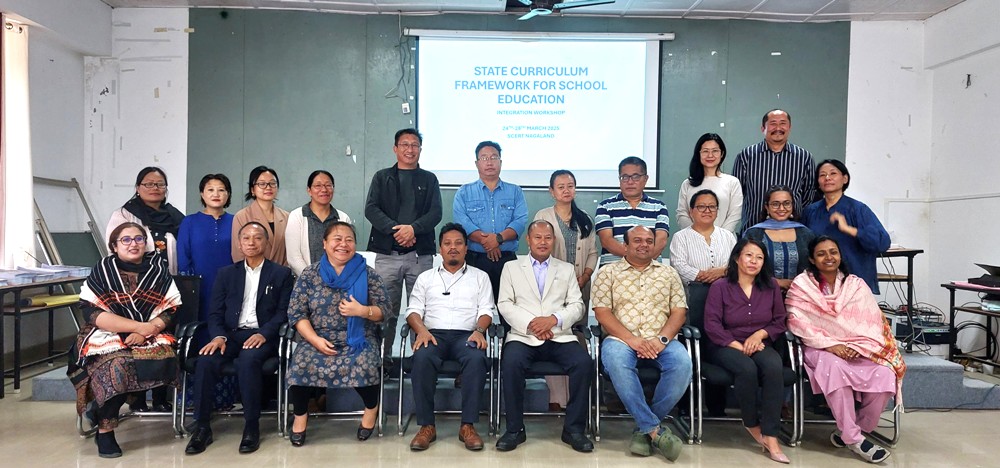
T Lima Longkumer, Dr Zavise Rume, Vikas Roy and others at
SIEMAT Hall in Kohima on Monday. (EM Images)
KOHIMA — A five-day State Curriculum Framework
for School Education (SCF-SE) Integration Workshop is underway in Kohima,
having commenced on Monday at the SIEMAT Hall, SCERT Nagaland.
Participants from the State Council of Educational Research
and Training (SCERT), Directorate of School Education (DoSE), District
Institute of Education and Training (DIET), and others, alongside their
partners from Azim Premji University, are taking part in the training, which
will conclude on March 28.
In his inaugural speech, Additional Director SCERT Nagaland,
T Lima Longkumer, stated that one of the first major steps taken toward
implementing the National Education Policy (NEP) 2020 was the development of
curriculum frameworks at both the national and state levels. Recognising the
importance of contextualising education according to the specific needs of each
state, the Ministry of Education directed all states in May 2021 to develop
four curriculum frameworks, including the SCF-SE.
He informed that in Nagaland, SCERT was appointed as the
nodal agency to coordinate this extensive and collaborative process, wherein a
steering committee was constituted to oversee the development work, ensuring
that all voices and perspectives were represented.
He added that the foundation of this framework lies in 25
position papers, developed by 25 focus groups comprising experts from DoSE,
SCERT, DIETs, NBSE, Nagaland University, the Department of Higher Education,
the Department of Social Welfare, the Department of Youth Resources and Sports,
as well as various NGOs. These papers covered diverse aspects of education,
providing the theoretical and policy foundation for curriculum development.
Following this, task groups were formed to develop different
sections of the SCF-SE, including subject-specific task groups for areas such
as Language Education, Science Education, and Art Education, as well as groups
focusing on broader themes like aims and curricular areas and school culture
and processes. These groups, consisting of members from various agencies and
institutions, have been working over the past year.
During these, two five-day workshops were conducted,
bringing together all task group members to refine and develop their respective
sections of the SCF. In addition to these workshops, task groups have been
holding independent discussions, meetings, and consultations with experts and
stakeholders to ensure a well-rounded and inclusive curriculum framework. Their
efforts culminated in the submission of their respective sections in early
2025.
Longkumer acknowledged the crucial role played by Azim
Premji University throughout this process, providing academic, technical, and
pedagogical support. He expressed appreciation for their contribution in
guiding and strengthening the effort.
He pointed out that the ongoing workshop is focused on
integrating the separate sections developed by the task groups into a single,
coherent document—the final State Curriculum Framework for School Education. He
noted that the objective is to ensure that all sections align seamlessly,
maintaining consistency in language, structure, and vision while addressing the
specific needs of Nagaland’s education system.
During the workshop, participants will engage in
discussions, refine content, and ensure that the final SCF-SE is a
well-structured and comprehensive document.
The goal is to create a curriculum
framework that will serve as a guiding document for shaping school education in
Nagaland in alignment with NEP 2020.
Furthermore, he encouraged participants to actively
contribute, share their expertise, and engage in meaningful discussions to make
the curriculum framework robust, inclusive, and transformative.
Vikas Roy, faculty at Azim Premji University, noted that the
workshop has now entered the stage of consolidating curricular areas, building
on the work done in previous sessions. He added that participants would also
focus on addressing cross-cutting themes to ensure a cohesive framework.