


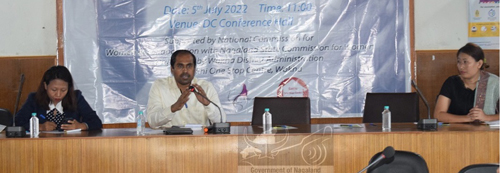
Dimapur, July 5 (EMN): Wokha district administration and Sakhi-One Stop Centre (OSC), supported by National Commission for Women, organised a one-day training and capacity-building programme for anti-human trafficking unit and other stakeholders dealing with prevention of human trafficking and rehabilitation of victims under Wokha district on July 5 at the conference hall of the deputy commissioner's office.
Delivering the keynote address, the deputy commissioner of Wokha, Ajit Kumar Ranjan, stated that no single organisation can handle issues such as human trafficking single-handedly. He, therefore, urged all stakeholders, NGO, and government agencies to come forwards and extend support in tackling such illegal crimes, stated a DIPR report.
Stating that those issues revolve around various departments in the government along with civil societies, he has sought good coordination between various agencies for detection of human trafficking right from the village level organisation to churches, police and other concerned government agencies. He also urged upon the stakeholders to work out a system to ensure that works are carried out in a coordinated fashion when it comes to detection, rescue, and rehabilitation of victims.
He also stated that rescued victims and families should be extended support from all sections to enable them come out from depression. He further suggested disseminating proper information on protection available to safeguard the victims of human trafficking and other acts against perpetrators committing the offense.
President of Wokha Bar Association, Oren Humtsoe, highlighted the concepts, different patterns, and dimensions of human trafficking, while Nzanbemo Kikon, sub-inspector of Wokha Police Station, and Shanchobeni P Lotha, nodal officer of Sakhi-OSC and WDLSA project assistant, dwelled on cases reported/ modus operandi of human trafficking in the district and the role of anti-human trafficking units and existing response system and legal mechanism to address human trafficking.
In the second session, DCPO from Social Welfare department, Moasenla; case worker of OSC, Thungbeni Kikon; and president of Lotha Eloe Hoho, Thungbeni Ngullie, spoke on rescue and rehabilitation services for trafficked women and children (schemes under MWCD, GOI); Psycho-social impact of trafficking and support system required; Role of civil societies in preventing human trafficking and challenges and way forward to address human trafficking.
The training programme was chaired by central administrator of OSC, Renthunglo Kikon.