[caption id="attachment_117701" align="alignleft" width="550"]
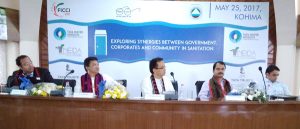 A section of panellists seen here at the seminar on sanitation that was conducted at the Civil Secretariat in Kohima town on May 25.
[/caption]
Dimapur, May 26 (EMN): Supporting the initiative of the government of India in promoting the Swachh Bharat Mission across India, the Federation of Indian Chambers of Commerce & Industry (FICCI), the apex body of Chambers in India, and the North East Initiative Development Agency (NEIDA), an initiative of the Tata Trusts, organised a seminar at the Civil Secretariat hall in Kohima on May 25.
The event was conducted on the topic “exploring synergies between government, corporate and community in sanitation.” The event was conducted with support from the Nagaland Public Health Engineering department.
The organisers issued a press release on May 25 informing about the event.
Around 1.2 billion or a sixth of the Earth’s human population lives in India and about half of this billion defecates in the open. The Indian government has demonstrated its political will to make India Open Defecation Free (ODF) by 2019 by launching the Swachh Bharat Mission (SBM) in both urban and rural capacities, the press release stated.
Hiranya Borah, deputy director general of the Ministry of Drinking Water and Sanitation, delivered the inaugural address. He spoke about the importance of improving the sanitation in Nagaland for improvement of health indicators of Nagaland. He said that Nagaland was “naturally a clean state in comparison to many other states of India,” according to the press release. He was stated as having hoped that Nagaland can achieve the Open Defecation Free status by October.
With 88.6% households having access to sanitary toilets, Nagaland is one of the better placed states in India. With the limelight on sanitation, several agencies and corporations have started to synergize efforts for better sanitation in various states including Nagaland and sanitation has become one of the major areas of focus for their CSR initiatives, the press release stated.
However, it stated, it was necessary to boost the preparedness of governmental agencies to cope up with the other states of India and to cope up with the changing dynamics of the sanitation sector. In Nagaland, the challenge would be to engage communities to take owner ship of changing habits and lifestyle related issues in order to ensure an ODF Nagaland.
Biswajit Chakrabarty, director of the North East Advisory Council-FICCI, was stated in the press release as having said that it was “wonderful” that the seminar on sanitation garnered huge response from so many stakeholders and welcomed the guests who included the deputy commissioners of Nagaland districts; brand ambassadors and village representatives from 11 districts of Nagaland besides industry members from Nagaland and key government officials from Nagaland, Assam and Mizoram.
Dr. Maong Wati Aier, secretary for Public Health Engineering department, during his special address at the seminar, talked about ‘progressive developments in the sanitation sector in Nagaland.’ He informed the gathering that six districts of Nagaland will become Open Defecation Free by June, 2017.
Biswanath Sinha, associate director of Tata Trusts and Divyang Waghela, Thematic Lead, Tata Water Mission highlighted the efforts of Tata Trust and NEIDA in states like Nagaland similar to their efforts in other states of India. Waghela stressed on the importance of communities in sanitation sector esp in state like Nagaland, the press release stated.
KD Vizo, commissioner and secretary for IT department, also spoke at the seminar. He highlighted the role of technology and said that Information technology has been changing the landscape of sanitation and in major administrative initiatives such as the Swachh Bharat Mission.
Around 150 stakeholders in the region from governments, including district commissioners, members of CBOs and private sectors were present at the deliberations, the press release added.


