[caption id="attachment_283399" align="alignnone" width="565"]
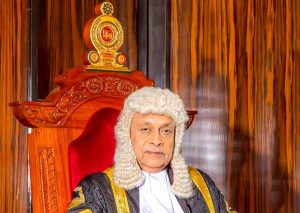 Sri Lanka Speaker Karu Jayasuriya
[/caption]
Colombo, Nov. 19 (PTI): Sri Lanka faces the possibility of a snap parliamentary poll, Speaker Karu Jayasuriya said on Tuesday, a day after Gotabaya Rajapaksa took over as the country's president.
Rajapaksa, 70, of the Sri Lanka Podujana Peramuna (SLPP) defeated Sajith Premadasa, 52, of the ruling United National Party (UNP) by more than 13 lakh votes.
The next parliamentary poll is scheduled only after August 2020. Constitutionally, a sitting prime minister cannot be removed unless he resigns. But following Rajapaksa's win, the need for a fresh parliamentary poll to allow the new president to form his own government has gained ground.
Speaker Jayasuriya on Tuesday said that after the presidential election victory of Rajapaksa, three options are being considered for the future functions of the Parliament.
The dissolution of Parliament on March 1 next year to pave for a snap parliamentary poll in April; dissolving Parliament immediately by providing two-third parliamentary support to dissolve the assembly; or allow the new president to form a caretaker Cabinet by resignation of the current prime minister.
Jayasuriya said he will convene a parliamentary party leaders' meeting to discuss all the three options and make a final decision. The date of the meeting is yet to be finalised.
Prime Minister Ranil Wickremesinghe is also under pressure to quit.
"As a party which honours democracy, we will discuss with parliamentary group, the Speaker and party leaders about parliamentary elections," a statement from Wickremesinghe's office said on Monday.
After his swearing-in as President on Monday, Rajapaksa in his speech made it clear that he needs his own government to implement his policies.
Sources in the ruling UNP said the party is hit by differences of opinion over their next move. There is no unanimity over whether the party should step down from the government or wait till Rajapaksa can constitutionally dismiss it.
UNP parliamentarian Nalin Bandara on Tuesday told reporters that the party leader Wickremesinghe should step down on his own.
"Discuss the matter with us MPs and make the decision. If he is not going to step down as the party leader we may even want to move our own way to form a new party," he said.
New SL PM, Cabinet appointment likely to be delayed
The appointment of a new Sri Lankan Prime Minister and Cabinet was likely to be delayed due to a pending a top level meeting between newly-elected President Gotabaya Rajapaksa, incumbent Ranil Wickremesinghe and Opposition Leader Mahinda Rajapaksa.
The probable way forward came under discussion at the United National Party's (UNP) Parliamentary group meeting on Monday amid mixed views on whether to extend support to the United People's Freedom Alliance (UOFA) for an immediate dissolution of Parliament or remain in Opposition till the end of February 2020, reports the Daily Financial Times.
While Prime Minister Wickremesinghe has said he was willing to step down to allow a successor and a news Cabinet to be appointed, there were divergent views on whether to support a snap General Election or sit in Opposition till end of February by when the President is constitutionally empowered to dissolve Parliament.
Sources have said that it was likely that Parliament will be dissolved in first week of December leading to an appointment of a caretaker Cabinet under Election Laws till the run-up to the Parliamentary Poll. In this case, the caretaker Cabinet will be headed by Mahinda Rajapaksa as interim Prime Minister.
Already nine ministers, loyal to former UNP Deputy Leader and National Democratic Front (NDF) presidential candidate Sajith Premadasa, have resigned since his defeat in the November 16 election, but many of Wickremesinghe's supporters still remain in office.
Wickremesinghe will hold another meeting with the UNF constituent party leaders on Tuesday to make a final decision on this matter, the Daily Financial Times quoted the sources as saying said.
Under the 19th Amendment of the Sri Lankan Constitution, the term of Parliament was reduced from six to five years and the powers given to the President to dissolve Parliament to the end of one year was increased to four-and-a-half years.
The incumbent Parliament first met on September 1, 2015 and hence the President can dissolve it by the end of February when it completes four-and-a-half years of its term.
Early dissolution will require a motion to be passed in Parliament with a two-third majority.


