


Share


Speaking at the Wipro Earthian Regional Awards 2022 Nagaland Chapter, organised by Community Educational Centre Society, at Hotel Saramati in Dimapur, Haralu pointed out that the Northeast region is among the top three biodiversity hotspots in the world.
This also means there is a great challenge in sustaining and preserving the existing biodiversity, she said, citing that India is home to approximately 510,000 plant species and about 78,000 animal species, out of which at least 7,000 plant species are endemic to India.
Haralu highlighted the critical role of seeds in biodiversity, stating that traditional and indigenous varieties of seeds may be at risk of disappearing if people do not learn how to preserve and conserve them.
‘The consequences could be that large companies might end up monopolising the seed market, which has already started happening with the sale of packet seeds,’ she said.
Despite being a small landlocked state, Nagaland has a rich and diverse biodiversity, Haralu said and asked the gathering what they were doing to preserve and protect this biodiversity.
She went on to say that if people do not have knowledge about their own biodiversity, it would be difficult for them to protect and conserve it, and urged the people to learn more about Nagaland and its biodiversity, expressing the need to understand the sociological background of the region.
Haralu also highlighted the significant population growth in India, from about 500 million before Independence to 1.5 billion currently. She pointed out that while the population has grown exponentially, the biodiversity has not; in fact, it has dwindled.
She emphasised on the need for balance and understanding of how the environment works together, in order to protect and preserve biodiversity.
Haralu also mentioned that Nagaland is home to nine different forest types, and many researchers were coming to study the region and discover new things.
[bsa_pro_ad_space id=1]‘Nagaland is full of diversity, and it is important to celebrate the individualities of each person while being respectful to one another; and the most important thing is the relationship between human beings and biodiversity,’ she added.
She mentioned that there was a time in India when 85% of the population was engaged in agriculture, but that has now come down to 56%; however, this 56% still comprises more than 600 million farmers across India.
Haralu pointed out that Nagaland is currently at a critical crossroads, with the traditional practice of agriculture facing the threat of industrialization. There is also a lot of debate regarding jhum cultivation, and stopping this practice could endanger many indigenous varieties of seeds, she opined.
She further maintained that there is huge potential for young students to pursue agriculture in a new way -- as researchers in environmental science, environmental laws, policies of water management, waste management, and more.
Arathi Hanumanthapa, programme manager of Wipro Foundation, introduced the Earthian programme, stating that it focuses on biodiversity, waste, and water. Through this programme, children and teachers were able to gain an understanding of the issues related to biodiversity, waste, and water in their respective areas, he said.
Hanumanthapa maintained that the Earthian programme aims to encourage a learning experience for both students and teachers, adding that the Wipro Earthian family comprises about 20,000 schools across India.
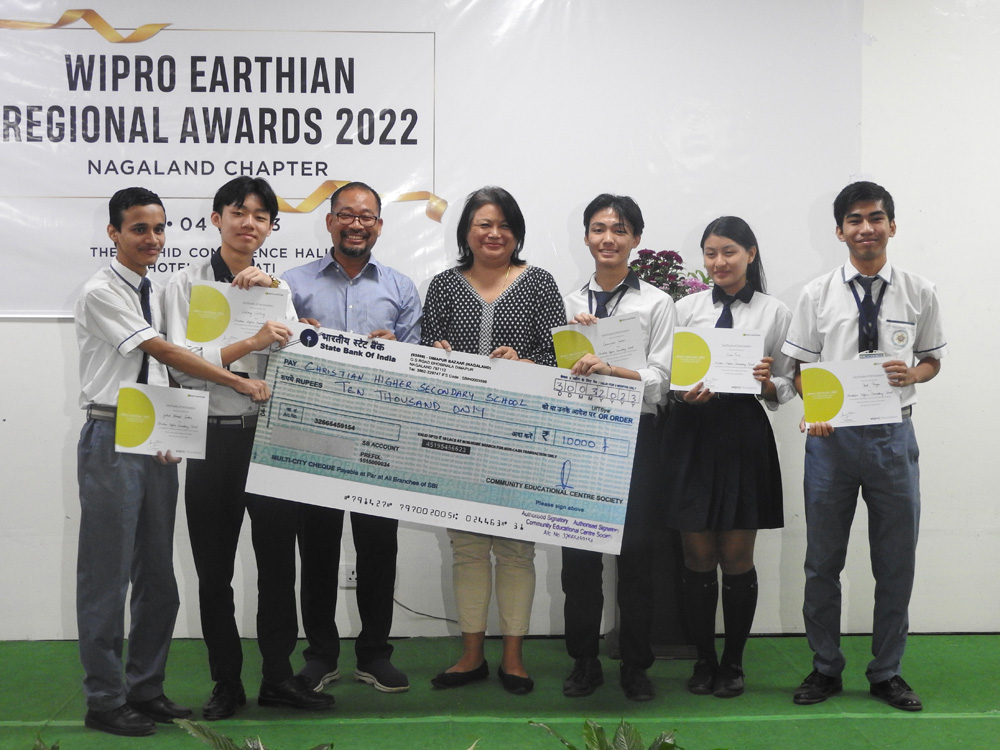
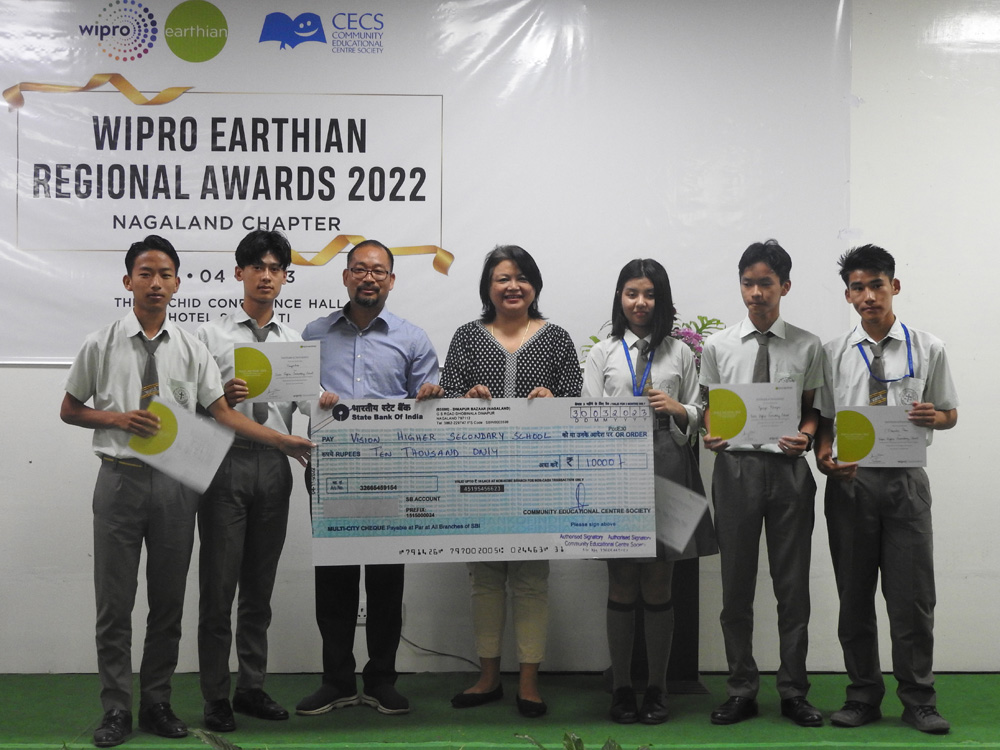
Christian Higher Secondary School Dimapur and Vision Higher Secondary School Dimapur were awarded the Wipro Earthian Regional Awards 2022, Nagaland Chapter.
A total of seven teams from five schools participated in the Wipro’s Sustainability Education Programme for schools and colleges. The regional award winning teams received a cash prize of INR 10,000 each.
Moreover, the winning team from Rajeshwari Karuna School, Tuli in Mokokchung, which had won the national-level Wipro Earthian annual award 2022, was also facilitated at the event.