[caption id="attachment_217148" align="alignleft" width="423"]
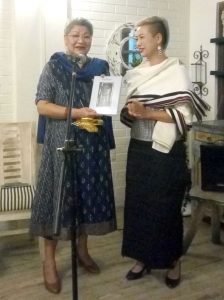 Monalisa Changkija (left) releasing ‘Sopfünuo’ on Friday in Dimapur.
[/caption]
Eastern Mirror Desk
Dimapur, Nov. 9: Amid the ‘Sopfünuo’ a poem collection by T. Keditsu and published by Heritage Publishing House was released on Friday at Muffets Pantry in Dimapur.
The book was formally released by Monalisa Changkija, Poet-writer and Editor of Nagaland Page newspaper. ‘Sopfünuo’ contains poems that unravels the tale of Naga women in 37 poems organised in Part I, II, III and IV.
Monalisa Changkija, who is also a poet and an author, said that “Sopfünuo is the unravished story of Naga women’s truths told in ways our foremothers orally imparted to generations of children within permitted spaces decreed as ‘women’s place’. It is a forceful statement of the culture of silence Naga women have been taught, trained and to which they have been threatened to conform from birth”.
“Most of all, this volume is an uncomfortable head-on collision with the reality of Naga society’s culture of invalidating women’s personhood. All this, Keditsu conveys so effortlessly, so unambiguously, so flawlessly and with so much versatility, as only a person in whose veins flows the blood of story-telling and poetry, can. This volume is powerful. It is dynamite-certainly not meant for the faint-hearted and deluded”.
“With Sopfünuo, Keditsu has arrived as a major poet much beyond Nagaland’s literary firmament” recognised Changkija as she remarked ‘we write because we have been fortunate to have been focused to the world of words’, said Changkija.
The latest book by the Naga poet, T. Keditsu is gaining much interest. The foreword is penned by Dr. Kevileno Sakhrie, a retired professor who served in Kohima College. She says, “Sopfünuo’ as an attempt to create a hybrid text that once connects the oral past to a literary present and future.”
Expressing her thoughts on the importance of orature and literature as part of many women’s daily struggle to communicate and share the values to their own and other children and to one another. Sakhrie said that the stories being narrated - just by being expressed in itself - the Naga women and poets like Keditsu are part of continuum in which they pass on existing messages of their children to future generations.
Sakhrie appreciated the of ‘Sopfünuo’, Keditsu aligns herself with Naga women poets before her and by using poetry and story she moves from the empowerment of herself to the empowerment of every person who reads her work.
“In her role as keeper of the fire, Keditsu reclaims and rearticulates the voices of all our forebears, for our own an that of our daughters”, asserts Sakhrie.
The poet, Theyiesinuo Keditsu - better known as T. Keditsu - is a writer and an educator. She is co-founder of Centre for Indegenous Knowledge and Alternative Learning (CIKAL) and advocates the revival of Indigenous Naga textiles and women’s narratives through her popular instagram avatar ‘mekhalamama’.
She is also the cultural secretary of Rattle and Hum Music Society and serves as trustee on the boards of the Dr. K &T Keditsu foundation and The Kohima Institute, and is currently an assistant professor at Kohima College in Kohima.


