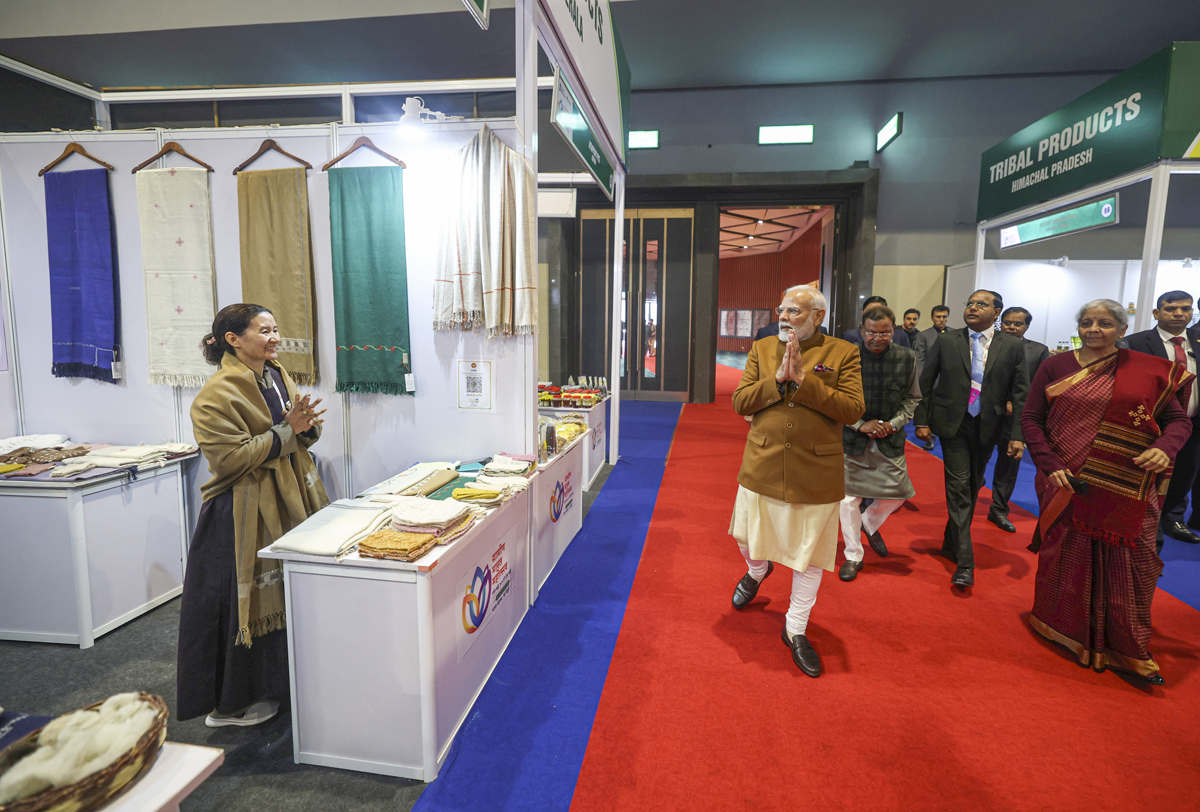
Prime Minister Narendra Modi visits stalls during the
inauguration of the Grameen Bharat Mahotsav 2025, in New Delhi, Saturday, Jan.
4, 2025. (PTI Photo)
NEW DELHI — Prime Minister Narendra Modi on Saturday attacked Opposition for
spreading venom in society in the name of caste and asked people to thwart such
conspiracies with a view to strengthening the shared culture and heritage of
villages.
Inaugurating the Grameen Bharat Mahotsav, the Prime
Minister said his government has been focusing on rural development since 2014
and villages will play a key role in realising the dream of Viksit Bharat by
2047.
In an oblique reference to Congress leader and Leader of
Opposition in the Lok Sabha Rahul Gandhi and other INDIA bloc leaders, Modi
said some people are trying to spread venom in society in the name of caste and
weaken the social fabric.
"We have to thwart these conspiracies, and preserve
and strengthen the common heritage of our villages," he stressed.
Opposition leaders including Gandhi and Akhilesh Yadav
have been continuously demanding caste census.
Modi said that since 2014, he has been constantly in the
service of rural India.
"Ensuring a dignified life for the people of rural
India is the priority of my government," the Prime Minister said and added
that the vision of the government is to ensure an empowered rural India,
provide ample opportunities for villagers, reduce migration and ensure ease of
life to the people of villages.
Talking about the schemes to provide basic amenities in
villages, Modi said toilets have been made as part of Swachh Bharat Mission,
and crores of people in rural India have been given pucca houses as part of PM
Awaas Yojana.
He said safe and clean drinking water is also being
provided through Jal Jeevan Mission.
"Today, healthcare facilities are being provided in
more than 1.5 lakh Ayushman Arogya Mandirs to the people," said the Prime
Minister.
He added that telemedicine, assisted by digital
technologies, has ensured the option of best doctors and hospitals to villages.
Crores of people in rural areas have benefited from the telemedicine through
e-Sanjeevini, he further added.
The Prime Minister highlighted the importance of creating
economic policies to strengthen the rural economy.
He said the vision of his government is to empower rural
India by transforming villages into vibrant centres of growth and opportunity.
"Our government's intentions, policies and decisions
are empowering rural India with new energy," he said.
He noted that through the PM Kisan Samman Nidhi, farmers
have received approximately Rs 3 lakh crore in financial assistance. Noting
that over the past 10 years, the amount of agricultural loans has increased by
3.5 times, he mentioned that now livestock and fish farmers are being provided
with Kisan Credit Cards.
In addition, more than 9,000 Farmer Producer
Organizations (FPOs) in the country are receiving financial assistance. He
further underlined that the government has consistently increased the MSP for
several crops over the past 10 years.
"When intentions are noble, the results are
satisfying," Modi said and added that the country is now reaping the
benefits of the hard work done over the past 10 years.
Citing a recent large-scale survey that revealed several
important facts, the Prime Minister noted that compared to 2011, consumption in
rural India has nearly tripled, indicating that people are spending more on
their preferred items.
He noted that previously, villagers had to spend more
than 50 per cent of their income on food, but for the first time since
independence, the expenditure on food in rural areas has fallen below 50 per
cent, and are now spending on other desires and needs, improving their quality
of life.
Highlighting another significant finding from the survey,
which revealed that the gap in consumption between urban and rural areas has
decreased, the Prime Minister remarked that it was previously believed that
urban individuals could spend more than those in villages, but continuous efforts
have reduced this disparity.
He noted that these achievements could have been realized
during previous governments' tenures, but for decades after independence, lakhs
of villages were deprived of basic necessities.
He pointed out that the majority of SC, ST, and OBC
populations reside in villages and were neglected by previous governments. This
led to migration from villages, increased poverty, and a widening gap between
rural and urban areas.
In his speech, Modi also mentioned a recent study by the
State Bank of India, which revealed that rural poverty in India has decreased
from approximately 26 per cent in 2012 to less than 5 per cent in 2024.
In an apparent jibe at opposition parties, Modi said that
while some people have been chanting slogans to eradicate poverty for decades,
the country is now witnessing a real reduction in poverty.
Speaking at the occasion, Finance Minister Nirmala
Sitharaman said banks have undertaken saturation drive for 16 government
schemes including Pradhan Mantri Jan Dhan Yojana, PM Mudra and PM SVANidhi.
Celebrating Rural India's entrepreneurial spirit and
cultural heritage, the Grameen Bharat Mahotsav 2025 is being organised from
January 4 to 9 with the theme 'Building a Resilient Rural India for a 'Viksit
Bharat 2047'.
The Mahotsav, through various discussions, workshops and
masterclasses, aims to enhance rural infrastructure, create self-reliant
economies, and foster innovation within rural communities.