


Share


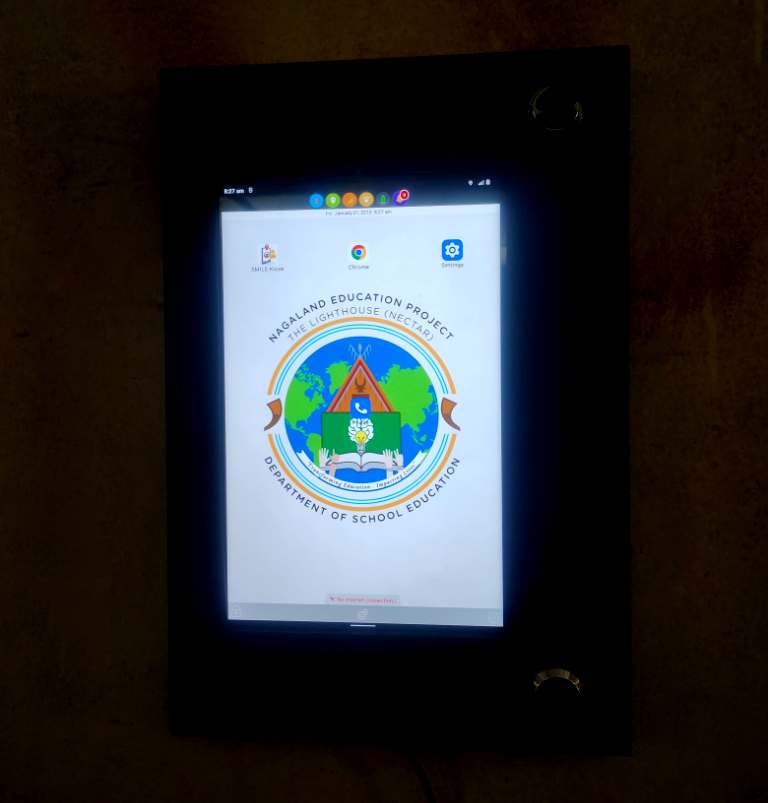
A photo of the tablet for marking attendance on TAMS being placed at a school in Kohima.
KOHIMA — On February 1, the day the Teachers’ Attendance Monitoring System (TAMS) via the Smart Attendance Management and Informative Leaves (SMILE) app went live in Nagaland, a total of 3,564 attendances were registered—out of over 22,000 active members.
This was informed to Eastern Mirror by Joint Secretary of School Education and Deputy Project Director of NEP-The Lighthouse (NECTAR), Avelu Ruho, on Monday.
Despite being Saturday and many schools in rural areas starting late for the new academic session, the first day witnessed 100% attendance in 22 schools, while 76 more had registered above 75% attendance.
The TAMS SMILE app was launched by Chief Minister Neiphiu Rio on the occasion of the 62nd Nagaland Statehood Day. The launch was preceded by two phases of pilot projects.
The first phase of the pilot project was implemented in February 2024 in two education blocks: L Khel in Kohima and Meluri block in Phek. The second phase of the pilot project conducted in April 2024 covered three districts: Kohima, Phek, and Dimapur.
Upon conclusion, the report stated that the attendance trend was higher in urban areas: Dimapur Urban registered the highest overall attendance at 64%, and L-Khel was in 2nd with 57%. The lowest attendance was recorded under Chiephobozou block with 18% and Sechu Zubza at 19%.
Findings
According to the findings of the pilot phases, it saw an initial attendance marking rate of 14% across three districts—Dimapur, Kohima, and Phek—on the first day, with Dimapur contributing 25%, Kohima 6%, and Phek 16%.
Meanwhile, teacher participation in marking attendance via the app showed an upward trend, with Dimapur Urban recording a peak of 76% on April 24 and 29, 2024, followed by L-Khel with 70% on April 22.
However, several challenges were encountered during implementation, wherein teachers using outdated devices faced difficulties in fetching their location accurately, while some devices were incompatible with the SMILE app.
Additionally, users who had not granted location permissions were unable to mark their attendance, and certain outdated devices fetched random locations, causing further issues. The failure to install the latest version of the app also led to problems in marking attendance.
Also, network connectivity issues in some areas affected the ability of teachers to log in, prompting recommendations to use peer Wi-Fi or offline attendance marking. iOS users, meanwhile, were unable to use the app due to its unavailability on the App Store, pending necessary credentials for hosting.
Another challenge arose in schools with multiple buildings located over 50 metres apart, necessitating the creation of secondary dummy schools with geo-fenced areas to enable teachers to mark attendance within their respective premises.
Offline or reinstall app
Now with the app going, Avelu informed that the employees have to delete the old app and reinstall the new one. She added that there is a tablet that was given to every school and office, so the user can perform the task.
She maintained that the app has a facility where if a user has network issues, they can opt for an offline marking of their attendance, and when the network comes back, they go back online.