


Nagaland DGP Rupin Sharma flags investigation challenges from a small CID and stretched SITs as state creates forensic directorate
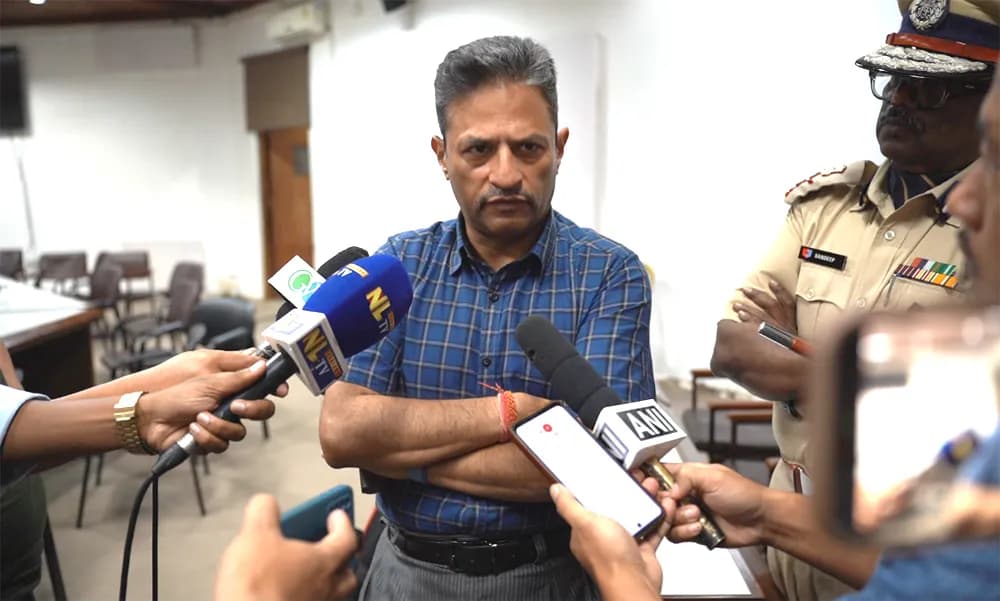
DIMAPUR — Nagaland’s small CID and the practice of drawing officers from other units to constitute special investigation teams (SITs) are posing challenges to complex criminal investigations, Director General of Police (DGP) Rupin Sharma said on Tuesday.
Speaking to journalists after the unit commanders’ meeting at the Police Complex in Chümoukedima, Sharma said Nagaland’s CID was made up of relatively small cells and did not have the resources available to Crime Branch-CIDs in larger states.
He was responding to a question about BJP Nagaland president Benjamin Yepthomi’s recent criticism of SITs—that some investigations had failed to produce results.
Sharma explained that SITs were constituted partly because the state did not have a large, well-resourced Crime Branch-CID with enough investigators to take up complex cases.
“In most cases, officers from different units of Nagaland Police are brought into an SIT,” he said, adding that these officers often had to continue their regular responsibilities while handling SIT duties.
Also read: Nagaland DGP flags challenges in tracing source of suspected spurious liquor
As a result, Sharma said, SITs might not always be able to “do full justice” to the investigations assigned to them. He acknowledged that some SITs had not been as successful as expected.
He reasoned that investigation was a relatively new discipline within the Nagaland Police and that the force was still developing its capabilities, while other states had progressed much further in this area.
“We are still developing our capabilities,” Sharma said, adding that the police were on track with the procurement of better equipment for modernisation.
Separate forensic directorate
WATCH MORE:
Meanwhile, Additional Director General of Police (ADGP) Sandeep Tamgadge said the state government had notified the creation of a separate Directorate of Forensic Sciences under Home department.
The directorate, he said, would no longer function under Police department and would operate as an independent entity, marking a step towards strengthening forensic capabilities in the state.
Sharma added that the modernisation of forensic facilities also had to take into account the volume and nature of crimes requiring investigation.
Nagaland registers around 1,300 FIRs annually, he said, pointing out that police had to prioritise equipment based on actual requirements rather than procure expensive, high-end equipment that might see little practical use.
He said the focus was on balancing available resources with the equipment needed to improve investigations.
Adequate arms, ammunition
On police modernisation, Sharma said the force currently had adequate arms and ammunition. Uniform items were being supplied through the normal government system, while further modernisation would depend on the additional equipment required.
He said there had been relatively few incidents over the past three-and-a-half years in which Nagaland Police had needed to use firearms to prevent crimes or apprehend criminals.
“This is also a question of balance — what weapons are required, when they are required and how many sophisticated weapons should be procured,” he said.
Sharma added that 561 vehicles had recently been distributed to various police units as part of modernisation efforts.
JOIN OUR WHATSAPP CHANNEL