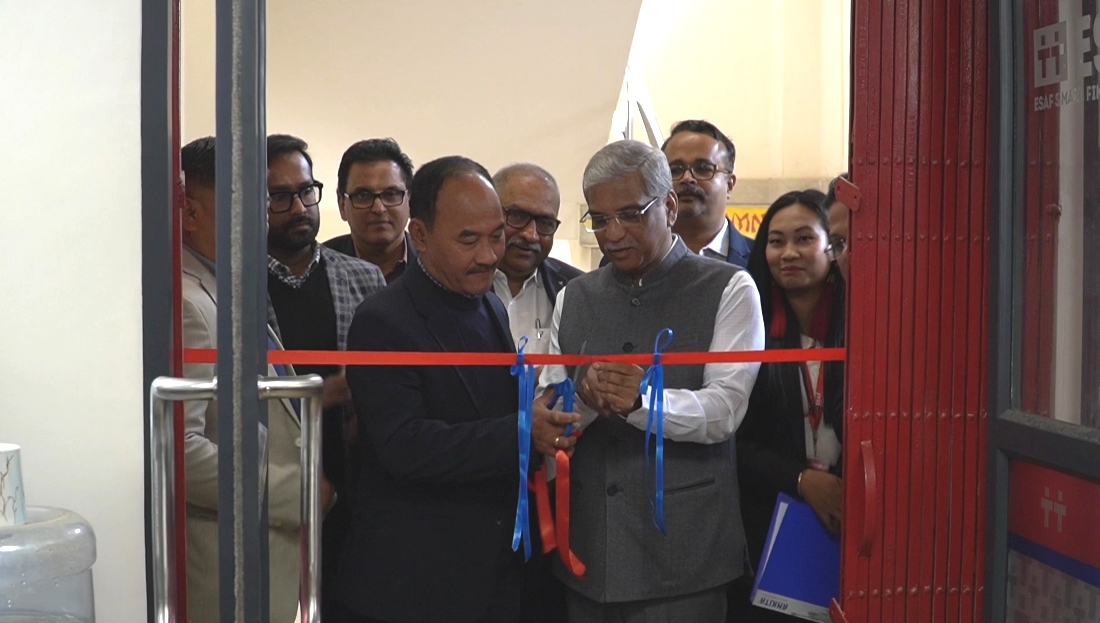
Taliremba cutting the ribbon during the inauguration of
Nagaland’s first ESAF Small Finance Bank, Kohima branch, at Secretariat Road on
Tuesday. (EM Images)
KOHIMA — In
Nagaland, there is a sharp imbalance in the banking sector between the rural
and urban areas, with rural areas being “badly” neglected by the banks even as
there is “overcrowding” of bank branches in some urban areas.
There are 26 different banks and 245 branches operating in
Nagaland. Of the total branches, 160 are located in semi-urban or urban areas
and only 85 branches are located in the rural areas, Principal Secretary of
Finance, Taliremba, said on Tuesday.
The principal secretary also disclosed that a big chunk of
the branches are located in a few districts. For instances, three districts –
Dimapur, Chümoukedima and Kohima – accounted for 57% of the total bank branches
in the state.
Dimapur has 60 branches, Kohima 56 branches, and
Chümoukedima has 24 branches. The three districts alone accounts for 140 of the
total 245 branches in the state.
The remaining 13 districts have just 105 or 43% of the total
branches in the state, Taliremba said during the opening of Nagaland’s first
ESAF Small Finance Bank (ESAF SFB), Kohima branch, at Secretariat Road.
Of Nagaland’s 74 rural development blocks (RDBs) in the
state, only 53 RDBs are ‘banked’ while 21 RDBs do not have any kind of banking
coverage or facility.
A single RDB consists of about 15 to 20 villages and larger
blocks have 30 to 35 villages with population of around 40,000.
“The end result showed ‘grey areas’ from the banking point
of view and it’s something that they are struggling with. There is a real
requirement for the banks to reach out to the people in rural areas,” he said.
While remarking that certain rural areas are “badly
neglected” by all the banks, Taliremba expressed optimism that in the days to
come, the banks will extend more banking facilities to the rural areas.
Conversely, in some happening places in urban areas, there
is overcrowding of bank branches, he said.
He noted there are seven bank branches, including the newly
inaugurated ESAF-SFB, along the Secretariat Road stretch in Kohima.
Keeping in view the good number of branches along the
stretch, he opined that the newly-launched bank will have a tough competition.
In his speech, K Paul Thomas, Founder, MD, CEO of ESAF Small
Finance Bank, said that the bank’s focus is small entrepreneurs and smallholder
farmers as well as reaching out to the unbanked sectors.
At their bank, 75% is for priority sector including
agriculture, micro entrepreneurs, loan to women, he said, and added that 90
percent of the borrowers are women.
About opening of the bank’s first branch in Kohima, he said
the focus is to expand banking services to small districts, rural areas and to
the unbanked and underbanked areas.
“The main goal is social commitment and to create
entrepreneurs from the state,” he said.
Executive Vice President of ESAF SFB, Bosco Joseph informed
that the branch in Kohima is the bank’s 777th branch functioning across the
country.
Commissioner and Secretary of Industries and Commerce,
Shanavas C, highlighted that the banking challenges in the state might be
different from other states.
He shared that in Nagaland, the population is spread out and
the terrain is challenging, making it difficult for banks to reach out to
remote areas.
Mentioning that there are a lot of unbanked people in the
rural areas, Shanavas expressed the hope that the ESAF Small Finance branch
will be able to reach out far and wide.