[caption id="attachment_168062" align="alignnone" width="550"]
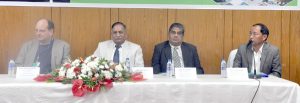 (L-R) Prof. Johannes Müller, director at Kiel University in Germany; Prof. Pardeshi Lal, vice-chancellor of Nagaland University (NU); NU Pro Vice Chancellor Prof. RC Gupta; and Prof Y Ben Lotha at the department of history, archaeology at NU at the Hotel Japfü in Kohima on March 12.
[/caption]
Kohima Bureau
Kohima, March 12 (EMN): A seminar to bring European and Indian scholars on a single platform to discuss various archaeological perspectives surrounding ethnology and archaeology, commenced on Monday at Hotel Japfü in Kohima.
Ten scholars each from Europe and India are participating in the seminar, which will conclude on Mar. 24.
The seminar will discuss the culture of a community’s infrastructure building tradition besides the role of “monumentality” in European and Northeast Indian landscapes.
The scholars from Europe include those from Germany, France, Sweden, Norway and Lithuania, representing the University of Gothenburg, University of Oslo, Kiel University, Umea University, University of Copenhagen and Lithuanian Institute of History.
The scholars from India are from the North-Eastern Hill University, Shillong; HNB Garhwal University, Uttarakhand; Sambalpur University, Odisha; Deccan College Post Graduate and Research Institute, Pune; and Nagaland University. It is expected that students from the neighbouring states would be joining in a day or two.
The 12-day seminar is organised by The Nordic Graduate School in Archaeology at the University of Oslo in Norway. It is a collaboration with the department of History & Archaeology at Nagaland University; and the Graduate School ‘Human Development in Landscapes’ Kiel Collaborative Research Centre 1266 ‘Scales of Transformation,’ Kile University of Germany.
Prof. Pardeshi Lal, vice-chancellor of Nagaland University was the chief guest of the event. Prof. Lal said in his address that archaeology was a discipline which would help in bridging gaps between the past and the present.
Delivering the keynote address was Prof. Johannes Müller, the director of the Institute UFG / CAU at. He said archaeology was becoming an important discipline. Expressing delight for the opportunity to participate with European and Indian students at the seminar, he was hopeful that the event would be a time for ‘exchange’ of knowledge and culture.
Dr. Tiatoshi Jamir, programme organiser of the department of history and archaeology at Nagaland University, also spoke. He expressed hope that the workshop would help explore and offer “alternative” insights and perspectives in theory and methodology.
With the emergence of archaeology as a distinct academic discipline in the modern era, Dr. Jamir said, the subject is playing “an important role in shaping our understanding of history.”
“And for a region like a Northeast and Nagaland, with local scholars that still heavily rely on colonial constructions of their regional history, it is essentially ‘alternative histories’ and a deeper sense of understanding of what the history of component of material culture research,” he said.
There will be tour to Khonoma, Khezhakeno village in Phek district; Wuilong and Yangkhullen in Senapati district in Manipur.


