[caption id="attachment_163809" align="aligncenter" width="565"]
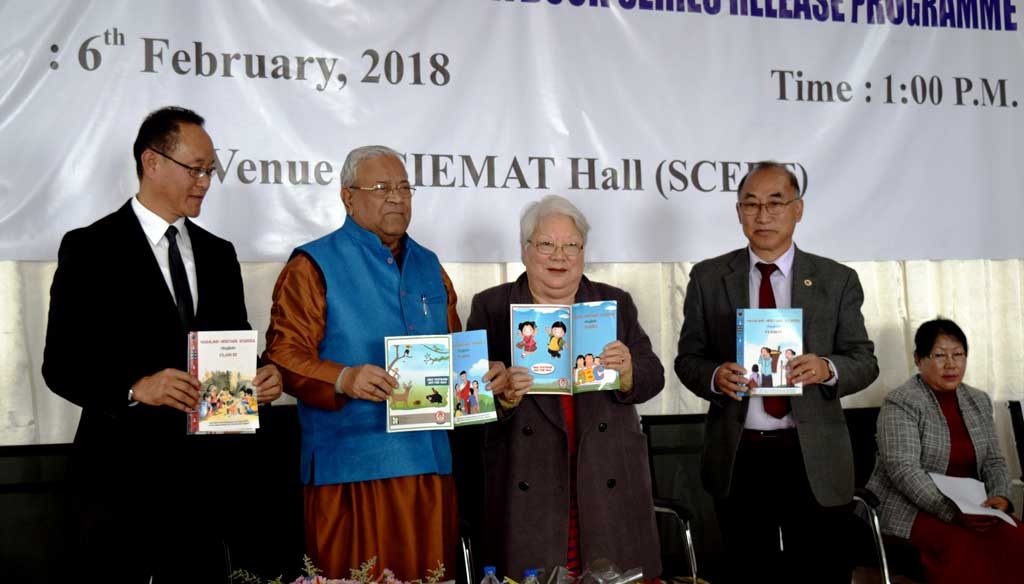 State governor PB Acharya along with Dr. Temsula during the launching of textbook in Kohima on February 6. (EM Images)
[/caption]
Kohima, Feb. 6 (EMN): With the primary objective to preserve, protect and promote Naga heritage, the State Council of Educational Research and Training (SCERT) has launched a textbook series titled ‘The Nagaland Heritage Studies,’ which will be introduced to all the schools in Nagaland.
The book was launched by state governor PB Acharya at SCERT, Kohima, on February 6 as the chief guest.
Delivering a brief report on the project, SCERT director T Sekhose said it has come up with 90 individual titles covering from Classes I-V in all the 17 dialects and one sub-dialect of the Rengma tribe. Besides, he stated that the department has come up with a book for Class-V students titled ‘Naga Heritage Studies in English,’ which will be introduced for the first time this year replacing Alternative English in all the schools.
Stating that the department has been mooting the ideas of tapping into the richness of Naga cultures for a number of years, he said the project could kick-start only in 2015, wherein it began to explore the possibilities of coming out with a separate vernacular textbook as an ideal platform to learn about our own cultures.
In partnership with school education in over 50 workshops, he said the department had collected stories about Naga culture with the inputs of the 17 tribal organisations and various tribal literature committees.
Despite Nagaland being blessed with rich cultural legacy, he rued that ‘for a very long time we have recognised the fact that as a government and as a department we have not been able to tap the richness of our culture.’
Sekhose expressed hope it will be able to complete the entire series covering the elementary stage including for students from Classes VI-VIII. He was optimistic that it would be something of a legacy for the children to recognise the fact, uniqueness and rich culture of the Nagas and all its social attributes to have a strong, stable and vibrant society.
Pressing on the need for preservation of the rich Naga cultural heritages in the state, Acharya said the core basis of one’s identity is the mother tongue. He also stressed on the importance of appreciating and promoting the cultural richness of every tribe and community. He also donated INR two lakh towards the promotion and preservation of the rich Naga cultural heritage.
Noted academician, Dr. Temsula Ao, in her remarks about the textbook, pointed out that any discourse on Naga identity, history and culture has to rely on oral traditions as we do not have any indigenous written accounts about ourselves.
While emphasising on the importance of translating oral tradition into ‘foreign’ language, which becomes necessary in the modern context when we are trying to establish our credentials among nations of the world, she however, cautioned on the hazardous factors of ‘internal displacement’ of meanings in the original.
She noted that there is often the temptation of embellishment, exaggeration and romanticising of native lores, which must be guarded against and that when oral tradition ‘progresses’ to literature, it undergoes an aesthetic change; a kind of deconstruction takes place within a given tale or story or idiom when it is used as a metaphor/critique by the writer to comment on contemporary issues.
She has appreciated the department on their venture.
The textbook is printed in Tenyidie, Lotha, Sümi, Nthenyi, Yimchunger, Kuki, Chokri, Liangmai, Nzokhwen, Sangtam, Ao, Chang, Khiamniungan, Phom, Pochury, Kuzhale, Konyak and Zeme.


