[caption id="attachment_209169" align="aligncenter" width="565"]
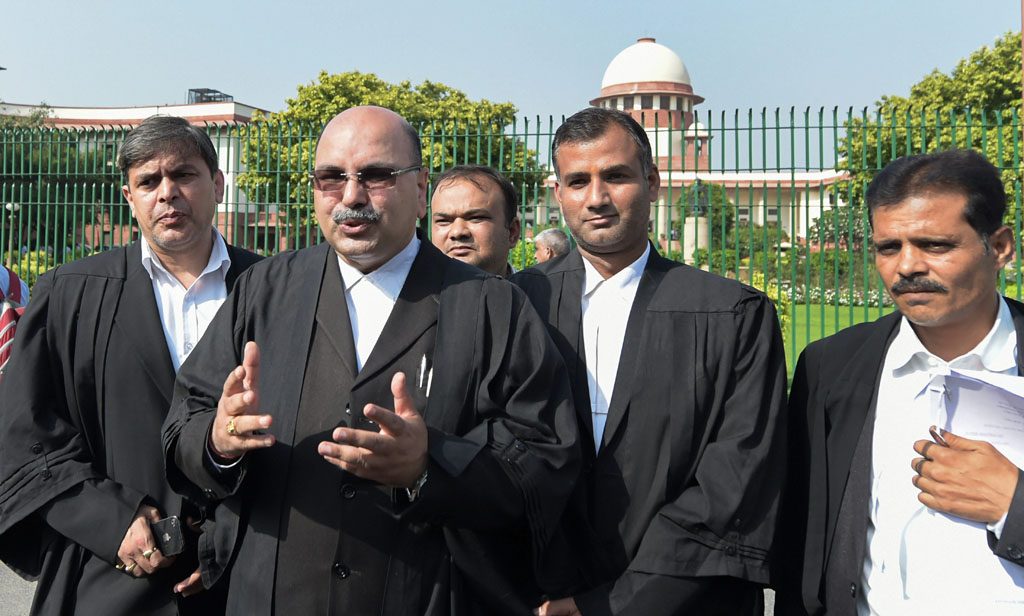 Hindu Mahasabha’s lawyer Varun Kumar Sinha talks to the media after a hearing on Babri Masjid-Ram Janmabhoomi case at the Supreme Court, in New Delhi, Thursday. (PTI Photo)
[/caption]
New Delhi, Sep. 27 (IANS): By a majority 2-1 judgement, the Supreme Court on Thursday rejected a plea for referring the Ramjanambhoomi-Babri Masjid issue to a larger Constitution Bench and referred the case to a three-judge bench to be set up that will begin hearing from October 29.
“No case has been made out to refer the case to a Constitution Bench,” said Justice Ashok Bhushan, reading the judgement on behalf of himself and Chief Justice Dipak Misra, who headed Thursday’s three-judge bench.
The bench was giving its verdict on petitions by some Muslims who had pleaded that the 2010 judgement of the Allahabad High Court splitting the title dispute into three parts be heard by a Constitution Bench as it involved reconsideration of a 1994 ruling by a five-judge bench of the apex court which had held that mosque was not an essential part of Islam to offer namaz.
The petitioners had contended that while deciding the title suit in 2010, the Lucknow bench of Allahabad High Court had referred to the observations made in the 1994 judgement by the five-judge bench.
However, in a dissenting ruling, Justice Abdul Nazeer said the judgement in the 1994 Ismail Farooqi case needed reconsideration and the matter should be referred to a larger seven-judge bench.
The majority judgement on Thursday held that a newly constituted bench will commence hearing from October 29 on a batch of petitions filed by both the sides -- Hindu and Muslim stakeholders -- challenging the 2010 judgement trifurcating the disputed site into three parts for Ram Lalla, Nirmohi Akhara and the original Muslim litigant.
“Observations in Ismail Farooqi case on mosques not being essential to religion was in the context of acquisition of mosque and made with respect to facts of that case. The observation made in Ismail Farooqi case has to be treated as only observation and not as the deciding factor of suit,” Justice Bhushan observed.
In his minority judgement, Justice Nazeer said “questionable” observations in the Ismail Farooqi ruling were arrived at without undertaking a comprehensive examination and they had permeated the judgement in the main Ayodhya title suit.
He said a Constitution Bench must decide what constitutes essential practices of a religion and thereafter the Ayodhya land dispute should be heard.
Justice Nazeer also said that whether mosque was an essential part of Islam for offering namaz was to be decided considering the religious beliefs and requires detailed consideration.
He also said that the question of the 1994 Ismail Farooqi judgement needed to be referred to a seven-judge bench.
The Supreme Court ruling that rejected a plea for referring the Babri Masjid-Ramjanmabhoomi dispute to a larger Constitution Bench is not a setback, a number of Muslim petitioners asserted on Thursday.
By a majority 2-1 judgement, the Supreme Court rejected a plea for referring the case to a larger Constitution Bench and referred the case to a three-judge bench to be set up that will begin hearing from October 29.
Advocate Zafaryab Jilani, the convenor of the Babri Masjid Action Committee, said the verdict was no setback.
“It is not at all a setback. It just means that the trial will start now. The court has clarified that the observations made by a Supreme Court bench in the Ismail
Farooqi case of 1994 were made in a particular context and not related to this case. I think that serves the purpose,” Jilani told the media.
All India Muslim Personal Law Board (AIMPLB) member Maulana Khalid Rashid Firangimahali echoed him.
“The positive aspect of today’s decision is that the court has made it very clear that Ismail Farooqi case will have no impact on the Ayodhya case. As far as the masjid and namaaz and the religious aspects are concerned, it is an established fact that mosques are built to offer namaz and they are an integral part of our religion,” he told the media.
“Our main contention is that the whole land belongs to the Sunni Waqf Board and whatever the Allahabad High Court said, legally I think it cannot be said that you can divide the land between the three parties when you have not decided as to whom does it belong. So our main contention is that the whole land should be given to the Sunni Waqf Board,” he added.
BJP Rajya Sabha member Subramanian Swamy said the Modi government should acquire the land and hand it over to the representative bodies of the Hindus.
“There is no need to talk about whose property is this, whether Ramjanmabhoomi nyas or others. What we have to understand is if the Hindus have a fundamental right to pray at the spot where the faith tells them that Lord Ram was born,” Swamy told CNN-News18.
“The government has s right to acquire properties including mosques. I would urge the Modi government to immediately acquire the entire land and hand it over to some representatives of the Hindua which include the various Akahras and the Vishwa Hindu Parishad,” he added.


