Dimapur, July 23 (EMN): A college in Kohima town on July 21 organized a “talk” on matter concerning relevance of Naga politics and identity.
The department of Sociology of Sazolie College at Jotsoma organised the event as a means to discussing the topic “Relevance of Naga (Homeland) Politics and Identity in the Present Neoliberal Context: A Critical Sociological Understanding” with Prof. Kedilezo Kikhi, department of Sociology and chair of Ambedkar Studies Centre at Tezpur University in Assam, as the speaker.
[caption id="attachment_128236" align="alignnone" width="300"]
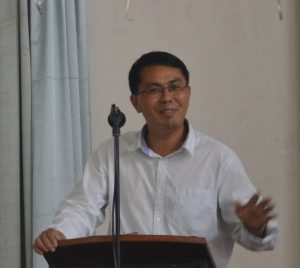
Prof Kedilezo Kikhi[/caption]
The organisers issued a press release on Sunday informing about the event.
In his presentation, the press release asserted, Prof. Kikhi ‘critically analysed the issue of Naga Identity in the context of Neoliberalism’ (sic). “The state is needed by the elites to accumulate and protect their wealth, which ultimately results in the rich getting richer and the poor becoming poorer,” the press release stated.
Further, he was stated to have posed the query whether or not one was supposed to trust the state. ‘Because instead of being the problem solver, the state itself has become a problem with an institutionalized corrupted system. In the absence of any mechanism to generate enough income for self-sustenance and self-sufficiency, he expressed his concern of what will happen when our “parasitic government” and “parasitic society” stops receiving the so-called “economic packages” or “pacifying packages” from the central government,’ the organisers explained.
The speaker lamented that “we” exploit the uniqueness of identity and ‘struggle by begging for these “economic packages,”’ the press release explained. ‘However, unfortunately, these are pocketed by the elites without any accountability. He stated that the movement for Naga Identity started with a good intention, but it has become a bait today thereby intensifying the parasitic system and giving growth to the nexus among the elites, which includes the politicians, bureaucrats and groups claiming to fight for the Nagas.’


