


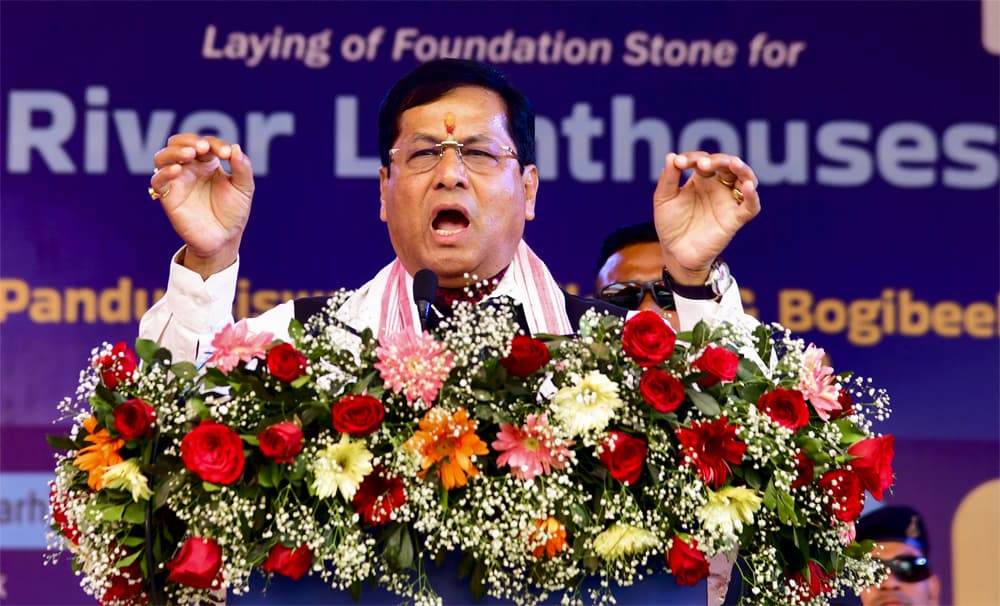
Union Minister Sarbananda Sonowal on Thursday laid foundation stones for four river lighthouses on the banks of the Brahmaputra, the first such infrastructure on an inland waterway in the country

GUWAHATI — Union Minister Sarbananda Sonowal on Thursday laid foundation stones for four river lighthouses on the banks of the Brahmaputra, the first such infrastructure on an inland waterway in the country.
The Union Minister of Ports, Shipping and Waterways kick-started the process to construct the lighthouses at Bogibeel in Dibrugarh district, Pandu in Kamrup Metropolitan, and Silghat in Nagaon district in the south bank of the river, and Biswanath Ghat in Biswanath in the north bank.
Laying the foundation stone at a function here, Sonowal said these four lighthouses are located at strategic points along the Brahmaputra, which is the National Waterway-2 and one of India's most important inland cargo and passenger corridors.
The combined project outlay for all the four structures will be INR 84 crore. Each lighthouse will rise up to 20 metres with a geographical range of 14 nautical miles and a luminous range of 8–10 nautical miles, powered entirely by solar energy.
Also read: Assam CM launches three welfare schemes
Congress releases first list of 42 candidates for Assam Assembly polls
Alongside navigation infrastructure, every site will feature a museum, amphitheatre, cafeteria, children's play area, souvenir shop and landscaped public spaces, positioning each lighthouse as a tourist landmark as well as a functional maritime asset, the minister said.
"A tonne of freight moved by water costs a fraction of what road transport demands, generates a fraction of the carbon and frees our highways for passengers and time-sensitive goods. These lighthouses on the Brahmaputra are a statement of intent that India's rivers are open for business, round the clock," he added.
Sonowal said that waterways offer a decisive cost advantage, as moving a tonne of cargo by inland waterway costs roughly one-third of road transport and half of rail.
"For a region like Northeast India, where road infrastructure is perpetually under pressure from both traffic and terrain, activating the Brahmaputra as a full-scale freight corridor is not a choice but a necessity," he added.
The commissioning of river lighthouses on NW-2 is a direct response to a 53 per cent surge in cargo movement on the Brahmaputra waterway in the financial year 2024–25, as recorded by Inland Waterways Authority of India (IWAI), a senior official said.
"Cargo traffic on NW-2 has been growing consistently, and the Brahmaputra corridor is now integral to supply chains serving Assam's tea, coal and fertiliser industries, in addition to carrying passenger and tourism traffic.
"The new lighthouses will enable 24×7 safe navigation, accommodate weather observation sensors and provide the navigational infrastructure necessary for the sustained growth of both freight and passenger movement on the river," he added.
Each lighthouse is scheduled for completion within 24 months of the award of contract, following geotechnical investigation, topographic survey and detailed design.
A Memorandum of Understanding between IWAI and Directorate General of Lighthouses and Lightships (DGLL) was signed in April 2025, covering all four sites.
The sites were formally transferred to DGLL under Right of Use agreements executed in June 2025, after a technical proposal placed before the Central Advisory Committee for Aids to Navigation.
The DGLL, under the Ministry of Ports, Shipping and Waterways, is the statutory authority responsible for providing aids to navigation across India's 11,098 kilometre coastline and now its inland waterways.