[caption id="attachment_166307" align="alignnone" width="550"]
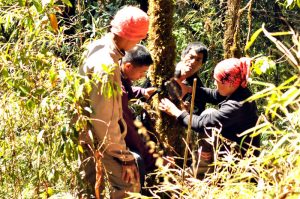
Alemba Yimchunger (second from right) along with wildlife researchers fixes a camera trap inside Fakim Wildlife Sanctuary in Kiphire.
Photo: Satem Longchar[/caption]
Eastern Mirror Desk
Dimapur, Mar. 1: The Sanctuary Nature Foundation–a conservation initiative of Sanctuary Asia, widely acknowledged as the leading nature and conservation portal in India–has announced monetary grant to Alemba Yimchunger, a true ‘mud-on-the-boots’ Naga conservationist.
The foundation has decided to give a monetary grant of INR 50,000 from its flagship Mud On Boots Project to ‘grassroots’ conservationist, and one-time hunter, Yimchunger. The Mud On Boots Project is quite unique.
This is a programme designed to empower and support ‘mud-on-the-boots’ conservationists in India, regardless of their academic qualifications or affiliations. Its select list features a goatherd from Rajasthan, a polio survivor from Haryana, a senior citizen from West Bengal and others–with biodiversity conservation as the common denominator.
In the words of Bittu Sahgal, the founder of Sanctuary Nature Foundation: “As the name implies, the project was developed to empower those conservationists who are doing valuable work in the field, who have mud on their boots, but who tend to fall under the radar of governments, large wildlife organisations and the media. By giving these earth heroes even minimal support to execute their projects and by spotlighting their contribution, we intend to magnify the impact of their conservation work and connect them with a wider network of wildlife and protectors across the world.”
For a small group of Naga wildlife researchers and conservationists, and an even smaller group from outside the state, who attempts to explore and study the stunning wildlife of Fakim forest in Pungro, Kiphire district, Alemba Yimchunger is nothing short of a legend.
The fifty-two-year-old Yimchunger’s ‘knowledge and natural instinct’ about the terrain and the habits of its wildlife-residents have for long astounded researchers who venture inside the Fakim Wildlife Sanctuary.
His history as a hunter in his youth, as is wont among most male Naga members, has only help to sharpen his instinct and understanding of the wild. “More than anything else, it is his natural ability to track animals and the knowledge he posses about the forest,” Satem Longchar, a Naga wildlife researcher told
Eastern Mirror on Thursday.
“I would say that he knows way more than any of those so-called biologists in Nagaland. I couldn’t be any happier with the choice. His knowledge about the Fakim forest is incredible,” she said.
Currently, Yimchunger is on contract with the state’s department of Forest as a camp guide inside Fakim Wildlife Sanctuary. It is a job he has had for the last three decades. Born in Fakim, it was natural for him to grow up hunting wildlife in the rich forests around his village.
However, as years turned, the dwindling wildlife in the region began to distress him and in the 1980s he discarded the ‘cultural norm of hunting’ and joined the cause to conserve the stunning biodiversity of Fakim.
The respect he commands among senior forest officials and researchers comes from the fact that he has been instrumental to the success of numerous expeditions and conservation initiatives in and around Fakim, including the conservation planting of Cephalotaxus mannii, a threatened species of tree; the distribution of solar lamps, seedlings and poultry to members of the community; camera-trapping exercises; and guiding and hosting researchers from across the country.
The Sanctuary Nature Foundation has also acknowledged that he had served as the guide to Dr. N Odyuo, a scientist from the Botanical Survey of India, when the latter discovered a plant species new to science in the area.
It has also observed that despite ‘his extensive knowledge of regional biodiversity and long years of work in the Fakim Wildlife Sanctuary’, Alemba Yimchunger earns a salary of just INR 3,450 per month and is yet to be regularised into the fold of the forest department.
“It takes uncommon courage to hold so steady a course in the face of such hardships, and yet, after all these decades, he still walks the forest with his enthusiasm untainted, his passion undiminished. Alemba Yimchunger represents the first generation of wildlife conservationists from Nagaland, and for many young researchers and forest department staff who visit the area, he has been and continues to be a perennial source of inspiration,” said Dr. Rohit Naniwadekar, a scientist with the Nature Conservation Foundation.
The financial grant extended to Yimchunger, according to the foundation, was in recognition of his three-decades of conservation work, ‘with the hope that it will ease some of the financial strain that he faces’.


