


Governor Nand Kishore Yadav reviews the progress of rubber cultivation, including drone-based disease control, in Nagaland.
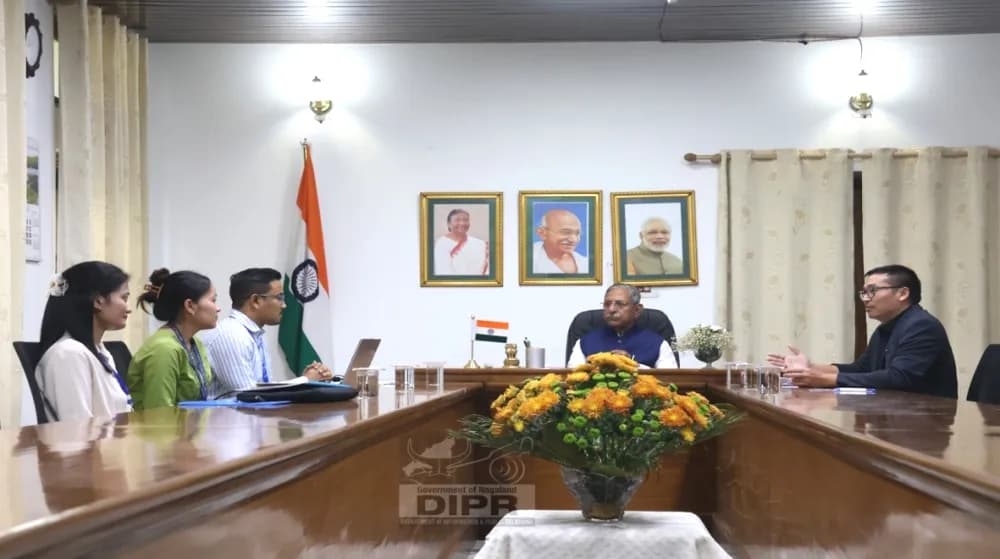
DIMAPUR — The Governor of Nagaland, Nand Kishore Yadav, held a review meeting with officials of the Rubber Board Regional Office, Dimapur, at Lok Bhavan in Kohima on Wednesday.
During the meeting, the governor reviewed the progress and initiatives undertaken by the Rubber Board for the development and expansion of rubber cultivation in Nagaland. The officials presented an overview of the status of rubber plantations, production, infrastructure development, farmer training, and welfare initiatives across the state.
According to an update from Lok Bhawan Kohima, as of March 31, 2026, Nagaland has a total rubber planted area of 29,794.39 hectares, comprising 11,977.71 hectares of mature plantations and 17,816.68 hectares of immature plantations. The state recorded a total production of 13,617.21 MT, with a productivity of 1,166.03 kg per hectare.
The meeting also reviewed key initiatives of the Rubber Board, including the Indian Natural Rubber Operations for Assisted Development (INROAD) project, Group Processing Centres (GPCs), farmer education and training programmes, the Tappers' Intensive Skill Improvement Programme (TISP), skill development initiatives, and disease intervention measures.
Under the INROAD project, efforts are being made towards large-scale plantation development and strengthening the rubber ecosystem in the Northeast. The project aims to promote sustainable expansion of rubber cultivation and improve the livelihoods of rubber growers.
Also read: Governor reviews coffee sector growth, challenges in Nagaland
The governor was also apprised of the establishment of Group Processing Centres aimed at facilitating collective processing, improving the quality of rubber sheets, and reducing processing costs for individual growers. The board is also focusing on capacity building through on-field training, practical demonstrations, awareness programmes, and exposure visits for rubber growers.
It was mentioned that the Rubber Board has further intensified efforts to address the shortage of skilled tappers through the Tappers' Intensive Skill Improvement Programme, which provides hands-on training in scientific rubber tapping practices.
Officials also highlighted the use of drone technology for combating Abnormal Leaf Fall disease affecting rubber plantations. Drone-based spraying of Copper Oxychloride has been undertaken across selected areas of Wokha, Peren, and Niuland districts, covering a total of 171.15 hectares.
The meeting deliberated on the challenges confronting the rubber sector, including poor rural road connectivity, a shortage of skilled tappers, dependence on outside labour, inadequate marketing channels, and damage to plantations caused by wildlife.
The future plans of the Rubber Board include the continuation of farmer education and training programmes, the expansion of skill development initiatives, the establishment of additional GPCs, and close coordination with the Department of Land Resources. Further expansion of activities is also being planned in anticipation of INROAD 2.0.