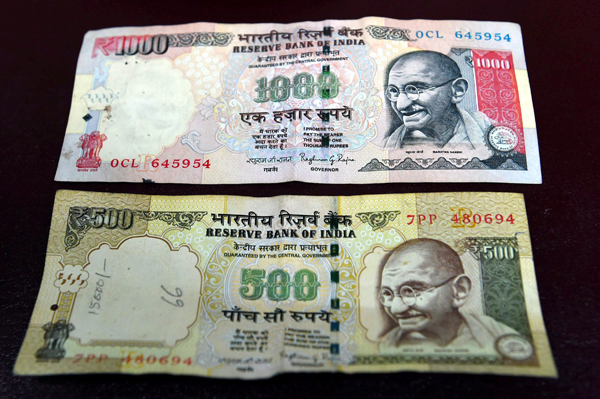
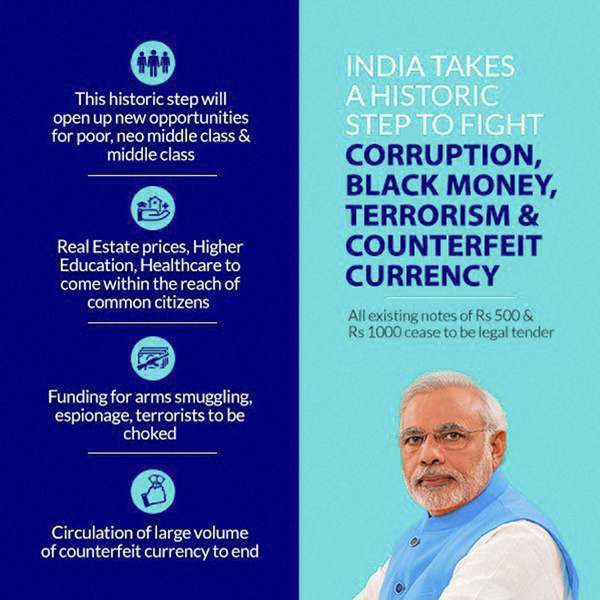
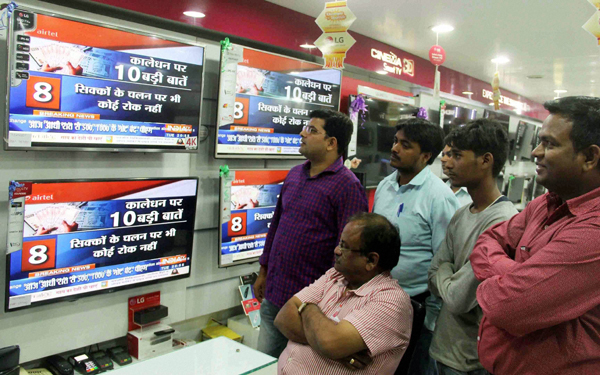
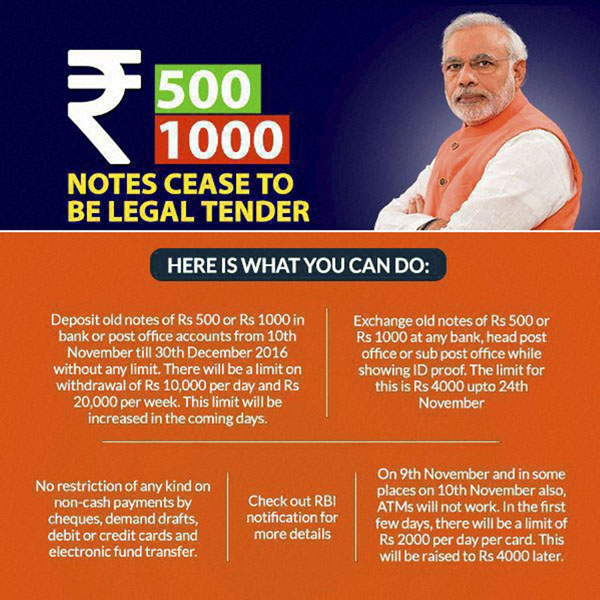
New Delhi, November 8 : High denomination notes of Rs 500 and Rs 1000 will no longer be legal tender from midnight tonight, Prime Minister Narendra Modi announced as he declared a "decisive" war against black money and corruption while disclosing a raft of steps to assure commoners that their money is safe.
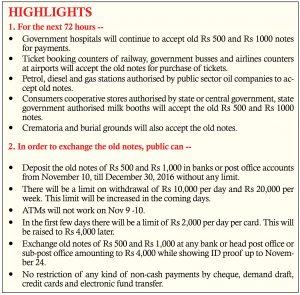
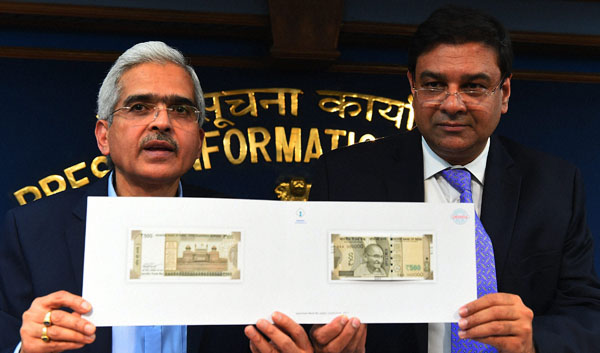
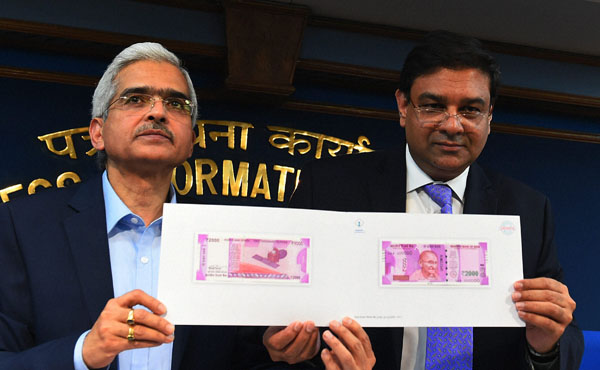
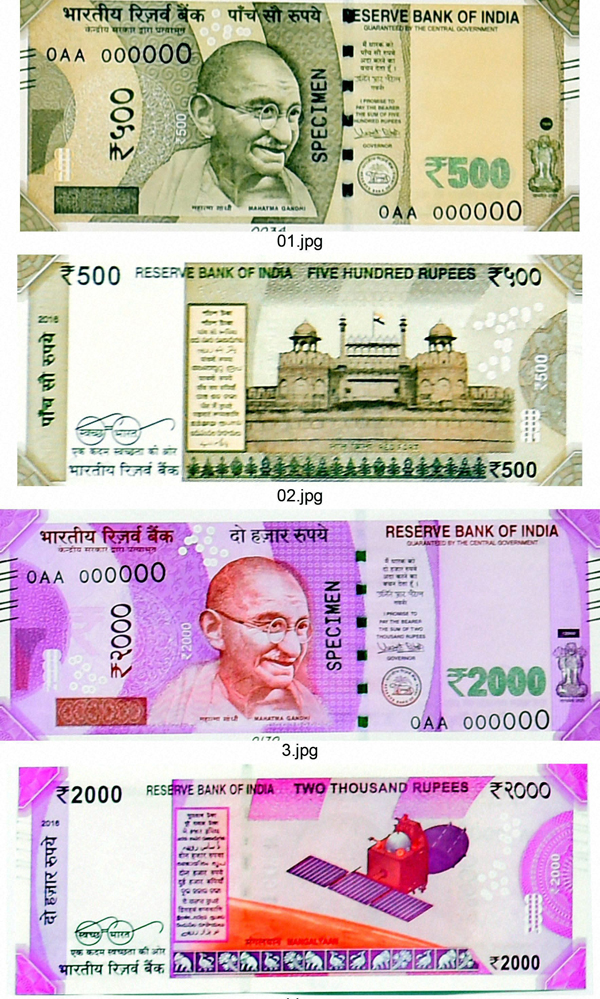
In his first televised address to the nation two-and-a- half-years after assuming office, he announced a 50-day window from November 10 to December 30 for those having these notes to deposit them in their bank and post office accounts "without any limit". He also said that new notes of Rs 2000 and Rs 500, with completely new design, will be introduced. Officials said such notes have already been reached banks to prepare for their circulation from November 10.
"Based on past experience, the RBI will hereafter make arrangements to limit the share of high denomination notes in the total currency in circulation," Modi said.
Banks will remain closed tomorrow and ATMs will also not function tomorrow and in some places on November 10 also.
In the first few days, there will be a withdrawal limit of Rs 2000 per day per ATM card. This will be raised to Rs 4000 later.
Similarly, keeping in mind the supply of new notes, in the first few days, there will be a limit of Rs 10,000 per day and Rs 20,000 per week. This limit will be increased in the coming days.
Rs 500 and Rs 1000 notes can also be exchanged for lower denomination currency at bank counters and select post offices till November 24 with a cap of Rs 4000 per day. From November 25, the cap will be raised.
There may be some who, for some reason, are not able to deposit their old Rs 500 or Rs 1000 notes by December 30, 2016, he said, adding they can go to specified offices of the RBI up to March 31, 2017 and deposit the notes after submitting a declaration form.
Officials said there were 6.7 billion pieces of Rs 1000 notes in circulation and 16.5 billion pieces of Rs 500.
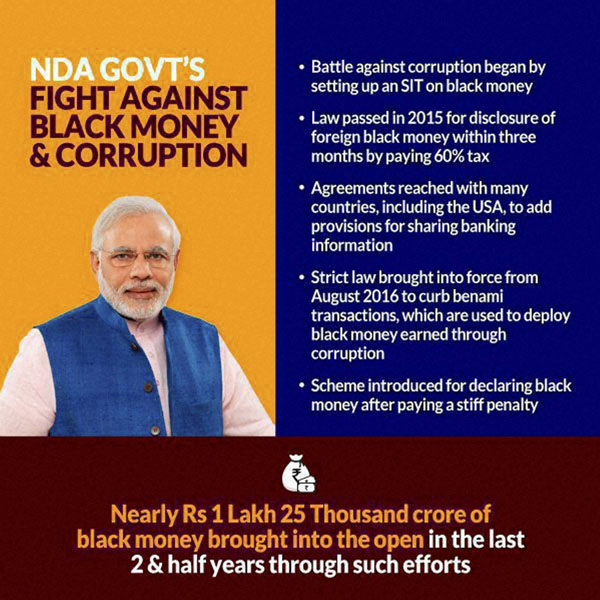
In his address, first in Hindi and later in English, Modi, whose government had implemented two schemes for unearthing of black money both domestic and abroad, said Rs 1.25 lakh crore belonging to the "corrupt" people has already been brought out in the open.
"There comes a time in the history of a country's development when a need is felt for a strong and decisive step," he said, asking political parties, all governments, social organisations and media to participate in the war against black money "with enthusiasm to make it a success".
The notes of Rs 500 and Rs 1000 "will not be legal tender from midnight tonight" and these will be "just worthless piece of paper," Modi said.
Banks to shut today, to work extra hours
Banks will open additional counters and work extra hours beginning Thursday to help people exchange Rs 500 and Rs 1000 notes that have been declared invalid from midnight on Tuesday. Anticipating panic and rush at bank counters, the Reserve Bank of India (RBI) as well as the government has set up control rooms in Mumbai and Delhi to avoid any crisis, Department of Economic Affairs Secretary Shaktikanta Das said.
Banks will remain shut on Wednesday to allow stocking of smaller currency notes and public will be allowed to tender their now invalid Rs 500 and Rs 1000 from November 10. They can deposit any amount of the invalid currency in their bank account till December 30 and also exchange them for lower banknotes at special counters at banks and post offices till November 24 but with limit of Rs 4,000 in a day.
Banks will however report any unusual transaction to the Financial Intelligence Unit and tax authorities for scrutiny. RBI Governor Urjit Patel said the central bank had ramped up production of the new higher security currency notes of Rs 500 and Rs 2,000 that will replace the notes being taken out of circulation.
The new notes will come into circulation from November 10, he said. He linked the government decision to use high denomination currency notes for terrorism financing and also for holding black money.
While overall currency circulation had increased by 40 per cent during 2011 to 2016, Rs 500 banknotes in circulation had gone up by 76 per cent and that of Rs 1000 by 109 per cent. As many as 16.5 billion notes of Rs 500 denomination are in circulation currently while 6.7 billion Rs 1,000 notes are in market.
While the government imposed strict cash withdrawal limits - Rs 2000 from ATMs and Rs 10,000 from bank account in a day and Rs 20,000 in a week, Patel said there will be no impact on liquidity in the markets including financial markets.
The cash withdrawal limits will be relaxed gradually as small currency denomination notes are adequately stocked with banks and ATMs and new currency notes come into wide circulation. A high-security Rs 1000 currency note will be re-introduced at a later date, Das said. Das said infusion of Rs 2000 note will be closely monitored and regulated by RBI.
[caption id="attachment_82656" align="alignleft" width="600"] [/caption]
[caption id="attachment_82658" align="alignleft" width="600"] [/caption]
[caption id="attachment_82657" align="alignleft" width="600"] currency[/caption]
[caption id="attachment_82653" align="alignleft" width="600"] [/caption]
[caption id="attachment_82650" align="alignleft" width="600"] [/caption]
[caption id="attachment_82652" align="alignleft" width="600"] [/caption]
[caption id="attachment_82655" align="alignleft" width="600"] [/caption]
[caption id="attachment_82654" align="alignleft" width="600"] [/caption]