[caption id="attachment_284031" align="aligncenter" width="600"]
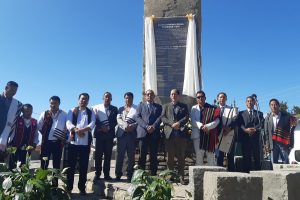 Neiphiu Rio with other leaders after unveiling the Tuophema Village Foundation Memorial Monolith on November 22 at Tuophema village. (EM Images)
[/caption]
Our Correspondent
Kohima, Nov. 22 (EMN): Chief Minister Neiphiu Rio on Friday said that our identity as Nagas will be lost if we ape other cultures and should, therefore, preserve our own culture and traditions. He was speaking at the unveiling of the Tuophema Village Foundation Memorial Monolith at Tuophema IN Kohima district on November 22.
The chief minister asserted: “Tourists visit Tuophema not because they don’t have places to stay but to explore our rich cultural heritage and traditions.”
When foreigners visit the state as a tourist destination, they are introduced to the unique Naga history, Naga political struggle for independence and different cultures, Rio said and added, “It is necessary that we try to promote our culture and traditions.” He also thanked the organisers for displaying organic products as decorations and keeping the Naga identity alive.
The state government has already declared Tuophema a ‘tourist village’ and it has attracted a good number of tourists from within the state and even across the globe. They visit the place to explore cultures, he stated.
Rio expressed happiness at the village’s cleanliness and sanitation and urged the villagers to be courteous and be sensible of manners as they are the ambassadors of the state.
“The need for change must begin at one’s home and that will automatically change the society,” he said.
The chief minister urged the villagers to work collectively towards ensuring a clean village for the tourists, in order to make them want to visit the village again. “A clean village would automatically mean a healthy village. Henceforth, let us recommit ourselves for the betterment of the village,” he said.
Rio also stated that village history is important and knowing the story of other’s failures and success ‘enables us to grow and strengthen us to excel’.
He thanked the ancestors for all the inheritance and urged everyone to follow their footsteps and live well. “Despite all my limitations, blessings of our forefathers and support of everyone has enabled me to keep me going. Without God and His blessings, I am helpless”, he stated.
“As inscribed in the monolith stone, pledging to progress in unity and strengthen one another, I hope and believe that we shall develop and be an aid for others too. As inscribed in the Bible, whoever wants to be leader must humble himself first. As a human, we tend to have pride and do wrong against others but we must beseech for God’s forgiveness and ask them to be humble instead of being boastful and stay united and help the neighbours,” he added.
Our forests have served us well and has enabled us to have our own water reservoir, and this is the outcome of our collective effort, he reminded.
Village elders, Salie-o Kense and Thekrucha Kaco also briefed the gathering on the history of the village. They said that both the clans, Kense and Kaco wanted to establish a new village. Kense came from the present Gariphema village and Kaco from Phenwhenyu village.
They met many times at the present Tuophema village but since it was the days of head hunting, and they did not know each other’s intentions and language, they would depart to their own respective villages after pointing spears at each other.
However, one day using sign language, both the clans understood that they both wanted to establish a new village. Hence, they counted their fingers to seven and they both returned on the seventh day and laid the foundation of Tuophema village.
Initially, it was called ‘Hutuophema’ but during the British Raj, the name was shortened to Touphema, as it is known today.


