


Our Correspondent
Kohima, July 6 (EMN): A centrally-sponsored project for rice fortification will be implemented in the six “bottom performing" districts of Nagaland on a pilot basis.
State technical officer of Centre for Health Research and Innovation (CHRI), Shan Ezung, said that the project, ‘rice fortification for better nutritional outcome’, will be implemented in the districts of Longleng, Phek, Kiphire, Peren, Dimapur, and Mokokchung.
NITI Ayog in its north-eastern regional districts Sustainable Development Goal (SDGs) Index report (2021-2022) showed that six (Dimapur, Longleng, Phek, Kiphire, Peren and Mokokchung) out of 16 districts of Nagaland were in the bottom performing districts list and needed special attention in terms of achieving SDG 3 (Good Health and Well Being) and SDG 2 (Zero Hunger) in the state, he said.
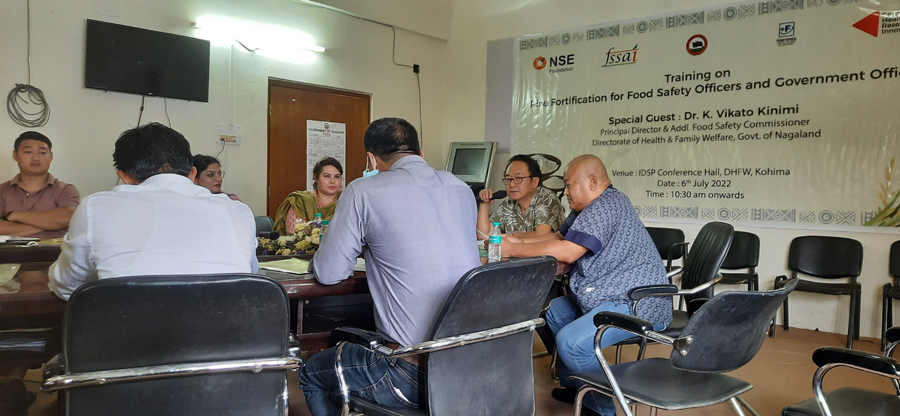
Towards this, a training programme with stakeholders was conducted at the Directorate of Health and Family Welfare, Kohima on Wednesday.
The pilot scheme is estimated to reach a total of 733787, 112094 and 75824 beneficiaries in the public distribution system, ICDS (now Anganwadi Services Scheme) and MDM (now PM Poshan) respectively. From the learning of the pilot, the project will be scaled-up to all the districts of Nagaland, he added.
The project's key outputs include supply and demand alignment of fortified rice, strengthened food safety among vulnerable populations, improved supplementary nutrition coverage among beneficiaries, increased consumer awareness about fortified rice in the state and open market availability of fortified rice in Nagaland, he informed.
Rice is a staple food in Nagaland and is consumed in large quantities among the locals. Consumption of rice for the 30 days period was reported by 99.5% of households in the state, the officer added.
State Programme Officer of Food Safety, DoHFW, John Kemp, said that the training was to capacitate the safety measures and regulations of fortified rice.
“It was with an aim to instill a clear concept of the project, which would in turn enable in addressing the needs associated with it as well as promoting the fortified rice in the community. The training should result in jointly developing a comprehensive sustainable action plan for an effective implementation of fortified rice in the state,” he said.
Lead, Nutrition Family Health of CHRI, Rohini Saran, while propagating rice fortification, said that it is a cost-effective programme, scalable and sustainable solution, and widely accepted.
Speaking at the training programme, Principal Director of Health and Family Welfare, Dr. K Vikato Kinimi, said that any disease, including cancer, is related to food and urged participants to give prior importance to the training to help the masses in return.
The National Family Health Survey-5 (2019-2020) revealed that anemia affects 34% of women in the reproductive age group (15-49 years), 10% of men and approximately 43% children less than five years of age in Nagaland.
The project is implemented in Nagaland with the support of the National Stock Exchange Foundation and Centre for Health Research and Innovation. It aims at introducing fortified rice to beneficiaries in the state who are covered under the National Food Security Act.
Fortification is the most effective strategy to combat the problem of micronutrient deficiencies in the population. Wheat, rice, milk, oil and double fortified salt are the various vehicles for which fortification standards have been released by the Food Safety and Standards Authority of India in 2016. Among the various commodities that can be fortified, rice is an excellent product for delivering micronutrients to a very large number of people, it was informed.
The training was organised by the Centre of Health Research and Innovation (CHRI) and National Stock Exchange Foundation (NSEF) in partnership with the Food Safety Authority, Department of Health and Family Welfare.