[caption id="attachment_187247" align="alignnone" width="550"]
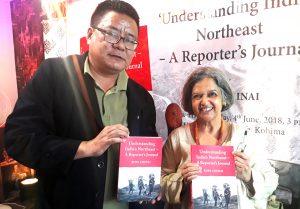 Author Rupa Chinai (R) with fellow journalist Xavier Rutsa Kohima on Monday. (EM Images)
[/caption]
Our Correspondent
Kohima, June 4 (EMN): A book titled ‘Understanding India’s Northeast- A Reporter’s Journal’ authored by Mumbai-based independent journalist Rupa Chinai was launched here in Kohima Monday afternoon at Symphony Cafe.
Chinai’s book recounts her personal interactions with indigenous communities living in India’s lesser known and politically sensitive northeast region during the last more than thirty years. According to her, barriers of geography, culture and race have long separated the people of the northeast from those in the mainland and instead of bridging those gaps, the Indian state has consistently pushed these communities against a wall.
In about 350 pages, the veteran journalist tries to provide context to the various protest movements of north-eastern groups in efforts to determine their own destiny while also talking about the diversity and complexity of inter-tribal relationships; of what it means for generations who have lived under the yolk of army as also insurgent excesses. The book also narrates the vision of the communities for their future, their environmental and health traditions and the egalitarian culture, which the author feels, hold much that the rest of India can learn from.
“Indian society ignores and even penalizes persons with independent minds before it discovers their value. The Indian media does likewise. Rupa Chinai, whose conscience is as active as her pen, is a perfect example of this,” stated Rajmohan Gandhi, historian and writer, in the foreword of the book. Chinai is said to have faced censures from different media groups she had worked for in the past.
“While she was with another media group, her keenness to bring the harsh realities in India’s northeast to the notice of the Indian ‘heartland’ was objected to, and she was asked to focus on less controversial matters. But Rupa was not easily deflected...,” Gandhi wrote. He points out that the general Indian attitude towards the northeast is marked with ignorance and indifference, that opinions are held about the region and its communities without knowing them. He goes on to state that Chinai’s survey would help in filling the gap, and commended the book as a ‘journal of a reporter of rare qualities, focussing on a region of rare importance’.
During the book launch, Chinai said her book not just talks about the conflict in the region but also about what is happening to the people in the region, what is damaging their inherent cultural knowledge and heritage, as also about the lives that she encountered and wanted to record to honour them. Someone who has written widely about two neglected areas of Indian journalism : the northeast India and public health, she said she had preferred to pursue her work not on loyalty to the media house(s) but loyalty to the people who were suffering.
Underscoring the need to create spaces for conversations between the people of the region and the rest of the country, she said there is now a huge interest and goodwill in ‘the rest of India’ to listen to the region. She emphasized the need to think together creative methods about how to strengthen the identity, heritage and history of the communities, and their visions.
According to peace activist Niketu Iralu, who officially released ‘Understanding India’s Northeast- A Reporter’s Journal’, the book was being released at an appropriate time in meeting a pressing need in the ‘worsening crisis of Nagaland and the NE region’.
He said the book is about the urgent issue of starting, deepening and widening understanding among peoples in situations of longstanding conflict, so that their formidable difficulties become their common strength instead of causing their destruction.
Iralu also talked about how he and his wife had, everytime they welcomed Chinai to Nagaland, wondered about the highly demanding long journeys she made over the years from her affluent home in Mumbai to pursue her deep convictions and commitment for the sake of bringing about a better life and better understanding of the dignity and self-respect of numerous obscure people far away from her comfortable home and community.
“She has survived the wear and tear of the travels so well because of the clarity of her commitment and purpose of life ‘to see the whole picture’ in order to help properly. After reading the book you will realize that the author from Mumbai knows about the peoples of our region much more intimately than many of us know about our own region,” Iralu said.
The understanding of the northeast region that the author has sought in order to convey it to the people of India and their government in Delhi is strikingly free from pressure for achieving the needed solutions, he stated, adding that is why the stories are captivating and hope-giving.
The octogenarian peace activist, who had a preview of the book, said it was very much about a better future for the region and all concerned with that challenge. Therefore, he shared what he called ‘a thought or two’ about the stalemate in the search for a settlement (to the Indo-Naga political issue) that has greatly agitated all the Nagas for a long time: “Our leaders have to make sure the increased tension that has undeniably come into the discussions made more dangerous by acrimonious blaming and condemnation of one another do not result in our resorting to use of force and violence again; Our leaders owe it to the Naga people to show statesmanlike leadership at this time so that what is already very bad is not made worse and the destruction that will result goes out of control.”
Asserting that everyone has, without exception, in their different ways contributed to the society, politics, religion, culture, economy and all else they have today which threaten to bring them down, the activist maintained that there was no room for blaming one another.
During the programme, Khesheli Chishi, advisor Indigenous Women’s Forum of North East India and Seno Tsuhah of the North East Network (NEN) also delivered brief speeches. The book launch and discussion was organized by NEN Nagaland.


