[caption id="attachment_211917" align="aligncenter" width="565"]
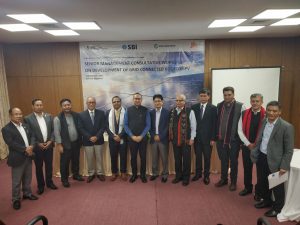 Mmhonlumo Kikon, centre, and a host of dignitaries from the Suprabha, NRE and others after the inaugural session at Kohima on Thursday.
[/caption]
Our Correspondent
Kohima, Oct. 11 (EMN):The concept of renewable energy and its environment-friendly, energy-effective application is a solution to mitigating the growing demand for, but dwindling supply, of traditional energy sources and fuel. However, there are challenges of application and implementation, and infrastructure and funding that may hamper the advancement of renewable energy as an energy source for the masses. This was one of the key issues a stakeholders’ workshop in Kohima discussed.
In collaboration with the World Bank, the department of New & Renewable Energy (DNRE) organised a workshop on the subject “senior management consultation on development of grid connected rooftop PV (GRPV) program in Nagaland,’ the event as conducted in Kohima on Thursday. The event sought to impact better understanding of rooftop solar (RTS) technology and implementation of the RTS in Nagaland.
Advisor to the chief minister and in charge of the NRE department, Mmhonlumo Kikon, addressed the event. In his address, Kikon acknowledged the World Bank, the State Bank of India, and the ministry of New & Renewable Energy for the development. The legislator hoped that all the stakeholders including the engineers, and departments in concern including the PWD, Urban Development and the NRE would benefit from the workshop.
With Nagaland gearing up to implement the RTS, Kikon said that a lot of publicity and promotion would be required to properly educate the people about the usefulness of said technology. He said that the initiative would not only ‘benefit engineers’ but the public too in providing energy solutions to individual homes, educational institutes, hospitals etc. Besides, he said, the application of the technology will reduce carbon footprint in the state thereby tackling regional Global Warming issues.
In regard to solar energy, the legislator informed that the government had proposed setting up smaller-sized solar parks with a capacity of about 23 MW. But, he said, there are teething problems especially in terms of funds for the project.
“Once the funding for infrastructural development is in place, the government of Nagaland would invite the independent power developers and investors to develop the project or go for a Joint venture,” Kikon assured.
On the hydro, he said projects areas have been identified in the state but there are serious issues again concerning funding for the projects. “In Nagaland our internal resources are very meagre and the government finds it hard to fund these projects,” the legislator explained.
‘The ministry of NRE’s funding for renewable energy projects is based on benchmark cost of all India; where 90% of benchmark cost is allocated as central financial assistance (CFA) to NE region which unfortunately is not sufficient to implement the RE projects. Hence, the gap funding is sought for from DoNER/ NEC to match up to 90% of the project cost,” the advisor said.
Stating that the Northeast region requires a different approach as the overall infrastructure there is still not in place especially in the road and power sector, Kikon said that the funding pattern for the region needs to be addressed seriously by an Independent body. He requested the World Bank to commission a study to devise a most appropriate project costing for renewable energy projects in the NE region and suggest changes for funding pattern in the ministry.
The advisor also suggested that the state should focus on developing green buildings, promote energy efficient appliances, and energy conservation in the state to transform Nagaland into a ‘better place to live in and work towards a zero carbon footprint’ state.
Also, a brief introduction about the ‘sustainable partnership for rooftop solar acceleration’ in Bharat (Suprabha) was given. It is a USD 13 million program which is led by the World Bank and the State Bank of India and is to be implemented in partnership with the ministry of New and Renewable Energy. Suprabha will be offering technical assistance to 17 partner states including the north-eastern states to establish an enabling ecosystem for accelerated deployment of grid connected rooftop solar applications.
The target given to Nagaland is about 50MW for RTS, it was informed.
The deputy team leader of Suprabha, Dr. Bivek Bandyopadhyay said India has a target of 175GW renewable power by the year 2022, of which 100 GW is projected for solar energy including 40 GW from rooftop solar systems.
He said that the overall objective of the Suprabha program is to establish an enabling environment to develop and nurture key aspects of the rooftop solar energy market for accelerated deployment.


