


Our Correspondent
Kohima, Dec. 20 (EMN): Nagaland Chief Minister Neiphiu Rio on Monday said that removing the Armed Forces (Special Powers) Act (AFSPA) will contribute towards confidence building, strengthening trust and removing the feeling of alienation in the monds of the people.
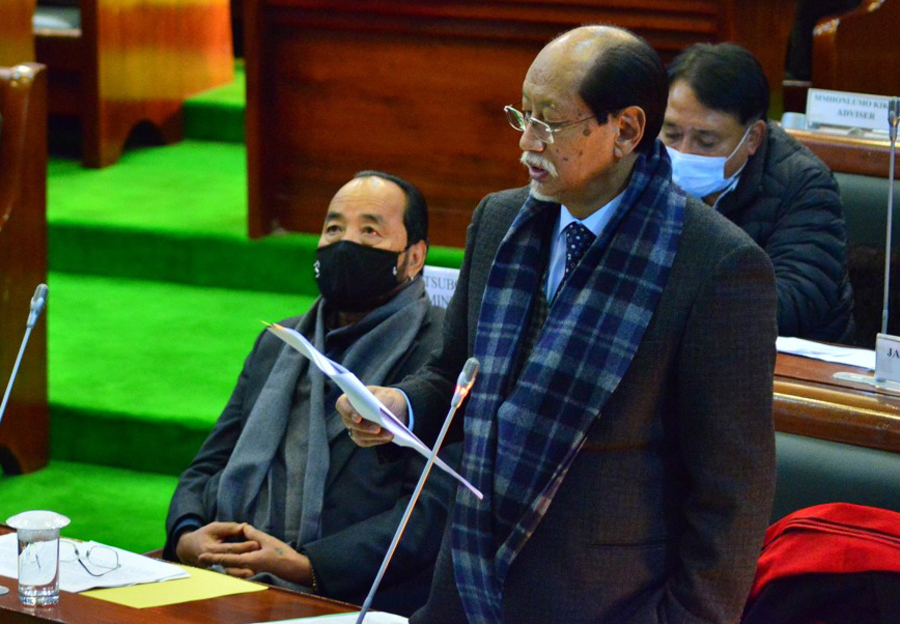
He was addressing the 10th session of the 13th the Nagaland Legislative Assembly (NLA) held less than a month after the ninth session was adjourned sine die on November 26. A special one-day NLA session was summoned to discuss the AFSPA and Mon killing incident.
The members of NLA observed a two-minute silence in memory and honour of the 14 innocent civilians killed by the Indian security forces in Mon earlier this month.
Rio reminded the House about the origin of AFSPA; how it was initially implemented to deal with the Naga armed insurgency before eventually spreading to other north-eastern states, which at present is still in force in Nagaland, Assam, Manipur (excluding Imphal Municipal Area), and the Naga-inhabited districts of Arunachal Pradesh, namely, Changlang, Longding and Tirap, as well as some areas bordering Assam.
Outside the Northeast, the Act has been in force in Jammu and Kashmir since 1990.
The CM expressed dismay over the law, which was used by the British to suppress the Indian freedom movement, being implemented in some parts of the country even today.
This Act empowers the security forces operating in disturbed areas to search any suspected premises and vehicles, to seize goods and articles, to arrest suspected persons without warrant, and to use firearms on civilians and suspected militants. And they cannot be dragged to law courts for such actions. It is generally opined that these special powers are given to security forces without adequate safeguards to prevent the possibility of it being misused, and without sufficient provisions to enforce accountability in the event of such misuse by the security forces, stated Rio.
Meanwhile, the CM reminded that the NLA had already adopted resolution for withdrawal of AFSPA on March 29, 1971 and on July 27, 2015. ‘I am grateful to the NPF for the United Democratic Alliance (UDA) government we are having today, to resolve the Naga political issue in a very healthy manner for the interest of our people,’ he said.
He viewed that all the members are aware that there have been many instances of misuse or abuse of the provisions of the AFSPA at the hands of the security forces while carrying out their operations in Nagaland and other parts of the Northeast, particularly in Manipur and Assam; and many instances of AFSPA gross abuse in the state, the latest being the killing of 14 innocent civilians at Oting and Mon on December 4 and the 5th.
“We should not focus too much on these special provisions of the AFSPA, or whether they amounted to violation of basic human rights and the fundamental rights guaranteed in the Indian Constitution etc., because, these issues have been debated at length amongst constitutional experts, legal luminaries, journalists, and even common citizens; and the overwhelming opinion is that it should be repealed,” he told the House, citing opinions expressed by legal experts, Supreme Court of India, human rights organisations, etc.
“So, let us hope that the Central government, in their wisdom, will decide to repeal the AFSPA. However, we should also remember that this Act is not Nagaland-specific anymore; it extends even to the state of Jammu and Kashmir beside other north-eastern states,” he said.
Reminding that repealing of AFSPA may take some time, as it will require Parliamentary approval, Rio pointed out that the state need to convince the government of India that the present situation in Nagaland does not require, or justify being declared 'disturbed area' for the purpose of imposing the provisions of the AFSPA, while adding that ‘the government of India and all Naga political groups (Except one Myanmar-based NSCN-K Yung Aung faction) currently engaged in political dialogue to resolve the long-pending Naga political issue are under ceasefire agreements. And the ceasefire agreements are working well, so much so, that there has been no major or significant aimed clash or conflict between the Indian security forces and the armed cadres of the Naga political groups in Nagaland for many years’.
He said that the Maoist-affected areas have seen much more armed conflicts and casualties in recent past, as compared to Nagaland and other north-eastern states. But the Centre does not want to impose AFSPA in these Maoist-affected areas and relies on state police forces and Central Para Military Forces (CPMF) to deal with the situation. So, there is no reason why it cannot do the same in Nagaland, and other Northeast states to deal with a much less volatile situation.
He maintained that in view of the improved situations in Nagaland, the state government has been consistently taking the stand to relief the state of the 'disturbed area' tag for more than 20 years. He added the declaration of a state or any area as 'disturbed area' under Section 3 of the AFSPA is made by the government of India generally for a period of six months only at a time and on the eve of the expiry of the period and that the centre will seek the views from the state government.
Towards this he said: “Every time, we have been taking the same stand, that there is no need or justification for extending the declaration of Nagaland as a ‘disturbed area'. But every time, our views, and our objections are ignored, and the declaration is renewed again and again for the last many years.”
While the current declaration of Nagaland as 'disturbed area' is going to expire by the end of this month, he exuded hope that this time the Central government will heed to the voice of the people and not extend it.
He stated that the NLA being a democratically elected representative of the people reflects the voice of the citizens.
“In our form of governance, the Nagaland Legislative Assembly is the temple of democracy in our State. We are duty bound and responsible to reflect the voice of the people and carry the aspirations of the masses. Entire Naga society has been calling for the repeal of AFSPA and that voice is at its loudest today,” he said, adding that even as the legislators participated in the discussion, the entire state was eagerly waiting for the result of the special session and the content of the resolutions.
He maintained that the House must sound the desire of the people, which is to repeal the undemocratic and draconian law, and urged all the NLA members to unite in one voice and send out a clear and loud message to the world that Nagas do not want to see this Act.
Let us tell the world that Nagas want to stand for democracy, justice and truth,” he said.
“We also need true peace to realise lasting political solution. Impediments like the AFSPA must be removed so that hurdles which are in the way for lasting peace are removed,” he added.
Rio informed that the Central government has announced ex-gratia and employment to the next of kin of the deceased families. “However, in case the families of the deceased prefer a job in the state government (sector), we are ready to give grade III or grade IV as per their qualification,” he added. The state government has also extended an ex-gratia of INR 5 lakh each to the families of those killing in Mon incidents.
He appealed to the citizens of Mon district and its civil societies to extend co-operation to the government and its agencies in the collective efforts to restore normalcy in the interest of all the citizens.
He also conveyed condolences to the families of the victims and wished a speedy recovery of the injured persons, saying that shares the grief of the bereaved families and condemn the killing of 14 innocent civilians in Oting-Tiru area in Mon District and the causing of serious injuries to many more.