[caption id="attachment_182874" align="alignnone" width="550"]
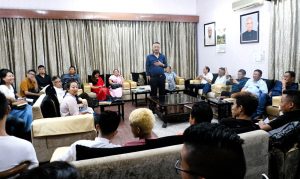 A scene from one of the FNR public interactions in New Delhi.
[/caption]
Dimapur, May 13 (EMN): The recent three-day long public interaction held at New Delhi as part of a series initiated by the Forum for Naga Reconciliation (FNR) exposed the dark underbelly of Naga nationalism, Nagaland state politics, tribalism and socio-political parochialism.
Held from May 4 to 6th, including visits to Naga churches around Delhi, the dialogue with church and the Naga citizenry in the Indian capital brought out the best as well as the worst of the Naga world.
The one hopeful discussion centred on Naga reconciliation and the need to pursue it; yet this was challenged by the intricacy surrounding the present state of affairs – described as ‘dysfunctional’ by the FNR member, Niketu Iralu.
“The Naga struggle was the right thing to happen and as a people we should remain proud of our rights and aspiration. However the Naga struggle has also produced a dysfunctional society. We are in the ICU,” he said.
According to him, ‘the present ills we are faced with including abuse of money and power has become destructive to both underground and overground politics’. The FNR, he said, was ‘getting Nagas to re-examine themselves’.
“Unless we do that our society has become impossible to function. FNR is doing a bold thing for our society to change,” Iralu said. Putting the FNR’s works into perspective, he said ‘reconciliation is the only thing we have to do if we are to have a future’.
One participant wanted to know if the FNR was playing the role of a facilitator or as a ‘rallying point for the Naga factions’. Others wanted to know if media reports were true about the FNR’s stance of ‘reconciliation’ first and ‘solution’ later.
In response, the convenor of FNR, Rev. Dr. Wati Aier referred to some of the agreements between the Naga political groups (NPGs) where the FNR was to play the role of a facilitator. He clarified that the idea or proposal of a Naga National Government did not come from the FNR but was suggested by the NPGs.
On the ‘reconciliation or solution’ confusion, Aier clarified the FNR’s position that both reconciliation and political solution were two sides of the same coin and the two were ‘parallel processes’.
Giving a more in-depth understanding of FNR’s work so far, Dr. Akum Longchari pointed out that Nagas are being challenged by the question of reconciliation. “Is the shared Naga future possible without forgiveness and reconciliation?” he posed while also reaffirming that FNR’s work does not end with cessation of violence.
“We came to Delhi in the spirit of learning and to engage with our people on how we can work together as a community, be competent in who we are and what we can do and move together into the future with confidence,” Dr Longchari said.
Another FNR member Nepuni Piku observed that many Naga youth have seen only the negative aspect of the Naga struggle and therefore the younger generation should learn from the experience of Naga elders. He suggested more forums where ‘intergenerational dialogue’ may take place. He also informed that the present work of the FNR was to ‘redirect its attention towards the people’.
During one of the interactions, the FNR was specifically asked about the ‘challenges’ faced in their journey so far.
“The first challenge was building trust and confidence. In the beginning some of the armed groups did not even want to fly in the same plane or stay in the same hotel room floor. Such was the trust deficit when we began,” Aier recounted. Another challenge was the ‘negative public expectation’ built over many years of ‘past failures in peace initiatives’.
“The question of the past was also a big challenge. The hurts and acrimony of the past made it very difficult to move things forward,” according to Dr Longchari. From reconciliation to political solution, identity politics to justice there was even a question on the sensitive topic of Naga identity and citizenship.
“What is FNR’s position on dual citizenship,” queried a student from Delhi University hailing from a Naga tribe in Manipur but settled in Nagaland. “Some people like us who are Nagas born in Manipur but settled in Nagaland are not considered real Nagas,” she said.
In response, FNR member Dr. Visier Sanyü said he was ‘ashamed’ to be from Nagaland if it was true that people from Nagaland treated Nagas from other states as ‘not real Nagas’. “Boundary divides us emotionally, culturally and nationally. It is stupid for us to be fighting over our Naga identity when it was the colonial powers who divided us,” he said.
On the theme of justice, which drew quite a number of queries from the participants, Dr. Pangernungba Kechu, member of FNR, said that it was very difficult to start the process of contextualising justice. However he suggested that ‘restorative justice’ is the way forward in the Naga context.
Dr. Longchari likewise called for a ‘Naga jurisprudence on justice’ while admitting that there were no easy answers to the question of justice. “Justice is at the centre of Naga reconciliation. We need to recover our indigenous wisdom and values. We need to develop Naga jurisprudence on justice.”
Another FNR member Rosemary Dzüvichü pointed out that the current processes were not really looking at ‘gender-based justice’. “Is peace possible without justice for women? We still have a lot of work to be done,” she said.
Dzüvichü encouraged the young people to ‘understand your history, come back to your homes, to your memories and to your history’.
Dr. Kechu described the FNR as a ‘voice in the wilderness trying to make sense in a very difficult situation’. He said the outcome of FNR’s work will also depend on how the stakeholders respond.
While appreciating the FNR, one participant pointed to a ‘disconnect’ between the public and what the FNR was trying to do. She also suggested that the FNR should ‘simplify’ its message and ‘give it a context’ for people to better grasp and understand. Another suggestion was to change the format of interaction in a way that allows the public ‘to take responsibility and make it a truly people’s movement’.


