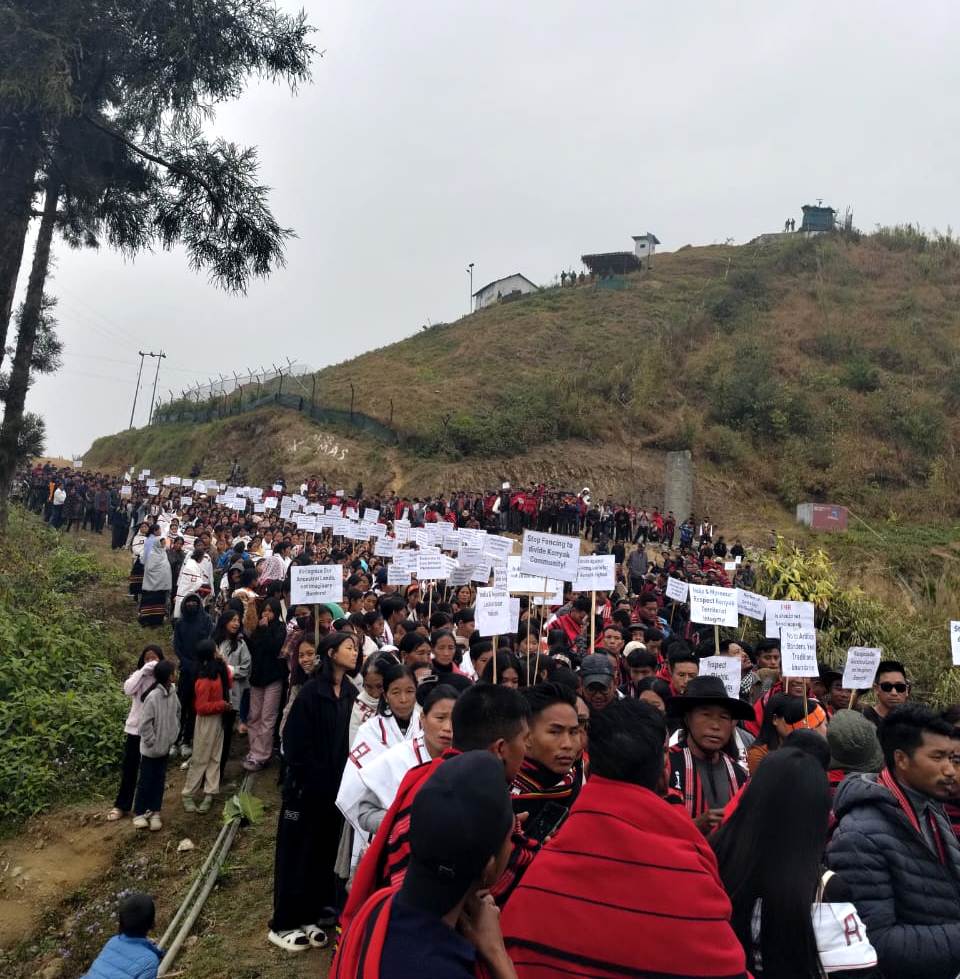
Protestors
at Longwa village in Mon district on Monday.(Courtesy: Longwa Students’ Union)
DIMAPUR — Scores
of protestors from Longwa and neighbouring Konyak villages in Myanmar on Monday
participated in a public rally organised by Konyak Union at Longwa village in
Mon district to show their resentment against the government of India’s move to
fence the Indo-Myanmar border and scrap the older Free Movement Regime (FMR).
The president of Longwa Students’ Union (LSU), Nahlak
Wangnao, informed that over 1200 people had assembled at the LSU Park in the
morning before marching towards the Chief Angh’s residence, located approximately
1.5 kilometres from the rally's starting point.
Meanwhile, the Konyak Union submitted an appeal to Governor
La Ganesan, requesting him to intervene and move an appeal to the Centre to
reconsider its decision to construct border fencing along the India-Myanmar
boundary and to revoke the decision to scrap the FMR provision of 2018.
The letter stated that this decision will have a profoundly
adverse impact on the Konyak community, whose ancestral lands and people have
been inseparably connected on both sides of the border.
It stated that the border demarcation between India and
Myanmar has its origins in arbitrary colonial decisions, beginning with the
Treaty of Yandabo in 1826, followed by modifications in 1834, 1881, 1894, 1896,
1921, 1992, and finalised at the Yangon Agreement on March 10, 1967.
The Konyak Union asserted that these historical agreements
were made without the consent or knowledge of the Konyak community.
It asserted that if fencing is deemed necessary, it should
follow the traditional boundary lines of the Konyak Naga community and not the
artificial lines drawn by colonial and post-colonial authorities—adding that
the Konyak community will not accept any forceful division of its land and
people.
The union stated that the decision of the Ministry of Home
Affairs to revoke the FMR and fence the 1,640 km boundary is based on false
premises and a misrepresentation of the realities faced by indigenous
communities.
This move contradicts the government of India's own stated
principles of the “Neighbourhood First” and “Act East” policies, which aim to
foster closer trade, connectivity, and people-to-people ties with Myanmar and
Southeast Asia, it stated.
Citing humanitarian grounds, the KU appealed to the governor
to take up this matter with the government of India and advocate for the
reconsideration of these decisions.