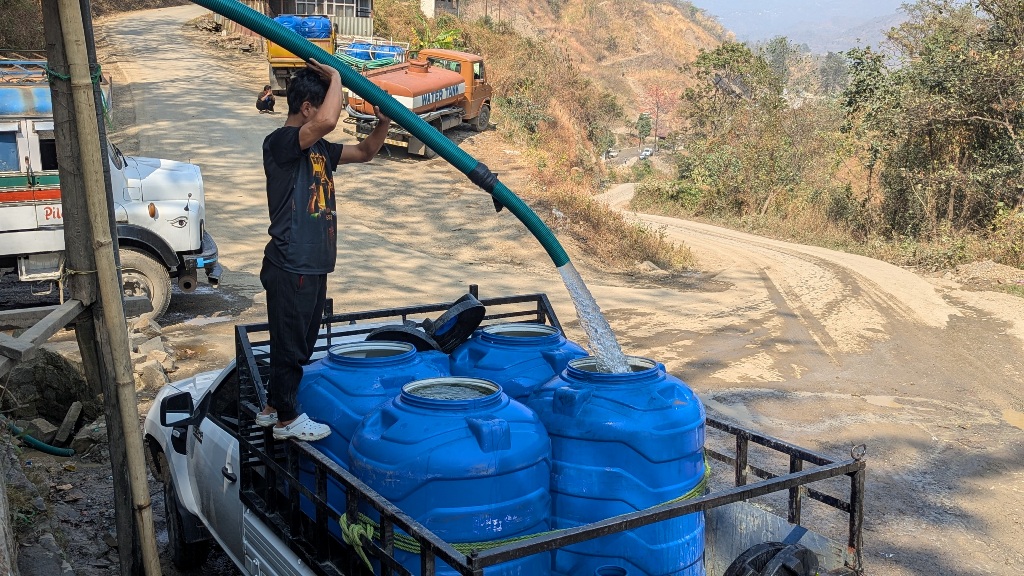
A water vendor is seen filling up his tanks at a private
water supplier point near Dzüdza Bridge (EM Images)
KOHIMA — As
Kohima grapples with its perennial water crisis, a network of private suppliers
and water vendors has become the city’s unofficial lifeline, ferrying thousands
of litres daily to homes, offices, and construction sites. With the public
water supply system failing to meet the demand, these suppliers work round the
clock to keep the capital’s taps from running dry.
One of the consistent private suppliers for the residents of
Kohima is located near the Dzüdza Bridge, along the National Highway-29, which
is about a 30-minute drive from Kohima.
During dry season, hundreds of water tank vehicles belonging
to both private and government agencies—and mostly from Kohima—arrive at the
three water distribution points every day. The water is being supplied and
managed by two private parties (from Mezoma village) as well as the Jotsoma
Youth Organisation.
The water vendors, depending on the size of their tanks, pay
a fee ranging from INR 100 to 300 to these private suppliers. Per pickup truck,
INR 100 is charged, and larger tanker trucks get between INR 150 and INR 300,
depending on the size and litres of the tanks.
Asobu Kithsu, one of the private suppliers, said that they
spend lakhs of rupees to replace and repair recurring damaged pipes and to maintain
them.
She said that they have struggled a lot to bring in water
from the source (Khonoma and Mezoma River). But this year, they are bringing it
from a different point. For this, lakhs of rupees have already been spent on
pipes alone this year.
The major challenge, she noted, was often repairing the
pipes between the source and the distribution point as they get damaged
quickly, especially during the rainy season. The pipes are also damaged by
heavy vehicles that pass through the route.
During peak dry season, they run their business 24x7. As a
private enterprise, she said that they do everything on their own. She noted
that there are more vehicles this year because of two reasons: there is no
rain, and due to early arrival of windy season.
While they don’t provide water during the off-season, their
businesses last for 3 to 4 months a year.
As a private water supplier, Kezhakolie Lhousa, too, has
faced similar challenges. Pipes are expensive as they spent a few lakhs every
year for maintenance and management.
His family business started about 10 years ago in Mezoma
village. Initially, they started selling water for INR 80 per vehicle.
"It’s been ten years since we have been selling it for
INR 100,” he said. From the profit, they purchase pipes—but it is not enough.
Nearly INR 4 lakh is spent on a single pipeline from the source to the outlet
point. This includes the labour charge and material cost.
“We cannot cover our expense from what is earned from
selling water,” he said. They have approached the department concerned for
assistance with water pipes and the construction of tanks but did not receive
any positive response, he said.
According to Lhousa, the main source of water is located
about 2 km away from the distribution point. By March or April, the water at
the sources dries up. By that time, vehicles will have to wait in line for at
least two hours to get water, he added.
Rokongulie, who is taking care of the JYO water tanks, said
that water has dried up sooner this year. He informed that their customers
mostly consisted of construction firms, railways, CRPF, and the Assam Rifles.
For them, the business runs throughout the year—even during
the rainy season. Around 120-130 pickup trucks come every day, he noted. They
charge INR 100 for a pickup truck, INR 150 for a mini truck, and INR 300 for
larger trucks.
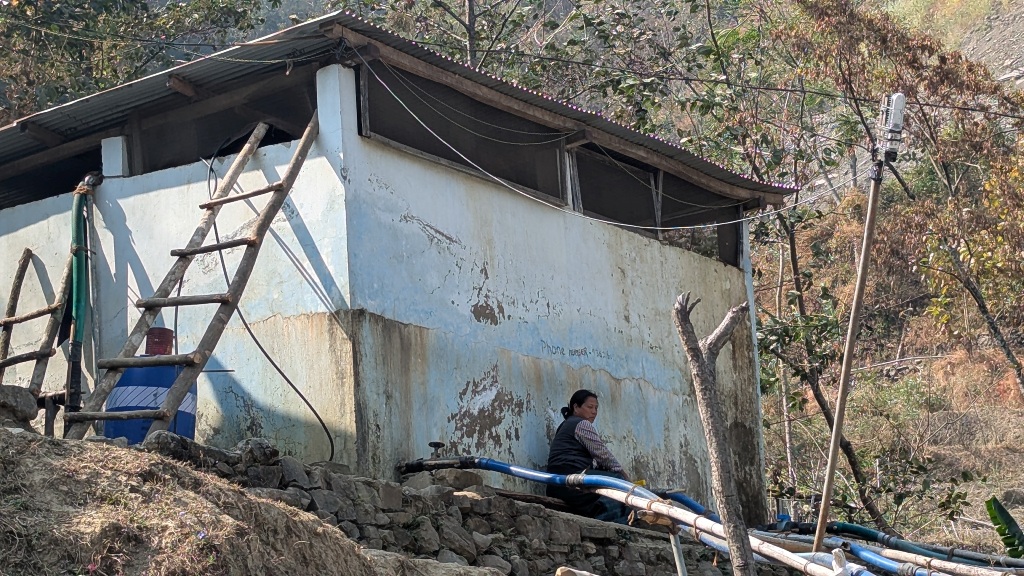
A female private water supplier assists in providing water
to the vendors. (EM Images)
Long lines for vendors
Enos Tamang, who came to fetch water on his tanker, said
that he makes about three trips per day, mainly for construction purposes.
During peak season (March and April), they have to wait for
two to three hours in the queue. “When there is no water, especially during the
peak season, the construction works have to stop. For two months, we will have
to struggle,” he shared.
Sanjay Ghimiri, who had recently started working as a water
vendor, shared that he usually makes four to five trips a day between Kohima
and the distribution point.
“Because of the water shortage, we need to wait in the
queue. Sometimes there are more than 50 to 60 vehicles, so we need to wait for
more than 2 to 3 hours,” he said, adding that poor road conditions worsen their
ordeals.
Another pick-up truck water vendor cited the deplorable road
conditions between Kohima and Dzudza Bridge. Because of the bumpy road
conditions, their tanks loaded with water get spilt, and they lose a good
amount of water. Besides that, they have to waste more time travelling.
He pointed out that it takes them two hours per trip during
the dry season and goes up to more than three hours per trip during the peak
season.
Around 2000 to 2250 litres make up a trip in which he
fetches around INR 1300 to INR 1500 depending on the distance of the location.